

Rapid fire trivia is a quiz format built on speed: short questions, short answers, and a clock that never stops long enough for anyone to think out loud. The core rules fit in a sentence. Ask one question at a time, give the player a few seconds to answer, award a point for each correct answer, and move on immediately. Everything else in this guide, from timers to tie-breakers, exists to keep that loop fast and fair.
Below you will find a complete rule set you can copy, three ways to play it (solo, teams, big groups), a scoring table, a sample round built from movie, TV and anime questions, and the disputes that break up most game nights, with a fix for each.
TL;DR
- Rapid fire means one short question at a time, a hard timer, and no discussion until the round ends.
- Pick one scoring model before you start: 1 point per correct answer is the simplest, and a penalty for wrong answers only works if everyone knows it upfront.
- Decide in advance what happens on a pass, a wrong answer and a tie. Most arguments come from rules invented mid-round.
- Keep rounds to 10 or 20 questions, and use a sudden-death question to break ties.
- Solo, teams and large groups all use the same core rules; only turn order changes.
Table of Contents
- What rapid fire trivia actually is
- The core rules, step by step
- How much time per question
- Turn order: who answers what
- Scoring: pick a model and say it out loud
- What makes a good rapid fire question
- A sample rapid fire round
- Keeping it fair: disputes, acceptable answers and ties
- Rapid fire variants worth trying
- Our perspective: speed is a rule, not a vibe
- Play rapid fire trivia without running the clock yourself
- A one-page rule sheet you can copy
- FAQ
- Sources
What rapid fire trivia actually is
A normal trivia night gives each question a minute of table talk. Rapid fire removes the talk. The host (or the app) reads a question, the player answers right away, and the next question follows within a second or two. The pressure comes from tempo, not from hard questions. In fact, the best rapid fire questions are short and have one clear answer, because a player who has to parse a three-line setup has already lost the round.
Three features separate rapid fire from other quiz styles:
- A hard per-question clock. Usually somewhere between three and ten seconds, depending on how difficult the questions are.
- One answer, no hedging. The first complete answer counts. "Is it... maybe Inception?" is a thinking-out-loud answer and the host can rule it incorrect.
- Volume. Ten to thirty questions per round, so a single miss never ruins the game.
Because the format is so light, it works as a standalone game, as a warm-up round, or as the closing round that decides a longer night. If you are building a full evening, our list of trivia round ideas for hosts shows where a rapid fire round fits among slower formats.
The core rules, step by step
Here is a rule set that works for almost any group. Read it aloud before the first question; it takes under a minute.
- One question at a time. The host reads the full question once. No repeats unless a real interruption happened (a phone rang, someone sneezed over the key word).
- The clock starts when the question ends. Not while it is being read. Otherwise the host's reading speed decides who wins.
- First complete answer counts. If a player changes their answer, the first full answer stands. This one rule removes most "I meant the other one" arguments.
- No conferring in individual rounds. In team rounds, only the named answerer speaks for the team.
- Pass is allowed or not, decided upfront. See the section on passing below.
- The host's ruling is final during the round. Disputes are saved for the end of the round, when the clock is no longer running.
- Answers are checked after the round if a source is needed. Do not stop the game to search.
That last pair matters more than it looks. A rapid fire round that pauses for a debate stops being rapid fire. Park the argument, keep the tempo, settle it between rounds.
How much time per question
There is no universal number, and the right clock depends on the question type. A practical guide:
| Question type | Suggested time | Example |
|---|---|---|
| One-word recall | 3 to 5 seconds | Who directed Jaws? |
| Name or title from a clue | 5 seconds | Which anime features a notebook that kills anyone whose name is written in it? |
| Two-part answer | 8 to 10 seconds | Name the lead actor and the year of the first Matrix film. |
| Multiple choice on a screen | 5 to 8 seconds | Pick one of four titles |
Formal quiz formats show how much timing can vary. In one professional quiz bowl ruleset, teams have 10 seconds to signal, and the first team to signal gets 20 seconds to answer. That is a deliberate, thoughtful format. Rapid fire sits at the opposite end: the answer window is a fraction of that, because speed is the point. If your players are new, start at 8 seconds and shorten the clock as they get comfortable. Dropping from 8 to 5 seconds is an easy way to raise difficulty without changing a single question.
Turn order: who answers what
The turn structure is the part that changes between solo, team and group play. The core rules above stay the same.
Solo
You face a run of questions against the clock. Typical variants:
- Fixed count: answer 20 questions and compare your score with your own best.
- Survival: the round ends at the first wrong answer or timeout. Score is your streak.
- Time attack: answer as many as you can in 60 seconds, with a pass costing nothing but the seconds spent.
Solo play needs honesty about the clock, which is why an app that enforces it is easier than a self-timed list of questions.
Head to head
Two players alternate questions, or both race to answer the same one. Alternating is fairer for mixed skill levels; racing rewards reflexes and needs a clear signal, such as a buzzer, a clap or an app tap. Whoever buzzes first answers, and if the answer is wrong, the question can pass to the other player. That pass-on-miss mechanic appears in the quiz bowl rules cited above, where an incorrect answer can pass the question to the other team.

Teams
Teams take turns receiving questions, usually three to five per turn. Appoint one speaker per question and rotate the role, so one confident voice does not carry the team. Teammates can whisper during the clock in friendly games, but in competitive play, silence keeps things fast.
Large groups
With eight or more people, direct questions to individuals in a circle, or let everyone write answers on paper for a "simultaneous" rapid fire round. For bigger crowds, our guide to large group trivia modes for movie, TV and anime fans covers formats that keep everyone playing instead of waiting.
Remote players
Over video, the rules need a defined signal because audio delay ruins "first to answer" calls. Use the chat or a tap-to-answer tool, and let the host's timestamp decide. We walk through the setup in remote trivia night for friends in five steps.
Scoring: pick a model and say it out loud
Scoring is where games get quietly unfair. The two most common models:
| Model | Correct | Wrong | Skipped or timed out | Best for |
|---|---|---|---|---|
| Simple | +1 | 0 | 0 | Casual groups, kids, mixed skill |
| Penalty | +1 | -1 | 0 | Competitive players who tend to guess |
| Weighted | +1 to +3 by difficulty | 0 | 0 | Mixed-difficulty rounds |
The simple model mirrors how a well-known standardized test scores items: one point for each correct answer and no points for incorrect or unanswered questions. It is easy to track in your head, which matters when you have no time to do arithmetic.
Penalties exist to discourage wild guessing. Test designers use them in multiple-choice exams: one university teaching guide describes a correct answer earning 1 point, no answer earning 0, and a wrong answer losing 1 divided by the number of choices minus 1. In a four-choice question, that works out to a loss of one third of a point. For a party, that is overkill. A flat -1 is simpler, but think twice: in an open-answer rapid fire game (no choices), guessing costs nothing in the simple model, which is fine, because a wrong guess still eats the clock.
The quiz bowl ruleset mentioned earlier uses a heavier version: 5 points for a correct answer, minus 5 for an incorrect one. That suits a formal competition with a moderator, not a living room.
Our recommendation for most groups: simple scoring, one point per correct answer, with a bonus point only for a perfect round. Players understand it in five seconds.

What counts as a skip, a pass or a timeout
Define all three before the game:
- Timeout: no complete answer before the clock ends. Zero points, next question.
- Pass: the player says "pass" before the clock ends. Zero points, and the question is gone (the host can read the answer for fun after the round).
- Pass-on-miss: in competitive modes, a wrong or missing answer lets the next player try. Award the point to whoever gets it right.
If passing is free, players will pass instead of guessing. To discourage that, allow a limited number of passes per round (two in a 20-question round works well) or count a pass as a wrong answer in penalty scoring.
What makes a good rapid fire question
Rules only work if the questions suit them. When we write or pick questions for a speed round, we check each one against four tests:
- Can it be read in under five seconds? If not, trim it.
- Is there exactly one correct answer? "Name a Pixar film" invites arguments; "Which Pixar film features a rat who cooks?" does not.
- Does the answer fit in one to three words? Long answers slow the host's ruling.
- Is the difficulty steady? A round that mixes a gimme and an obscure deep cut feels random. Group questions by level.
Also avoid questions with answers that can change, such as "most recent winner of...", unless you check them before game night. For mixed topics, split your round evenly, ten or twenty questions, so no one feels the host favored a category. Our write-up on mixed category trivia with fewer disputes shows how to balance that.
A sample rapid fire round
Here is a ten-question round at 5 seconds each, mixing film, TV and anime. Read the question, start the clock when you finish, and score one point per correct answer.
- Which director made Jurassic Park and Jaws? (Steven Spielberg)
- In Breaking Bad, what is Walter White's chemistry-teacher alias? (Heisenberg)
- Which Studio Ghibli film features a girl who works at a bathhouse for spirits? (Spirited Away)
- What is the name of the fictional African nation in Black Panther? (Wakanda)
- In Naruto, what is the name of the village where Naruto grew up? (Hidden Leaf Village, or Konoha)
- Which sitcom is set at the Dunder Mifflin paper company? (The Office)
- What color pill does Neo take in The Matrix? (Red)
- In Attack on Titan, what are the giant humanoid creatures called? (Titans)
- Which TV series features the Iron Throne? (Game of Thrones)
- Which 1997 film ends with a ship sinking in the North Atlantic? (Titanic)
Scoring: 9 to 10 is elite, 7 to 8 is strong, 5 to 6 is solid, and anything under 5 means you should play it again at 8 seconds. If you want a second ready-made round with a different mix, the ten-question anime trivia set is a good follow-up.
Keeping it fair: disputes, acceptable answers and ties
Questionable answers
The three most common disputes are spelling, partial answers and alternate names. Settle them with a house rule before the game: phonetic spelling is fine, a last name alone is fine for people, and a subtitle is optional for franchise titles. When something is truly ambiguous, one published party game takes the practical route: the group collectively decides whether a questionable answer is acceptable, and may look it up online if necessary. Do the looking up between rounds so the clock stays alive.
Ties
Ties are the norm in short rounds, so plan for them. The same party game's rules call for an extra round where only the tied players compete to see who scores the first point. That is sudden death, and it is the cleanest option for rapid fire:
- Only tied players take part.
- The host reads a fresh question that no one has seen.
- The first correct answer wins; if both miss, ask another.
- Keep these questions at medium difficulty so the game does not stall.
We keep a list of 20 tie-breaker questions hosts can use live or online for exactly this moment. Pull from it instead of improvising, because improvised tie-breakers tend to be unfair to someone.
Host neutrality
If the host is also playing, they should answer last or sit out the scoring. Better still, let a third person or an app run the questions so no one doubts the call.
Rapid fire variants worth trying
- Category blitz: all ten questions from a single franchise or genre, perfect for fandom showdowns.
- Escalating clock: start at 8 seconds, then drop one second every five questions.
- Streak bonus: three correct in a row earns an extra point.
- Elimination: a wrong answer sits you out; the last player standing wins.
- Couples mode: two players trade questions and compare totals. Our 30-minute date night trivia puts this into a full evening.
Pick one variant per round. Stacking three twists makes the rules take longer to explain than the round takes to play.
Our perspective: speed is a rule, not a vibe
We built Flicksy around one idea: trivia gets dull when nothing is at stake in the next ten seconds. Most trivia games and printed quiz books fail the same way. The questions are fine, but the pacing is left to the person running them, so the tempo sags, the arguments grow, and the energy leaves the room.
That is why we treat the clock as part of the rules and not as decoration. A visible timer settles "was that in time?" before anyone can ask. Fixed rounds mean you know how long the game lasts. Simple scoring means no one needs a calculator. And when the format is the same in solo, couch and head-to-head play, players learn the rules once and carry them everywhere.
If you take one thing from this guide, make it this: write your rules down before the first question, and enforce them identically for everyone, including the host's best friend. The group will forgive a hard question. It will not forgive a rule that changes mid-round.
— Aakash
Play rapid fire trivia without running the clock yourself
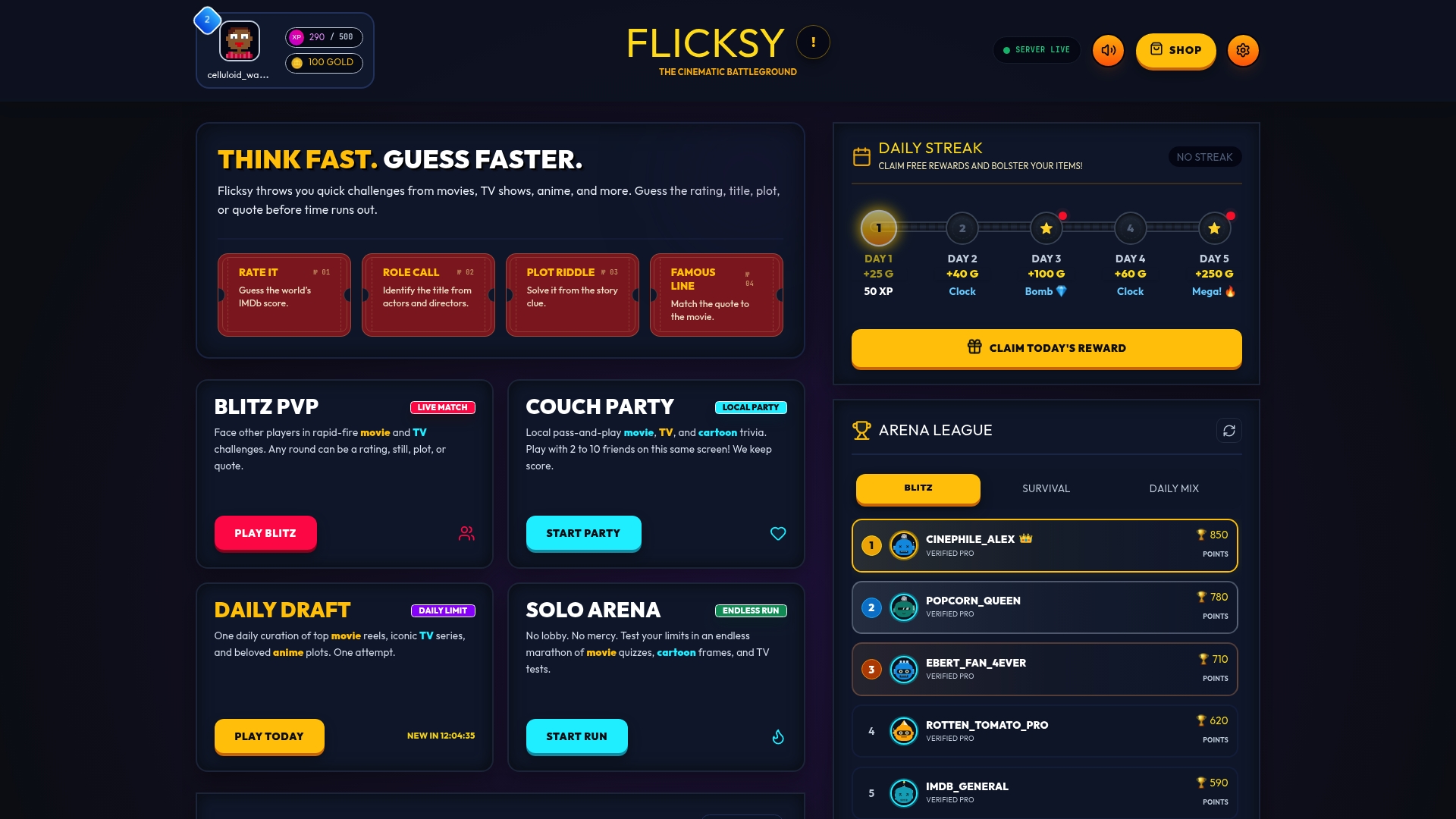
Running timers, tracking scores and settling disputes is a lot to do while also reading questions aloud. Flicksy handles that part. It is a free-to-play trivia app with rapid-fire questions on movies, TV shows and anime, and it offers Blitz PvP for real-time matches, Couch Party for local multiplayer on one device, and Solo Arena for endless runs against the clock. Daily quizzes, leaderboards and daily rewards give you a reason to come back.
If you are hosting a night built around films, our movie night trivia plan pairs ready rounds with scoring tips, and our pop culture trivia games for hosts gives you five more rounds to mix in.
A one-page rule sheet you can copy
Paste this into a note or read it aloud before the first question:
- Rounds have 10 or 20 questions.
- Each question gets 5 seconds (8 for beginners), counted from the end of the question.
- The first complete answer counts.
- 1 point per correct answer. Wrong, passed or timed-out answers score 0.
- Each player gets two passes per round.
- The host rules during the round; disputes are discussed after it.
- Ties go to a sudden-death question between tied players only.
That is seven lines, and it covers nearly every situation a rapid fire game throws up. Adjust the numbers for your group, but keep the structure.
FAQ
What are the basic rules of rapid fire trivia?
The host asks one short question at a time, and the player must answer within a fixed number of seconds, usually three to ten. Each correct answer earns a point, and the next question follows right away. Discussion and disputes wait until the round is over.
How many questions should a rapid fire round have?
Ten to twenty is the sweet spot. Ten suits quick warm-ups and casual groups, while twenty gives skilled players enough room to separate from the pack. Rounds above thirty tend to drag and lose the pressure that makes the format fun.
Should wrong answers lose points?
Only if everyone agrees to it before the game starts. Penalties discourage blind guessing and suit competitive players, but they add arithmetic and can sour a casual group. For most games, one point for a correct answer and zero for anything else is the safest choice.
How do you break a tie in rapid fire trivia?
Run a sudden-death round with only the tied players, using fresh questions nobody has seen. The first correct answer wins, and if both miss, ask another. Keep a few medium-difficulty questions in reserve so you are not inventing one under pressure.
Can you play rapid fire trivia alone?
Yes. Solo versions use a fixed set of questions, a survival streak or a 60-second time attack, and you compete against your own best score. A timer is essential, so an app or a stopwatch is better than answering from a printed list.
Sources
- Quiz Bowl Rules, Society of American Foresters
- How Exams are Scored, CLEP, College Board
- Coping with student guessing on MC-tests, University of Antwerp
- 5 Second Rule instructions, Buffalo & Erie County Public Library