

Date night trivia is a structured question-and-answer game couples play to entertain each other while learning something new, and it works because it turns idle conversation into a game with stakes. Grab your partner tonight and run a quick round with a moderate number of questions split between pop-culture guesses and personal questions. You will laugh, you might learn something you did not expect, and you will spend an hour actually looking at each other instead of a screen.
TL;DR:
- Matching the trivia format to your mood and available time maximizes fun and engagement, whether you prefer quick rounds or a full evening of questions.
- Ready-to-use question sets cater to different themes, such as lighthearted, flirty, Love Map, and pop-culture, making it easy to tailor the game to your emotional state.
- Alternating between light and deep questions, and incorporating icebreakers, helps keep the game romantic, relaxed, and free from unintentional interrogation.
- Running trivia remotely over video calls with shared screens can enhance connection, especially for Love Map and flirty rounds, without physical distractions.
- Including small stakes like chores or small prizes motivates participation and keeps the game lively without creating unnecessary competition.
Table of Contents
- Choose a Game Format: Which Couples Trivia Style Fits Your Mood and Time
- Ready-to-Use Question Sets You Can Play Tonight
- How to Run the Session: Rounds, Timing, and Scoring
- Expert Tips and Pitfalls: Keep It Romantic, Not Competitive
- Trivia Beyond the Living Room: Dining, Home, and Virtual Dates
- Prizes and Rewards: Small Stakes That Keep the Game Fun
- Icebreaker Questions to Start the Evening Gently
- A Real Couch Party Night: What Actually Elevated It
- Getting Started With Flicksy for a Zero-Prep Trivia Night
- Sources
Choose a Game Format: Which Couples Trivia Style Fits Your Mood and Time
Not every night calls for the same energy. A rainy Tuesday after work needs something lighter than the format you would run for an anniversary dinner. Matching the game to the mood saves you from forcing a slow, reflective round when you both just want to laugh.
The main couples trivia formats break down like this:
- Newlywed-style ("How Well Do You Know Me"): one partner answers a question about themselves privately, the other guesses. Best for surprises and gentle ego bruising.
- Pop-culture rounds: movies, TV, music, anime. Playful, competitive, zero emotional risk.
- Would You Rather / This-or-That: forces a choice that reveals values, not facts. Great for conversation starters.
- Rapid-fire 60-second rounds: high-energy, short bursts. Ideal when you only have 20 minutes between dinner and a show.
- Double-date or team formats: two couples paired off, which adds a social layer and takes pressure off any single relationship's "score."
Short on time and just want a scoreboard and a clock? A quick-hit format like Flicksy's Blitz PvP covers the rapid-fire style without anyone writing a single question by hand. For a slower, no-tech evening, a pen-and-paper Newlywed round with wine and low lighting beats any app. The setup should match the energy you actually want, not the one you think you should want.
Ready-to-Use Question Sets You Can Play Tonight
You do not need to write a single question yourself. Here are four categories, ready to read aloud, each built for a different mood.
Lighthearted set (fast, factual, no risk):
- What was the first movie we watched together?
- What's my go-to order at our favorite restaurant?
- What's the last song I had stuck in my head?
- Where did we go on our first real date?
- What's my most-used emoji in texts?
- What's one food I claim to hate but secretly like?
Flirty and spicy set (playful, a little intimate, still framed as trivia):
- What's the first thing you noticed about me physically?
- What's a compliment you think about but rarely say?
- What's a small thing I do that you find surprisingly attractive?
- What's your favorite memory of us being spontaneous?
- If we had a free weekend with no plans, what would you want to do with me?
- What song would you say is "our song," even if we never officially picked one?
Deep, Love Map inspired set (the questions that actually build connection): the Gottman Institute's research on "love maps" argues that partners who keep an updated mental map of each other's inner world report higher satisfaction. Try:
- What's a fear I've never said out loud to anyone but you?
- What's a goal I have for the next five years that we haven't really talked about?
- What's a moment from my childhood that still shapes how I act now?
- Who is someone I've lost touch with that I still think about?
- What's something I'm proud of that I don't think you fully know about?
- What would I do with a totally free year and no obligations?
Pop-culture set (movies, TV, anime): pick a shared favorite show and quiz each other on plot details, character names, or the year it aired. This is where a curated app helps, since hand-written movie trivia gets stale fast once you have exhausted your shared watch list.
Score the lighthearted and pop-culture rounds normally, one point per correct guess. For the flirty and deep sets, skip strict scoring and hand out bonus points for the best follow-up story instead. And build in a pass rule from the start. If a question feels too raw for the mood you are in, either partner can skip it with zero explanation owed.
How to Run the Session: Rounds, Timing, and Scoring
Structure turns a pile of questions into an actual evening. Here is how to size it to the time you have.
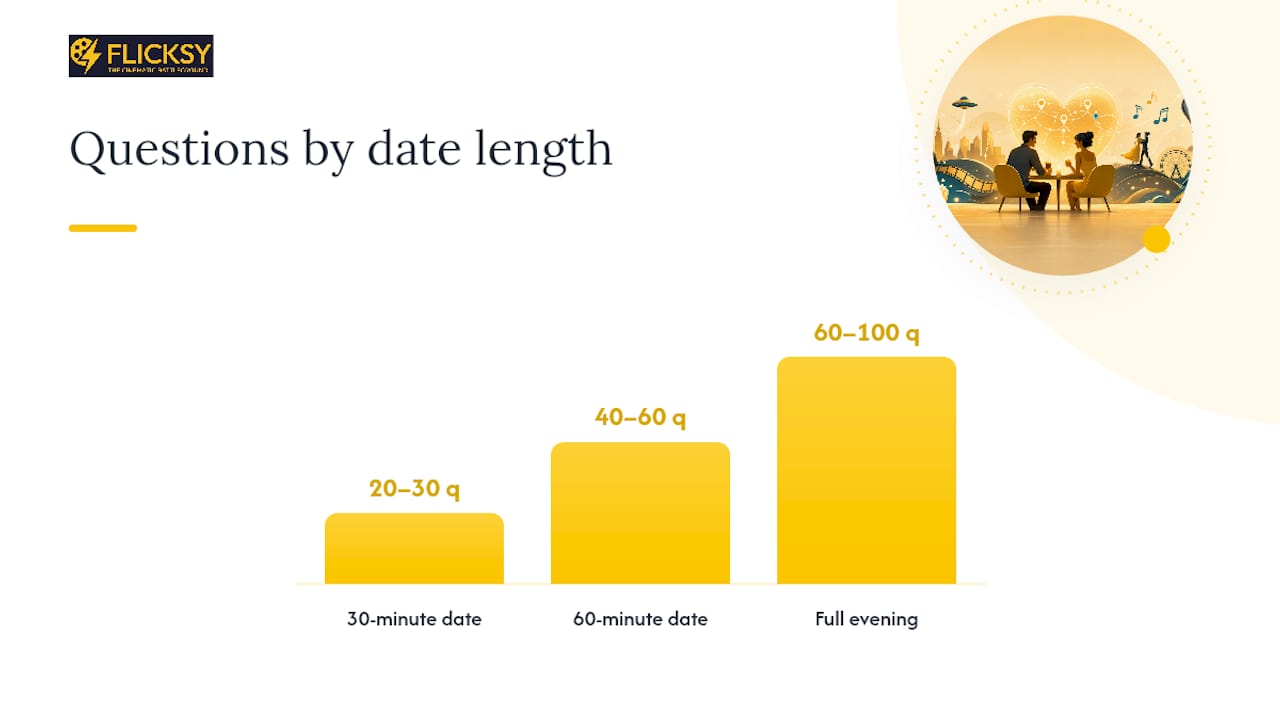
- 30-minute date: 20 to 30 questions, mostly lighthearted and pop-culture, one or two deep questions mixed in near the end.
- 60-minute date: 40 to 60 questions across three or four rounds, alternating light and deep so nobody gets stuck answering heavy questions back to back.
- Full evening: 60 to 100 questions split across 6 to 8 rounds, each themed (one round pop-culture, one round Love Map, one round flirty, and so on).
Zola's breakdown of Newlywed Game formats notes that apps commonly build in quick five-minute modes, standard ten-minute modes, and deeper fifteen-plus-minute sessions, which maps almost exactly onto these three date lengths.
Assign roles before you start: one partner reads questions, the other scores, and you swap roles every round or two so nobody feels like they are running a quiz show at their own date. Pick a scoring style that fits your competitive streak: straight point-per-correct, a wager round where you bet points on how confident you are, or a cooperative version where you are both just trying to beat your combined score from last time.
Always have a tiebreaker question loaded and ready, something silly and low-stakes like "who is more likely to cry at a commercial." It keeps a tied game from fizzling out.
Pro Tip: If you're in a long-distance stretch, run the game over video call and use a shared screen for pop-culture rounds. The Love Map and flirty questions actually work better remotely, since you're not distracted by snacks or a TV in the background.
Expert Tips and Pitfalls: Keep It Romantic, Not Competitive
The biggest mistake couples make with trivia is treating it like a memory test instead of a discovery game. Long-term partners often stop asking each other deep questions because they assume they already know the answers. That assumption is the exact gap trivia is built to close. A structured question gives you a nonjudgmental excuse to ask something you would never bring up unprompted at dinner.
Game flow matters more than people expect. Rotate who reads the questions so one person is not stuck hosting all night, and always keep a tiebreaker in your back pocket so a close game does not end in an argument about who actually won.
There is a physiological reason this works. Shared play and novelty trigger oxytocin and dopamine responses that researchers tie to bonding and renewed attraction. That is a good argument for sequencing: run a fun, low-stakes pop-culture round first to get the dopamine flowing from playful competition, then slide into the deeper Love Map questions once you are both relaxed and laughing.
Set a pass rule before round one starts. Trivia should never turn into an interrogation, and a fast "skip, no explanation" agreement keeps every question safe to ask.
Trivia Beyond the Living Room: Dining, Home, and Virtual Dates
Trivia adapts to almost any date setting once you drop the idea that it needs a table and a scoreboard. At a restaurant, keep it quiet: pull out three or four lighthearted or flirty questions between courses instead of running a full round, since you do not want to be shouting pop-culture answers across a table for two.

At home is where the full format shines. Dim the lights, put on a low-key playlist, and run a full 60 to 100 question evening broken into themed rounds. This is also the easiest setting to layer in a double-date, since you have room for two couples and no waiter interrupting your deep round.
Virtual dates benefit from trivia more than almost any other date-night activity, because most other activities need shared physical space. A video call with a shared screen for pop-culture rounds, paired with the flirty and Love Map sets read aloud, closes distance in a way small talk rarely does.
If you want to stretch a trivia night into something bigger, pair it with a simple outing. Couples in Southern California, for example, sometimes bookend a home trivia round with a short walk from a list like SoCal Sights' romantic date ideas, turning one evening into two distinct experiences without much extra planning.
Whatever the setting, keep the format light enough to fit the room. A five-course dinner does not need 100 questions. A quiet night in can absorb all of them.
Prizes and Rewards: Small Stakes That Keep the Game Fun
Trivia without a little stake can feel flat by round three. You do not need anything expensive, just something that gives the scoreboard a reason to matter.
The classic option is a chore swap: loser handles dishes, walks the dog, or picks the next three shows you watch together. It costs nothing and settles a real annoyance in a way that feels fair because you both agreed to the rules going in.
Physical prizes work too, especially small and specific ones: winner picks the takeout order, chooses the next movie, or gets a foot rub. Some couples run a running tally across multiple trivia nights and build toward a bigger reward, like the loser planning the next date entirely.
If you are playing a Blitz PvP style rapid-fire round through an app, leaderboards and daily streaks already supply some of that reward loop automatically, since watching your combined score climb over multiple sessions creates motivation to keep playing. That works especially well for competitive couples who like tracking progress over time rather than resetting the stakes every single night.
Keep the reward proportional to the format. A quick 20-question round deserves a playful, low-stakes prize. A full evening with 80 questions and real emotional depth deserves something a little more thoughtful, not necessarily bigger.
Icebreaker Questions to Start the Evening Gently
Jumping straight into deep Love Map questions cold rarely works well. Warm up with a few icebreakers that are easy, low-pressure, and get you both laughing before anything more personal comes up.
Try opening with these:
- What's the most useless talent you have?
- If you could instantly master one skill, what would it be?
- What's a food combination you love that other people think is weird?
- What's the last thing that made you laugh out loud when you were alone?
- If our relationship had a theme song, what would it be right now?
These questions cost nothing emotionally and take fifteen seconds each to answer, which is exactly the point. They loosen up the room, establish the playful tone for the rest of the night, and signal that this is a game, not a therapy session. Once you have both laughed once or twice, you are in the right headspace to move into the flirty or deep sets without either of you feeling ambushed.
A Real Couch Party Night: What Actually Elevated It
The best trivia nights I have seen described are not the ones with the hardest questions. They are the ones with a little production value. One setup worth copying: four rounds through a Couch Party session, alternating a movie round with a Love Map round, phones face-down the entire time.
A few small touches did the real work. A pre-made playlist for transition breaks between rounds. Lights dimmed instead of overheads. Snacks portioned out before the game started so nobody had to pause to raid the kitchen mid-round. None of that is complicated, but skipping it is the difference between a game night and a date.
For more on building sharp pop-culture rounds, the Flicksy blog's take on new releases is a good source of fresh questions before your next movie-trivia round.
— Aakash
Getting Started With Flicksy for a Zero-Prep Trivia Night
Every format covered above maps directly onto something Flicksy already runs. Want the living-room double-date? That is Couch Party, built for local multiplayer with no setup beyond opening the app. Want the rapid-fire 60-second rounds? That is Blitz PvP, head-to-head and fast. Want to warm up solo before game night so you are not the weak link on the movie round? Solo Arena gives you unlimited practice against the clock.
The curated movie, TV, and anime quizzes solve the actual bottleneck most couples hit: running out of good pop-culture questions after the third date night. Built-in timers keep rapid-fire rounds honest, and leaderboards give your ongoing scoreboard somewhere to live between sessions instead of a sticky note on the fridge.
Getting started takes less time than writing out a paper trivia list. Open Flicksy, pick Couch Party for tonight's date or Blitz PvP if you only have ten minutes, and let the app handle the questions while you handle the conversation.
Sources
- Do you truly know your partner? — The Gottman Institute
- Newlywed Game Questions — Zola expert advice
- Love hormone (oxytocin) — Healthline