

The fastest, fairest tie breaker for most quizzes is a closest-number estimation question, and below you will find categorized tie breakers you can use right away plus clear rules to run them without an argument. This covers numerical, pop-culture, visual, and audio formats, along with a short checklist for keeping scoring honest in person or online.
TL;DR:
- Before asking, state the unit, rounding rule, and time limit; collect answers simultaneously and decide in advance how equally close answers will be resolved.
- Keep three to five backup questions per category, and pilot candidates with a small group; replace prompts everyone answers identically or nobody can estimate.
- For virtual rounds, collect answers through private polls, messages, or timed forms, then test image visibility and audio volume on the equipment used live.
- If a prompt proves ambiguous or poorly worded, discard it and switch to a prepared backup instead of clarifying it during the round.
Table of Contents
- Which tie breaker format fits your quiz night?
- A ready-to-use tie breaker bank for every category
- How to run a tie breaker fairly
- Running tie breakers in virtual, visual, and audio formats
- Testing your tie breakers before the quiz begins
- A quick checklist you can save or print
- Why these formats work for modern trivia
- A faster option for rapid-fire tie breaks
- FAQ
- Sources
Which tie breaker format fits your quiz night?
Closest-number questions win on speed and objectivity: everyone writes a guess, the closest number wins, and there is almost no room for debate. Historical and pop-culture counts work well when the room is already excited about a theme, since a question like "how many Oscar-winning films star a dog" keeps the energy up while still testing recall, perfect for hosts planning themed quiz nights with funny costume ideas. Word puzzles and sequence questions add variety for quiz nights that lean more on wit than memory. Visual and audio prompts work when you have the equipment to show an image or play a clip clearly to every table. Sudden-death tossups make sense only when you have more time to spare and want drama over speed, since they can run several rounds before producing a winner.
- Numerical estimation: fastest and hardest to dispute.
- Pop-culture counts: high energy, works best when tied to the quiz theme.
- Word or sequence puzzles: good for wit-focused rounds.
- Visual or audio prompts: strong when equipment and clarity are solid.
- Sudden-death tossups: use only when extra time is available.
A ready-to-use tie breaker bank for every category
Here is a working bank organized the way most quiz night guides recommend: numerical first, then counts and dates, then visual or audio, then wordplay.
- How many bones are in the adult human body? (206)
- How many time zones does Russia span? (11)
- How many countries drive on the left side of the road? (closest guess wins; treat this as an estimation prompt rather than a fact check)
- How many steps lead to the top of the Eiffel Tower? (closest guess wins)
- How many strings does a standard harp have? (47)
- How many moons does Jupiter have? (closest guess wins, as the count can change with new discoveries)
- How many dimples are on a regulation golf ball? (closest guess wins)
- How many countries are members of the United Nations? (closest guess wins)
- How many Grammy Awards has the most-awarded artist won? (closest guess wins)
- How many "Fast and Furious" films had been released? (closest guess wins)
- In what year did the first iPhone launch?
- How many James Bond films star Sean Connery?
- Visual prompt: show a blurred movie poster and ask teams to name the film; score by first correct, legible answer.
- Visual prompt: reveal a famous landmark cropped to one detail; closest guess on the location wins.
- Audio prompt: play five seconds of a well-known movie theme; first correct written answer wins.
- Audio prompt: play a muffled line of dialogue from a classic film; closest guess wins.
- Word puzzle: unscramble "GTINRA" into a one-word film genre (RATING, or accept any valid anagram).
- Sequence puzzle: put four historical inventions in order by year.
- Wordplay: name a movie title that is also a common English idiom.
- Creative: write the funniest one-line alternate title for a famous film; host or panel vote decides.
Keep three to five backups per category so a repeated question across quiz nights never becomes an advantage for returning teams.
How to run a tie breaker fairly
Collect answers the same way every time: either every tied team writes and submits simultaneously, or each sends one representative answer, decided before the question is read. Specify the unit, the rounding rule, and the time limit out loud before you ask the question, since vague instructions invite disputes after the fact. If two answers land equally close, predefine the resolution in advance, whether that means a coin flip, a second numerical question, or whichever answer was submitted first.
- State units, rounding, and time limit before the question, not after.
- Require simultaneous written submission to prevent hedging or copying.
- Predefine the tie-of-ties rule so you never improvise it live.
- If a question turns out ambiguous or mis-phrased, discard it and move straight to a backup.
Official quiz competition rules often use a staged approach, starting with pre-marked tie-break questions and moving to sudden-death tossups only if a tie persists, which is a useful model for any quiz night.
Pro Tip: Announce your tie-break procedure before the quiz starts, not when the tie happens, so no team can accuse you of making up the rules on the spot.

Running tie breakers in virtual, visual, and audio formats
Online quizzes need extra safeguards against searching for the answer mid-question. Collecting answers through a private poll, direct message, or timed form submission keeps teams from seeing each other's guesses and discourages a quick search.
- Use private polls, DMs, or form links instead of an open chat for virtual tie breakers.
- Check image resolution and screen-share visibility before showtime, not during.
- Test audio volume and clip length on the same setup you will use live.
- Set a strict, visible countdown timer and stop accepting answers the moment it ends.
Testing your tie breakers before the quiz begins
A tie breaker only works if the answers spread out, so pilot each candidate question with a handful of people before the live round. Avoid both extremes: a question everyone knows produces another tie, and one nobody can estimate produces random guesses instead of genuine skill. Phrase prompts to invite a reasoned estimate rather than a flat guess, such as asking for a count tied to something familiar. Research on question difficulty suggests that host judgment alone often misjudges how hard a question will feel, and that model-assisted estimation can predict a spread of answers more reliably than instinct. A related study on model uncertainty backs the same point: testing a question on even a small sample before using it live is worth the extra five minutes. If a pilot test produces identical answers from everyone, swap the question for a backup rather than risk a repeat tie.
A quick checklist you can save or print
- Announce the tie-break rules before the quiz starts.
- Collect every answer simultaneously and keep a backup copy.
- State the unit and rounding rule out loud, every time.
- Verify a close numerical answer against two reliable sources if there's any doubt.
- Keep three to five reserve tie breakers ready in each category.
Closest-number tie breakers remain the format most quiz hosts reach for first because they are fast, objective, and rarely produce a repeat tie once distinct guesses are on the table, according to practical tie-breaker guides.
Why these formats work for modern trivia
Estimation tie breakers settle a close score in under a minute, which matters once a room has been playing for two hours and wants a clean finish. Fast, visibly fair resolution keeps the energy up instead of letting a tie drag into a debate about rules. Teams remember whether a tie breaker felt fair far longer than they remember who won it.
— Aakash
A faster option for rapid-fire tie breaks
If you would rather skip writing your own backup questions, Flicksy offers a rapid-fire trivia alternative for moments needing tie breakers.
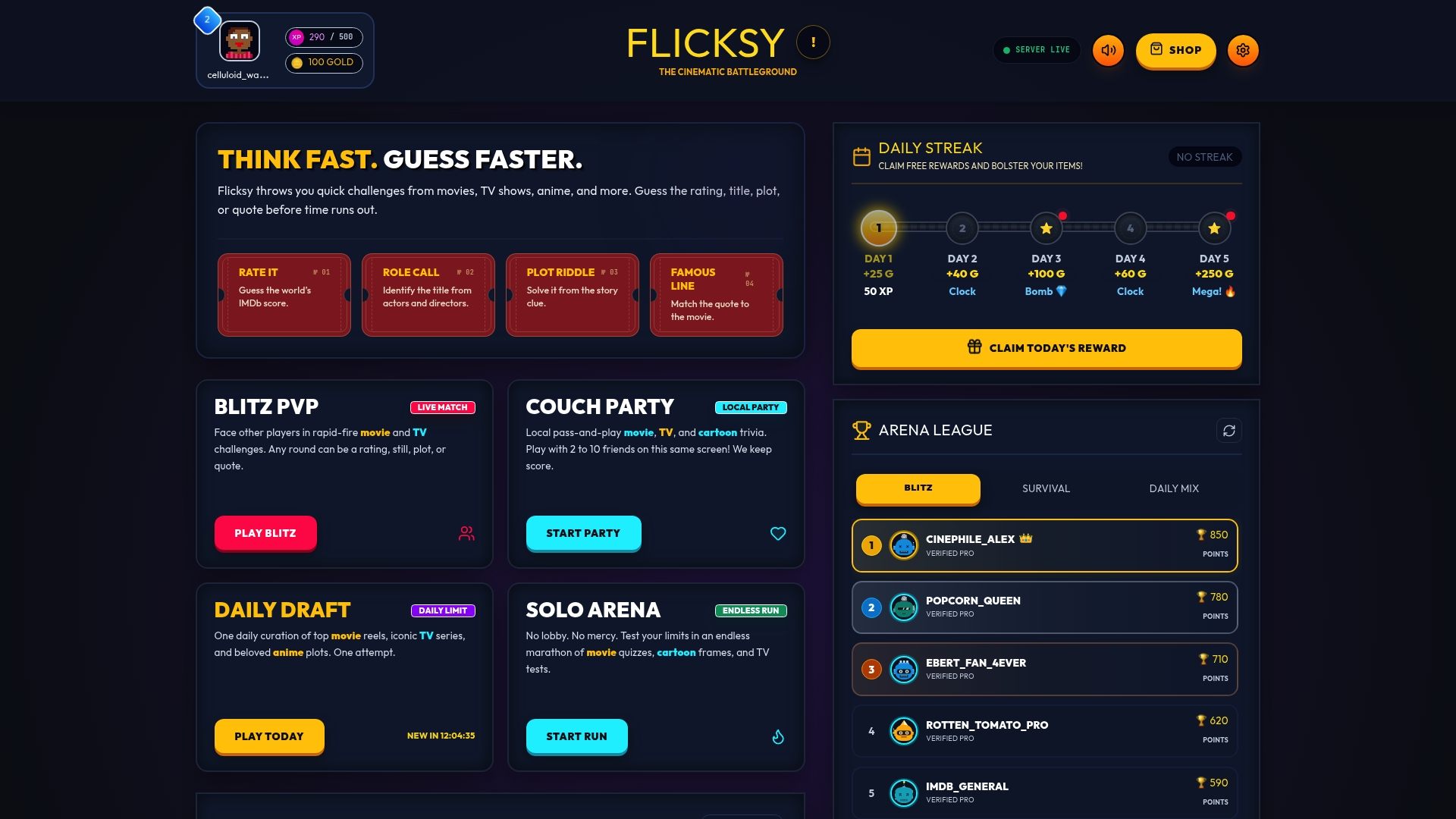
Open Flicksy before your next quiz night and keep a rapid-fire round ready for the moment a tie breaker is needed.
FAQ
What are some good tie breakers?
Closest-number questions, like guessing how many bones are in the human body or how many time zones Russia spans, are among the most reliable because they are fast to score and hard to dispute. Historical counts and pop-culture stats work well too, especially when tied to your quiz night's theme.
What are some funny tie-breaker questions?
Creative prompts work best for laughs, such as asking teams to invent the funniest one-line alternate title for a famous movie or to unscramble a jumbled word into a film genre. A host or panel vote usually decides these, since there is no single correct answer.
What are 10 good trivia questions for a tie breaker?
A strong set mixes categories: a few numerical estimates (bones in the body, strings on a harp), a couple of historical counts (UN member countries, James Bond films with Sean Connery), one visual prompt, one audio clip, and one wordplay or sequence puzzle. Mixing categories prevents one team's early strength from carrying into the tie breaker.
What are some good numerical tie-breaker questions?
Numerical tie breakers work best when the answer is a specific count or year that few people know exactly but most can estimate, such as the number of dimples on a golf ball or the year the first iPhone launched. Closest guess wins, which removes any need for a judge's call.
How do I handle an ambiguous tie-breaker question?
Discard the question immediately and move to a backup rather than trying to clarify it mid-round, since any clarification can look like favoring one team. This is why keeping three to five reserve questions per category in advance matters.