
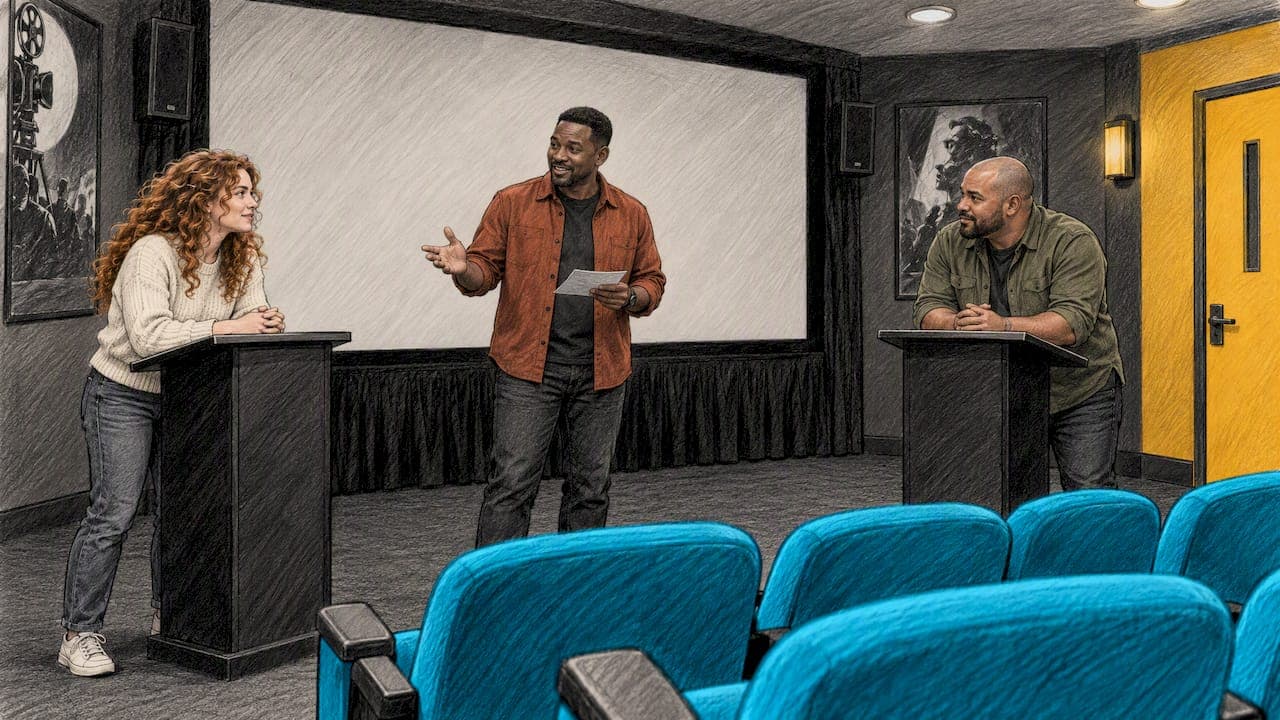
Sudden death trivia is a format where one wrong answer ends your run, or where a tied match is settled by the first correct answer. The first meaning is a solo challenge: miss once and you are out. The second is a live tiebreaker: tied players or teams get questions one at a time, and the first to answer correctly wins. Below you will find how each version works, how to write fair questions, and how to run either one with friends or on your own.
TL;DR
- Sudden death has two common forms: a solo "one miss and you're done" quiz, and a head-to-head tiebreaker where the first correct answer wins.
- Aim for questions that about half to 60% of players can answer. Too easy ends the game with a shrug, too hard drags it into a stalemate.
- Set a cutoff before you start. Many hosts switch to a closest-number question after three unresolved rounds.
- Agree the ground rules first: who speaks for a team, what counts as a valid answer, and how timing is judged.
- Movies, TV and anime suit the format well because fans answer fast and argue loudly, which is the point.
Table of Contents
- What sudden death trivia actually means
- How a sudden death tiebreaker works, step by step
- Writing questions that end the game at the right moment
- The solo version: one miss and you're out
- Sudden death with a movie, TV and anime crowd
- Ground rules that prevent arguments
- Our perspective: speed is the sport, fairness is the rulebook
- Playing sudden death-style duels on Flicksy
- Choosing a format for your group
- Common mistakes to avoid
- FAQ
- Sources
What sudden death trivia actually means
The phrase borrows from sports overtime. The game does not run a full clock. It stops the moment someone gains or loses an edge. In trivia that shows up in two ways.
The elimination quiz. You answer a chain of questions, and the first error ends your attempt. Your score is how far you got. This is the style behind the "miss one and you're done" quizzes that dominate search results for the term, usually organized by decade or topic. The appeal is tension: every question feels heavy because there is no buffer.
The tiebreaker. Two players or teams finish a normal game level on points. The host then asks questions one by one. According to a trivia host guide on tiebreakers, the first side to answer correctly wins, and if both miss, play moves to the next question until there is a winner or a set limit is reached.
The two forms share a feeling, but they need different design. An elimination quiz is a solo endurance test, so questions should climb in difficulty. A tiebreaker is a duel, so questions should be even in difficulty and quick to judge.

How a sudden death tiebreaker works, step by step
Here is a clean sequence for a live game with friends, a bar night or a watch party.
- Confirm the tie. Check the scores out loud so nobody argues afterward. If you track points on paper, read the totals to the room.
- Name the rules. Say who answers for each team, how long they have, and whether a wrong answer eliminates that side for the round or just skips the question.
- Ask one question. Keep it short enough to read in one breath.
- Judge it fast. First correct answer wins. If both sides miss, say so and move on.
- Apply the cutoff. If nobody has scored after your limit, switch to a different tiebreaker.
That last step matters more than it looks. Professional hosts often use a pre-set cutoff: if no team answers correctly after three rounds, the format shifts to a closest-to-the-truth or numerical estimation question so there is always a definite winner. The same guide recommends keeping sudden death to about three questions before moving to an estimate, to prevent fatigue.
If you want a bank of backup questions ready, we keep a list of trivia tie breaker questions hosts can use live or online.
Who answers first?
Going first can be an advantage or a disadvantage, depending on the question. Some tournament-style formats handle this directly: if a tie survives a set number of questions, the order of answering is swapped for the next round to cancel out any edge from going first. At home you can do the same with a coin flip for the first question, then alternate.
Better still, remove the order problem. Have both sides write their answer down or lock it in at the same time, then reveal. Educational game designer Scott Nicholson argues that trivia works best when all players take part at once instead of one person answering while everyone else watches. Simultaneous submission is fairer and keeps the room awake.
Writing questions that end the game at the right moment
The most common mistake is picking a question you think is hard and fun. In sudden death, difficulty is a dial that controls how long the game runs.
Experts suggest aiming for questions that roughly 50 to 60% of average participants can answer. If the question is too easy, both sides get it and nothing resolves, or the winner is decided by reflexes alone, which feels anticlimactic. If it is too hard, nobody gets it, and you drift into a marathon of misses that drains the room's energy.
For a mixed audience, a few habits help:
- Pick one clear answer. "Which studio made this film?" is easier to judge than "What is a notable thing about this scene?"
- Avoid spelling traps. Anime titles and character names have multiple romanizations. Decide up front that a phonetic answer counts.
- Skip trick questions. In a tiebreaker, a dispute is worse than a miss.
- Test your own bank. Ask two friends who are not playing. If both get it instantly, or neither does, replace it.
Use pyramid-style clues for speed and accuracy
One design worth borrowing comes from quiz bowl. Questions are written in a pyramid: the first clues are obscure, and later clues are easier. Researchers describing this model note that it lets players interrupt early if they have deep knowledge, so the format rewards both speed and accuracy.
For a movie tiebreaker, that might look like a question that begins with a detail only a devoted fan would know about a production, then moves to the director, then to a plot beat nearly everyone remembers. A player who buzzes on the first clue earns the win. A player who waits for the last clue still has a shot, but risks the other side getting there first.

The solo version: one miss and you're out
If you are playing the elimination version alone or with friends taking turns, the design logic flips. You want a ramp, not a flat line.
A good run often looks like this:
| Stage | Questions | Difficulty | Purpose |
|---|---|---|---|
| Warm-up | 1 to 5 | Most people get them | Build momentum |
| Middle | 6 to 15 | Fans get them, casual viewers guess | Separate players |
| Late | 16 and up | Deep cuts | Make streaks feel earned |
Two cautions apply. First, the elimination format punishes bad question writing more than any other format, because one ambiguous item ends someone's run unfairly. Second, speed adds pressure of its own. Research on gamified quizzes shows that time limits raise challenge and engagement, but a window that is too short can push error rates up and frustrate players. In that study of engineering students using quiz games, wrong answers were actually associated with longer response times, so the link between speed and accuracy is less simple than it sounds. The practical takeaway: give players enough time to read the question once, then let the clock do its job.
Sudden death with a movie, TV and anime crowd
Pop culture is a natural fit. Fans carry a lot of detail in memory, they recognize a quote or a scene in a second, and they love to argue about edge cases. That is useful for a live tiebreaker and a risk for an elimination quiz, so plan for it.
Some formats that work well:
- Quote ID. Read one line of dialogue, and the first correct title wins.
- Opening-theme ID. Play two seconds of an anime opening or a TV theme and ask for the show. Fast to judge, hard to fake.
- Cast match. Name a character and ask for the actor or voice actor. Make sure only one answer is valid.
- Release-order duel. Give two titles and ask which came first. A coin-flip guess is possible, so use it only as a last resort before an estimate round.
- Closest number. "How many episodes did this series run?" works as the final fallback when sudden death stalls.
For more round ideas beyond the tiebreaker, see our guide to 12 trivia round ideas for hosts and the pop culture trivia games with five ready rounds.
Ground rules that prevent arguments
Professional hosts treat sudden death as theater. That means the drama is part of the product, and so is the friction. Their advice is to set ground rules before starting, such as who the team spokesperson is and what makes an answer valid, because disputes about timing and shouted-out answers are the usual trouble in loud rooms.
A short rule card you can read aloud:
- One spokesperson per team. Only their answer counts.
- The first complete answer is the answer. No changing it afterward.
- Close spellings count if the sound matches.
- The host's ruling is final, and a ruling is made within a few seconds.
- If three questions pass with no winner, we go to a closest-number question.
Saying this out loud takes under a minute. It saves much longer arguments later.
Our perspective: speed is the sport, fairness is the rulebook
We build trivia around movies, TV shows and anime, and we think sudden death is the format that shows what fast recall really feels like. When the stakes are one question, nothing else matters: not the rounds you won earlier, not the category you are weak in. It is the purest test of whether you know the thing right now.
But we have also seen how quickly it goes wrong. A tiebreaker that depends on who has the louder voice or who sits closer to the host is not a contest of knowledge. So we lean on three beliefs when we think about rapid-fire play:
- Everyone should be answering. Waiting and watching is the least fun part of trivia. Simultaneous play, whether on couch devices or a shared screen, keeps the energy up.
- Speed and accuracy should both count. A fast wrong answer should not beat a slightly slower right one. The best rapid-fire formats reward the person who is quick and correct.
- A match needs an ending. Whether it is a cutoff, a closest-number question or a timer, players should always know how this ends.
Those ideas shape how we think about our own modes, which you can read about in how Blitz mode rewards fast fan recall. If you want to host, our notes on movie trivia for friends cover formats, rounds and rules that fit a living room.
— Aakash
Playing sudden death-style duels on Flicksy
If you would rather not write questions and keep score by hand, Flicksy is a free-to-play trivia app built around rapid-fire questions on movies, TV shows and anime. Blitz PvP gives you real-time head-to-head matches, Couch Party handles local multiplayer when friends are in the same room, and Solo Arena offers endless quiz challenges when you want to test yourself against the clock. There are also daily curated quizzes, daily rewards and leaderboards.
Flicksy is not a strict one-miss-and-out game, but the pressure of a fast duel is similar. For a quick match against one opponent, see our page on starting a 1v1 trivia match in seconds, or our guide to winning 1v1 Blitz.
Choosing a format for your group
The right version depends on who is in the room and how long you have.
| Situation | Best format | Why |
|---|---|---|
| Two friends, five minutes | 1v1 duel with a closest-number backup | Fast, clear winner |
| Party with 6 to 12 people | Elimination rounds, last one standing | Everyone plays, the room watches the finale |
| Tied teams at the end of a quiz night | Three-question sudden death, then estimate | Matches host practice |
| Playing alone | Ramping elimination run | Gives you a personal best to beat |
| Large group | Split into teams and use simultaneous answers | Avoids waiting around |
For bigger groups, our write-up on app-first large group trivia modes covers how to keep everyone involved. If you run a full evening, the movie night trivia plan fits a 60 to 90 minute slot, and the notes on mixed category trivia show how to keep disputes down with 10 or 20 questions.
Common mistakes to avoid
- No cutoff. Without one, a stalemate can run for a dozen questions while the audience drifts away.
- Questions with several right answers. If a film has two plausible titles in different regions, pick another question.
- Letting the loudest person win. Use a spokesperson or written answers.
- Starting too early. Sudden death works because the room has just watched a close game. Do not tack it on before the scores are final.
- Ignoring the solo player's experience. In an elimination quiz, one unfair item ends a run. Review every question for a single, checkable answer.
FAQ
What does sudden death mean in trivia?
It usually means one of two things. In an elimination quiz, your first wrong answer ends your run. In a tiebreaker, tied players get questions one at a time, and the first correct answer wins the match.
How many questions should a sudden death tiebreaker have?
Hosts commonly cap it at about three questions. If nobody has scored by then, they switch to a closest-number estimate so that the game is guaranteed to finish.
What if both teams get the answer wrong?
You ask the next question. The usual rule is that play continues until one side answers correctly and the other does not, or until your pre-set limit triggers the estimate round.
How hard should sudden death questions be?
Target questions that around half to 60% of typical players can answer, per host guidance on tiebreakers. Easier questions end things anticlimactically, and harder ones can stall the game.
Can I play a sudden death style game on my phone?
Yes. Apps like Flicksy let you play quick head-to-head matches or solo challenges on movies, TV and anime. It is not a pure one-miss-and-out format, but it delivers the same high-pressure, fast-answer feel.
Sources
- Trivia Tiebreaker Questions: Types, Strategies & Examples
- World Series of Pop Culture, Wikipedia
- Improving the Trivia Game Model, Scott Nicholson
- Quizbowl: The Case for Incremental Question Answering
- More haste, less speed? Response time and accuracy in gamified online quizzes, Frontiers in Education