
Pick 4 to 6 rounds that mix visual, audio, themed, and interactive formats and you've already solved the biggest problem in trivia hosting: monotony. Variety keeps fast recallers and slow thinkers equally engaged, because nobody dominates every category. Grab your shortlist below, match rounds to your crowd size, and start building your running order tonight.
TL;DR:
- Mixing diverse formats like picture, music, and interactive rounds keeps all skill levels engaged and prevents monotony during trivia nights.
- Use clear, well-structured questions with a gradient of difficulty and avoid stacking expert-level trivia early or late in the session.
- Source images from public domains or test printed pictures beforehand to ensure clarity, especially for virtual or print-based rounds.
- Incorporate themed rounds such as decades, franchises, or holidays to refresh content and maximize participant familiarity.
- For movie or TV nights, utilize curated question packs from platforms like Flicksy to minimize prep time and ensure thematic consistency.
Table of Contents
- Trivia Round Ideas You Can Steal Tonight
- How to Run Six Crowd-Favorite Formats Without Winging It
- Setting Up a Picture Round That Actually Looks Good
- Music Rounds Without the Copyright Headache
- Interactive Rounds That Get People Off Their Chairs
- Building the Night: Pacing, Round Counts, and Sample Agendas
- Building a Movie Round in Minutes: A Host's Workflow
- Multiple Choice, True/False, or Open-Ended: Which Format Fits Which Round
- Keeping Mixed Skill Levels Happy in the Same Round
- Where Fresh Questions Actually Come From
- Scoring Systems and Tiebreakers That Don't Cause Arguments
- Adjusting Rounds for Small Groups, Big Crowds, and Virtual Nights
- What Actually Makes a Trivia Night Memorable
- Get Movie and TV Rounds Ready in Minutes With Flicksy
- Sources
- FAQ
Trivia Round Ideas You Can Steal Tonight
You don't need twelve months of planning. You need a stack of formats that work, and the good sense to mix them. Here's a working shortlist, each one built for either screen-share or in-person play, or both.
- Picture logo round: Blur or crop 10 brand logos; works great on Zoom screen-share.
- Name that tune: 15-second clips, oldest to newest; needs a speaker and playlist.
- Finish the lyric: Read the first half of a chorus line, teams write the rest; no audio equipment needed.
- One-letter answers: Every answer starts with the same letter (say, "M"); paper and pen only.
- Timeline/sequence: Teams rank five events chronologically; index cards work fine in person.
- Odd-one-out: Four items, one doesn't belong; a whiteboard or slide does the job.
- Emoji translation: Movie or song titles rendered in emoji strings; a shared screen is ideal.
- Movie poster IDs: Crop the title and tagline, show just the art; virtual-friendly.
- Bring-an-item scavenger: "First team to bring a red object wins a point"; in-person only.
- Charades: Teams act out categories in 60-second bursts; needs floor space, so in-person.
- Wager/speed round: Teams bet points on their own confidence before answering; works anywhere.
- Continue-the-sequence: Give three items in a pattern, teams supply the fourth; low-prep, outside-the-box categories like this refresh a tired rotation fast.
How to Run Six Crowd-Favorite Formats Without Winging It
Picking a format is easy. Running it without dead air is the actual skill. Here's the nitty-gritty for six formats that show up on almost every winning trivia night.
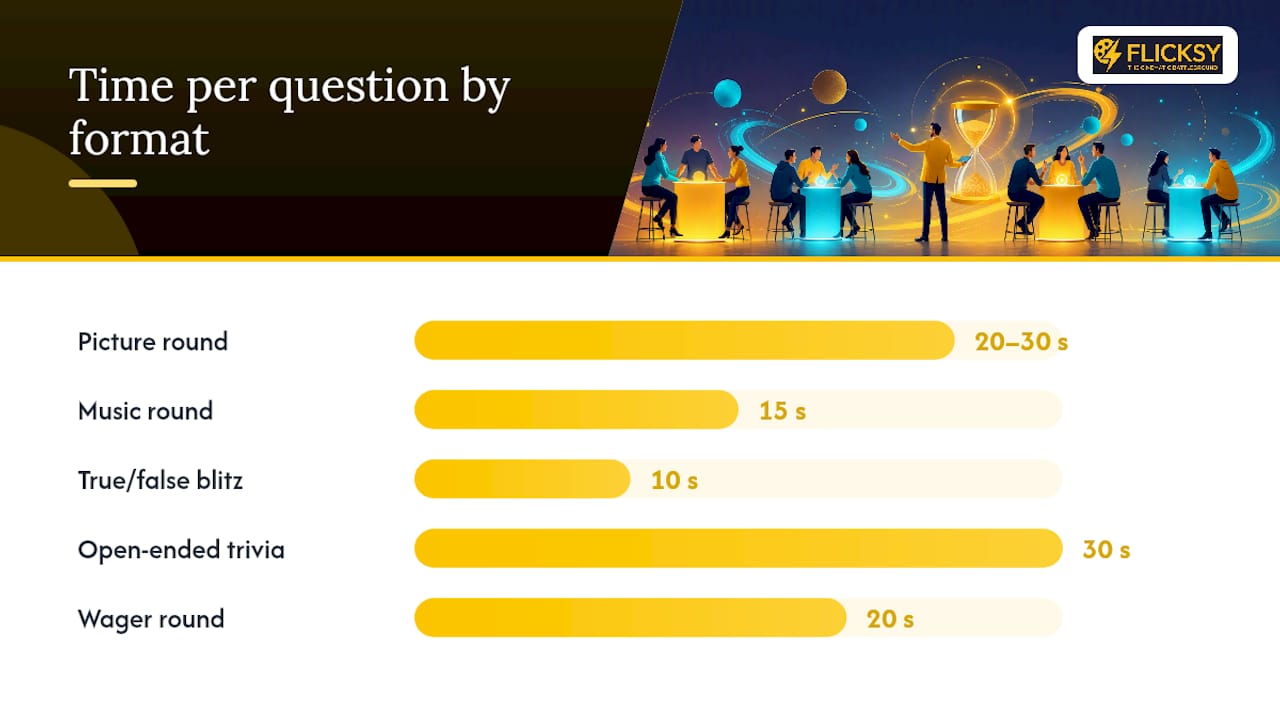
- Picture round. Materials: 10 printed or projected images. Time per question: 20 to 30 seconds. Sample: show a cropped shot of a red London phone box; answer is "United Kingdom." Scoring: 1 point per correct answer, 2 for a bonus detail (which city).
- Music round. Materials: speaker, curated playlist, timer. Time per clip: 15 seconds. Sample: play the opening riff of a well-known movie theme; answer is the film title. Scoring: 1 point for the song, 1 for the artist or composer.
- True/false blitz. Materials: none beyond a question list. Time per question: 10 seconds. Sample: "The Great Wall of China is visible from space. True or False?" (False.) Scoring: 1 point, minus half a point for wrong guesses if you want to punish blind guessing.
- Open-ended trivia. Materials: paper answer sheets. Time per question: 30 seconds. Sample: "What year did the first iPhone launch?" (2007.) Scoring: full point for exact answers, partial credit for close numeric guesses.
- Wager round. Materials: scorecards teams can flip. Time per question: 20 seconds. Sample: teams stake 0 to 5 points before seeing the category. Scoring: staked points, win or lose.
- Physical/charades round. Materials: prompt cards. Time per turn: 60 seconds. Sample: "Act out: Jurassic Park." Scoring: 1 point per correct guess, capped at three guesses per team.
The most common host mistake is writing ambiguous clues that have two defensible answers. Read every question out loud to someone else before the event. The second mistake is stacking a round entirely with expert-level trivia, which alienates half the room in the first two minutes.
Pro Tip: Put your hardest question third in each round, not first or last. Teams settle into a rhythm and stay confident instead of tanking on question one.
Setting Up a Picture Round That Actually Looks Good
Picture rounds pull real weight in trivia night lineups, but sourcing images is where most hosts stall. Logos, landmarks, movie stills, and flag identification all work as prompt types, and you can build a full round from any single category or mix them.
For sourcing, Wikimedia Commons and Wikipedia's own gallery of sovereign state flags give you public-domain images with no licensing headaches. Screenshots from your own device are fine for personal, non-commercial trivia nights, but avoid reselling any event built around copyrighted movie stills.
- Print picture rounds on plain paper at 300 DPI minimum, or the details blur.
- For virtual games, share images full-screen and give an extra five seconds since remote players scroll or zoom.
- Number each image clearly. Ambiguous numbering costs more disputes than wrong answers do.
Pro Tip: Test every printed picture round from across the room before the night starts. What looks sharp on your laptop often turns to mush on a home printer.
Music Rounds Without the Copyright Headache
Short clips around fifteen seconds are ideal: long enough to identify a song, but brief enough to keep the round focused. Layer clues by playing the chorus first, then the more obscure intro or bridge if nobody guesses.
If you're worried about licensing for a public or recorded event, instrumental versions or lyric screenshots sidestep most issues while keeping the round recognizable. For casual home or private nights, streaming a normal playlist is fine.
- Score 1 point for the title, 1 for the artist, and a bonus point for the year or movie it's from.
- Rotate genres by decade to avoid one team's music taste dominating the whole round.
- Keep a stopwatch visible so teams know exactly when writing time ends.
Interactive Rounds That Get People Off Their Chairs
Question-and-answer formats are the backbone of any trivia night, but physical and interactive rounds are what people actually post about afterward.
- Scavenger round: Call out an item ("something with a barcode"), give 90 seconds, first team back wins the point.
- Charades: Rotate one actor per team per turn so nobody hogs the spotlight, and cap each attempt at 60 seconds.
- Bring-an-item: Announce the category at the start of the night so teams can plan, then collect points at a fixed time slot.
Keep prompts simple enough for any age or mobility level, and rotate who acts or fetches so the same person isn't sprinting every round. A quick group photo after the scavenger round makes for the kind of social post that brings people back next week.
Building the Night: Pacing, Round Counts, and Sample Agendas
Most hosts land on 4 to 6 rounds of 8 to 10 questions each for a night running 90 to 120 minutes, and that structure holds up whether you're running a bar quiz or a living room game.
90-minute agenda: Welcome and rules (5 min), Round 1 general knowledge (10 min), Round 2 picture round (10 min), Round 3 music round (10 min), interactive scavenger round (10 min), Round 4 wager/speed round (10 min), scoring and tiebreaker (10 min).
Two-hour agenda: Add a themed decade round after intermission and a charades round right before the final wager round. Save your highest-drama format, the wager round, for second to last. It builds tension right before the final score reveal instead of burning it off too early.
- Place interactive rounds in the middle third of the night, when attention naturally dips.
- Never end on a picture round; end on something with a clear winner and instant excitement.
Building a Movie Round in Minutes: A Host's Workflow
For film and TV nights, Flicksy supplies theme-aligned question packs so you're not hunting for stills or trivia facts from scratch. Blitz PvP works well for a fast head-to-head tiebreaker, while Couch Party suits a full-table group round.
A quick workflow: pick a franchise or decade theme, pull a curated pack, then run it as either format depending on group size. For soundtrack-based rounds, keep clips under 15 seconds and favor instrumental themes. They're easier for teams to place without lyrics giving away the answer.
Multiple Choice, True/False, or Open-Ended: Which Format Fits Which Round
Each question format does a different job, and mixing all three across a night keeps the pacing honest.
Multiple choice works best for harder or more obscure questions, because it gives struggling teams a fighting chance without making the round trivial for experts. It's also the fastest format to score, since answers are usually a letter or number.
True/false is the format to reach for when you need speed. A true/false blitz of 10 rapid questions fills a lull between longer rounds and rarely takes more than five minutes. The tradeoff is that guessing is baked in, so weight these lower in your scoring if you want skill to matter more than luck.
Open-ended questions reward genuine knowledge and create the most satisfying "we got that one" moments, but they slow the pace and invite scoring disputes over spelling or partial answers. Reserve open-ended formats for your strongest, most confident round, usually somewhere in the middle of the night, and set a clear rule upfront: are close spellings accepted, are first names enough, is "the '90s" close enough to an exact year?
A smart running order alternates formats round by round. Open with multiple choice to build confidence, drop in a true/false blitz to reset energy, then let open-ended questions carry your marquee round once teams have warmed up.
Keeping Mixed Skill Levels Happy in the Same Round
The single biggest reason trivia nights lose players is difficulty mismatch. A room full of casual players facing an expert-level sports round checks out fast, and a room of sharp regulars gets bored by anything too easy.
The fix is to build each round on a gradient instead of a flat difficulty. Open with an easy, high-confidence question everyone can answer, move through two or three medium questions, and save the genuinely hard one for the second-to-last slot rather than the finale. This structure, sometimes called a difficulty curve, keeps weaker teams scoring points early so they stay invested, while still giving your strongest teams something to chase.
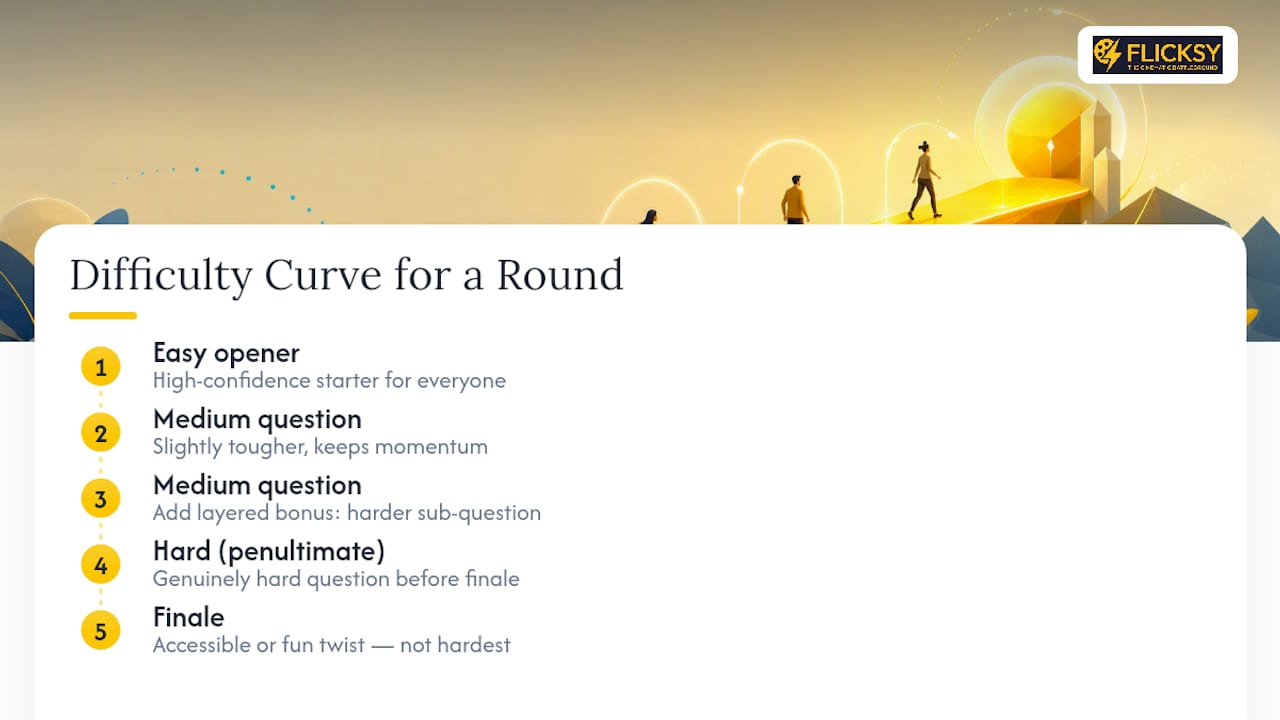
Another trick: build "layered" questions where a bonus sub-question adds difficulty on top of an easier base answer. "Name this actor" gets everyone in; "and name the film this photo is from" only rewards the sharper teams. You keep both skill levels engaged in the same 20 seconds instead of splitting them into separate rounds.
Watch your own reactions during a test run. If you wrote a question and needed to look up the answer yourself, it's too hard for a general room. If it feels insultingly obvious, cut it or move it to the opening slot.
Where Fresh Questions Actually Come From
Running dry on ideas after a few trivia nights is common, and it usually means you're writing from memory instead of pulling from real sources. Start with current events, recent movie and TV releases, and anniversaries. If something happened five, ten, or twenty-five years ago this year, it's fair game.
Cross-category questions keep a single round from feeling like a pop quiz on one narrow subject. A "1990s" round shouldn't be all music. Mix in a movie, a piece of technology, and a world event from the same decade, and suddenly the round rewards different kinds of trivia knowledge instead of just one team's specialty.
Packaged round collections with ready-made questions and answers save serious prep time when you're stuck, and they're worth keeping in a folder for the weeks you're short on ideas. Unusual round templates with built-in answer keys are especially useful for last-minute nights when you don't have time to fact-check your own writing.
Rotate who writes questions if you host regularly. A single writer's blind spots (their favorite decade, their favorite sport) show up fast over multiple weeks, and players notice.
Scoring Systems and Tiebreakers That Don't Cause Arguments
Keep your scoring simple enough to track on a single sheet of paper. Most rounds work fine on a flat 1 point per correct answer, with a bonus point reserved for detail questions (the "and name the director" style add-on).
Wager rounds are the exception. Let teams stake anywhere from 0 to 5 points on their own confidence before hearing the question, and score exactly what they staked, win or lose. It's the single easiest way to inject late-night drama without changing anything about your question difficulty.
For ties, skip the awkward sudden-death shootout and use a pre-written tiebreaker question with a numeric answer, like "What year was the Eiffel Tower completed?" Whichever team's guess lands closest without going over wins. Keep one tiebreaker question in your back pocket every single night; you'll need it more often than you'd think.
Adjusting Rounds for Small Groups, Big Crowds, and Virtual Nights
A living room game of four teams plays very differently from a 20-team bar crowd, and the same round can flop or thrive depending on which one you're running.
For small groups (under six teams), lean into interactive and physical rounds. Charades and scavenger hunts feel awkward with 40 people watching but genuinely fun with a tight group of friends. You can also loosen your timing, since there's less crowd management to worry about.
For large crowds, tighten your timers and rely more on picture and multiple-choice rounds, since open-ended scoring gets chaotic fast when you're collecting 20 answer sheets by hand. Assign a designated scorekeeper per section of the room if you're running a bar-sized event.
For virtual nights, physical and scavenger rounds mostly don't translate, so double down on picture rounds, music rounds, and open-ended written formats submitted through chat or a shared form. Build in a few extra seconds per question, since screen-sharing and typing both add lag that in-person paper answers don't.
What Actually Makes a Trivia Night Memorable
Cheap upgrades like an era-specific playlist, handwritten table signs, or a taped-up photo backdrop do more for atmosphere than any expensive prop. Alternating a cognitive round with a physical one keeps energy from flattening out. My real checklist: playlist ready, timer charged, tiebreaker question written, one interactive round scheduled by the midpoint.
— Aakash
Get Movie and TV Rounds Ready in Minutes With Flicksy
For film, TV, and anime themed nights specifically, some trivia platforms cut your prep time down to almost nothing compared to hunting for stills, soundtrack clips, and fact-checked trivia yourself. It's built around rapid-fire questions across those exact categories, so you're not stitching together a round from five different browser tabs.
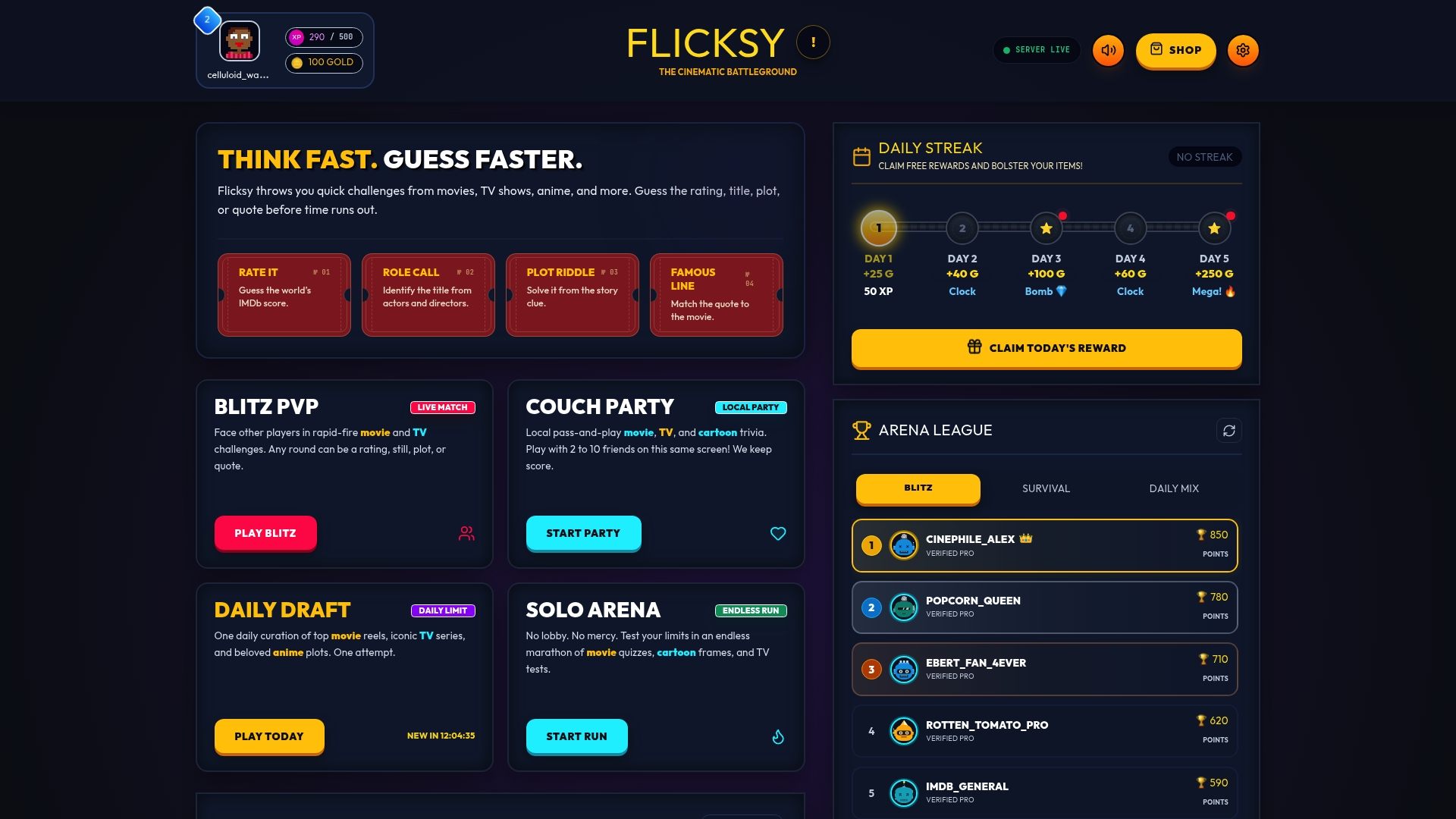
If you're short on time before Friday night and want a themed round that's already curated, Flicksy's Blitz PvP mode runs a fast head-to-head that works great as your closing tiebreaker format. Couch Party mode handles a full group in one sitting, and Solo Arena is there for the between-events itch when you want to sharpen your own movie and TV knowledge. DIY prep still wins when you're building a fully custom local or niche round, but for anything movie, TV, or anime themed, download Flicksy and pull a ready-made pack before your next trivia night.
Sources
A few sources are worth keeping in your back pocket for whenever you're stuck on ideas. Trivia Host Help's round and theme guide covers dozens of formats with example agendas built in. The Quizmasters' outside-the-box categories post is the go-to for refreshing a stale weekly rotation. Top Trivia Questions' unusual round collection hands you ready-to-run questions and answers when you're out of time to write your own.
For images, Wikimedia's gallery of sovereign state flags and general Wikipedia image pages are public domain and safe to print or project without licensing worries. If you want emoji-based prompts for a translation round, Emoji Trove's meme reference is a handy source for meanings and phrasing.
- Trivia Night Ideas: 50+ Themes, Formats & Round Ideas
- Bar Trivia Category Ideas: Think Outside the Box
- 35+ Unusual Quiz Round Ideas (with Q&As!) - Top Trivia Questions
FAQ
What are some fun trivia picture rounds?
Logo identification, cropped movie posters, landmark photos, and flag guessing all work well, and you can pull public-domain images from sources like Wikimedia Commons without licensing issues.
What are some good ideas for themed trivia rounds?
Decade nights, single-franchise rounds (one movie series or TV universe), and holiday-specific quizzes all perform well because they let you write layered questions around a single, familiar theme.
What are some good ideas for quiz picture rounds?
Beyond straight identification, try "spot the difference" between two similar images, or "guess the year" using a single photo, since both add a twist without complicating scoring.
What are some good trivia round ideas overall?
A strong lineup mixes visual, audio, themed, and interactive formats, roughly 4 to 6 rounds of 8 to 10 questions each, with at least one wager or speed round to close the night on tension. For movie and TV themed nights specifically, a ready-made pack from a platform like Flicksy saves the prep time that usually goes into sourcing stills and fact-checking trivia by hand.