

A trivia power-up is a one-time helper that bends a single question in your favor: it removes wrong answers, adds seconds, lets you skip, or multiplies the points you score. Used well, power-ups turn a lost round into a close one. Used badly, they get burned on easy questions and leave you empty-handed when the hard one lands. This guide covers the main types, when each is worth spending, how to keep them fair in a group, and how we think about them at Flicksy.
TL;DR
- Power-ups fall into four families: elimination, time, skip or swap, and score multipliers.
- Save them for questions where you have partial knowledge, not for ones you know cold or know nothing about.
- In head-to-head play, a power-up is worth most when your opponent is also under time pressure.
- In a group, agree on the rules before round one so nobody argues about a hint mid-game.
- Power-ups support good habits. They do not replace recall, speed and a calm head.
Table of Contents
- What a trivia power-up actually is
- The four main types of trivia power-ups
- When to spend a power-up and when to hold
- Power-ups in head-to-head play
- Using power-ups in a group or at a party
- Real-life "power-ups" that need no app
- Our perspective on power-ups
- Try the decisions yourself
- Designing power-ups for your own trivia night
- Common mistakes with trivia power-ups
- FAQ
- Sources and further reading
What a trivia power-up actually is
The term comes from video games, where a power-up is a temporary boost: a mushroom, a shield, a speed burst. Trivia borrowed the idea. A power-up is a limited-use action you trigger on one question, usually before you lock in an answer. Most are earned (by streaks, daily play or milestones) or granted in small numbers at the start of a match.
Three traits define the genre:
- Limited supply. If you could use one on every question, it would be a rule, not a power-up.
- Single-question effect. The boost applies to one question and then it is gone.
- A trade-off. Good designs make you give something up: a few points, a decision under pressure, or the chance to use it later.
That trade-off is the whole game within the game. Knowing when to spend is a skill separate from knowing the answer.
The four main types of trivia power-ups
Names vary from app to app and from living room to living room, but nearly every power-up fits one of four families.
| Family | What it does | Best used when | Main risk |
|---|---|---|---|
| Elimination (often called 50/50) | Removes some wrong options | You can rule out one answer but not decide between the rest | Wasted if you already know the answer |
| Time boost | Adds seconds or freezes the clock | The question is long, or you know the topic but need to recall a detail | Slows your pace if overused |
| Skip or swap | Replaces the question | You have no idea and the question is worth the same as any other | Swapped-in question may be no easier |
| Score multiplier | Raises points for a correct answer | You are confident and want to widen a lead | Costs you more if you are wrong, in games that penalize misses |
Elimination
This is the most familiar one. If four options become two, your odds of a lucky guess go from 25% to 50%. The math is simple, but the real value comes from how you use it. The best moment is when you can already discard one option. Removing two wrong answers then leaves you comparing the final pair using whatever partial memory you have.

A practical example: a movie question asks which director made a film, and you remember the name starts with a particular letter or that the director is known for a certain genre. Elimination turns a vague feeling into a decision.
Time boosts
Extra time sounds weak next to a 50/50, but in rapid-fire formats it is often the strongest tool. Many wrong answers in fast trivia are not a lack of knowledge. They are a memory that needs two more seconds to surface. If you know the show but cannot place the season, a few extra seconds can rescue it. Our guide to speed versus accuracy in trivia goes into why rushing costs more points than most players expect.
Skip or swap
A skip is insurance against a blank. It is best for questions in categories you truly do not know. The mistake is skipping too early: in a short match, you may only have two or three skips, and a question that looks scary on first read is often solvable after ten seconds of thought. Use a skip when you have read the question twice, nothing came, and the clock is half gone.
Score multipliers
Double points, streak bonuses and risk-reward bets all live here. They reward confidence. The right time is a question squarely in your strongest category, ideally when you are slightly behind. A multiplier on a question you would answer correctly anyway is pure gain. A multiplier on a coin flip is a gamble, and you should treat it like one.
When to spend a power-up and when to hold
The common mistake is spending power-ups early, because they feel free and the questions feel hard. A simple three-part test helps.
1. Do you have partial knowledge? Elimination and time boosts work best on questions where you know something. If you know nothing, a skip is the right tool. If you know everything, use nothing.
2. What is the match state? Ahead by a wide margin, you can play conservatively and keep your power-ups for a late comeback by your opponent. Behind, a multiplier on a strong-category question is how you close a gap.
3. How many questions remain? Unused power-ups are worth zero at the end of a match. If you have three left and four questions to go, spend them. If you have one left and ten to go, wait for the best spot.
A good default for a short match: hold your first power-up until at least a third of the questions have passed, so you have seen the shape of the categories. Then spend deliberately, with the last one reserved for the final questions, where scores are tightest.

Power-ups in head-to-head play
In real-time one-on-one rounds, a power-up has an extra effect: it changes the tempo. If your opponent is answering in four seconds and you spend a time boost, you might get the answer right but fall behind on speed bonuses in games that award them. In that case an elimination option is better, because it makes you faster instead of slower.
If the format rewards speed, ask whether the power-up shortens your decision or lengthens it. Elimination and multipliers shorten or sharpen it. Time boosts lengthen it. Match the tool to the scoring. For deeper tactics on this, see our PvP trivia strategy guide, and if you want to practice the format itself, starting a 1v1 match is the quickest way in.
Using power-ups in a group or at a party
In a living room or bar game, power-ups create fun but also friction. Someone uses a hint, someone else says it was not allowed, and the night loses momentum. A few simple rules prevent that.
- Announce them before the round starts. Say how many each player or team gets and what each does.
- Make them visible. A card, a token or a tally on the scoreboard. Hidden power-ups lead to arguments.
- Decide the timing. Can a power-up be played after seeing the question? After hearing someone else answer? Most groups settle on before an answer is committed.
- Keep the count small. Two or three per player is plenty. More than that and the novelty fades.
For large groups, power-ups also help balance skill. Giving a beginner team an extra skip is a gentle handicap that keeps the game close without feeling patronizing. If you are running big rooms, our piece on large-group trivia modes for movie, TV and anime fans covers formats that scale, and the guide to preventing cheating in trivia is worth reading before you introduce hint mechanics, since any extra help should be official and visible.
If you run mixed rounds, keeping them short helps too: shorter sets mean fewer rules to remember and fewer disputes, which we cover in mixed category trivia with 10 or 20 questions.
Real-life "power-ups" that need no app
The best boosts are habits. Several are free and work in any game.
- Read the last line first. In long questions, the actual ask is usually at the end. Reading it first tells you what to look for.
- Eliminate by hand. Do mentally what an elimination power-up does: cross out answers that cannot be right by era, genre or format.
- Anchor to a fact. Tie each category to two or three anchor facts (a decade, a studio, a lead actor). Anchors speed recall.
- Review misses. Write down the questions you missed and revisit them a day later. Our walkthrough on spaced repetition for trivia recall shows how to schedule that review.
- Practice the reflex. The faster you retrieve, the fewer time boosts you need. Our list of habits for answering trivia faster is a good starting routine.
If you do all of this, power-ups stop being a crutch and become a tiebreaker. That is where they belong.
Our perspective on power-ups
At Flicksy, our games are built around speed and accuracy in movies, TV shows and anime, in modes such as Blitz PvP, Couch Party and Solo Arena. When we think about helpers in that kind of game, we start from one belief: a boost should never replace knowing the answer. It should reward a player for making a smart call under pressure.
That shapes how we look at the whole idea:
- Fast formats need light tools. In rapid-fire rounds there is no time to read a menu of options. A helper has to be understood in a glance.
- Fairness comes first in head-to-head. Competitive play only feels good when both sides believe the result was earned. Anything that can be bought or earned should be visible and balanced, and should not decide a match on its own.
- Solo play can be looser. Against the clock alone, a helper is a personal tool, and nobody else's result depends on it.
- Fan knowledge is the real engine. Someone who has watched an anime series three times will beat someone who spent a boost on a guess. We want that to stay true.
We offer Flicksy as a free-to-play app, and the way we see it, anything optional should add fun, never gate it. If you take one principle from us, it is this: treat every boost as a decision, because decisions are what make trivia a game rather than a quiz.
— Aakash
Try the decisions yourself
Reading about when to hold and when to spend only goes so far. The quickest way to build the instinct is to play fast rounds and notice your own patterns: which categories you hesitate in, and when pressure makes you rush. Flicksy gives you rapid-fire movie, TV and anime trivia in Blitz PvP for real-time matches, Couch Party for friends on one screen, and Solo Arena for endless practice against the clock, with daily quizzes, rewards and leaderboards to keep you coming back. Play Flicksy and see how your instincts hold up.
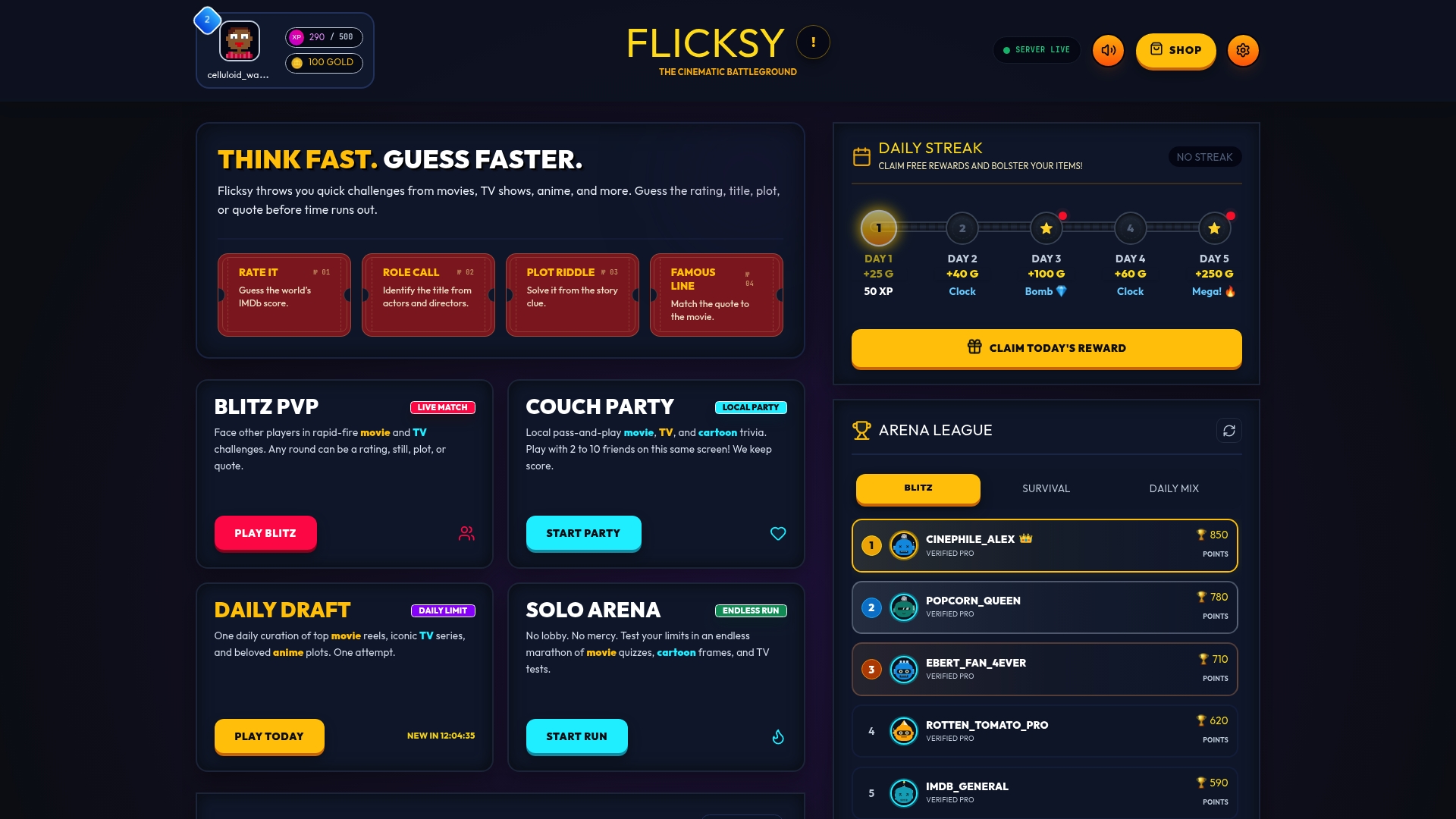
If you want a structured way to improve, start in Solo Arena to learn your weak categories, then take that into a friendly match. For a competitive angle, our guide to winning 1v1 Blitz rounds is a sensible next read.
Designing power-ups for your own trivia night
If you host, you can build your own system with paper and a marker. Here is a simple set that works for a team game of around 20 questions.
| Power-up | How it works | Per team |
|---|---|---|
| Two Down | Host removes two wrong options from a multiple-choice question | 1 |
| Extra Ten | Team gets ten more seconds to answer | 1 |
| Swap | Host reads a replacement question from the same category | 1 |
| Double Down | Points for the question are doubled if correct, zero if wrong | 1 |
A few tips from running games like this:
- Print the cards. One card per power-up, handed back to the host when used.
- Cap it to one per question. Stacking turns the game into a puzzle about power-ups instead of trivia.
- Plan your tiebreak. If a close game ends level, have a few questions ready. Our list of 20 trivia tie-breaker questions covers live and online use.
- Test on a friend first. One practice round will reveal any confusing rule.
Common mistakes with trivia power-ups
Burning them in the first minute. Early questions feel high-stakes because nothing else has happened yet. They are not.
Using elimination on questions you know. If you are sure, answer. The boost is worth more later.
Holding everything to the end. The opposite error. Unused boosts score nothing.
Ignoring the scoring rules. A multiplier with a penalty for wrong answers is a different tool than one without. Read the rules once, carefully.
Letting the boost replace review. If you keep needing a skip in the same category, that category is your homework.
FAQ
What is the most useful trivia power-up?
For most players it is elimination, because it helps in the widest range of situations: any question where you know a little. In fast head-to-head formats, a score multiplier can matter more, but only if you are confident in the category.
Should I save power-ups for the end of a match?
Save the best one for the late questions, since scores are usually closest there. Do not hold all of them, because anything left at the final question is wasted. A balanced plan is to spend one around the middle and keep one in reserve.
Are power-ups fair in competitive trivia?
They are fair when both players have the same access and the rules are clear and visible. They feel unfair when one side can gain a lasting edge that skill cannot match. In a group, announce the rules before the first question.
Can I get better at trivia without power-ups?
Yes, and it is the best long-term route. Work on fast recall, review your misses on a schedule and practice in short sessions. Over time you will need fewer boosts and use the ones you have more precisely.
Sources and further reading
This guide draws on our own game design experience and on the following Flicksy guides:
- Speed vs Accuracy in Trivia: How to Balance Both
- PvP Trivia Strategy: How to Win Rapid-Fire Head-to-Head Rounds
- Start a 1v1 Trivia Match in Seconds, Try Flicksy's Blitz PvP
- Three App First Large Group Trivia Modes for Movie, TV, and Anime Fans
- How to Prevent Cheating in Trivia: 9 Tactics That Work
- Mixed Category Trivia: 10 or 20 Questions, Fewer Disputes
- Win Quiz Night: Use 2357 Spaced Repetition for Faster Trivia Recall
- How to Answer Trivia Faster: 9 Habits That Work
- 20 Trivia Tie Breaker Questions Hosts Can Use Live or Online
- Win 1v1 Blitz: Competitive Trivia Games for Movie, TV & Anime Fans