

Yes, spaced repetition works for trivia, and it works better than almost anything else you could do instead of cramming. Write your weak facts as active-recall question cards, review a small stack for ten minutes today, then again in two days, then three, then five. Prioritize whatever you get wrong. That's it. Everything below explains why it works and how to run it without overthinking the schedule.
TL;DR:
- Spaced repetition significantly increases retention, with learners able to remember up to twice as much material compared to cramming.
- The 2357 schedule recommends reviewing new facts on days 2, 3, 5, and 7 for optimal recall, especially when planning around upcoming events.
- Effective cards should focus on one fact per card, with clear, quiz-like clues and short answers to maximize recall accuracy.
- Tools like apps, spreadsheets, or Leitner boxes can automate or simplify scheduling, but consistency and tagging misses remain crucial.
- Pairing durability-focused review with timed quiz games improves both long-term memory and speed under pressure.
Table of Contents
- What Makes Spaced Repetition Work for Trivia Recall
- The 2357 Method and Other Simple Schedules
- Turning Schedules Into Trivia Cards That Actually Work
- Choosing a Workflow: App, Spreadsheet, or Index Cards
- Pairing Spaced Review With Fast Game Sessions
- Your First Week: A Simple Checklist to Get Moving
- Practice Retrieval Speed With Flicksy
- Sources
- FAQ
What Makes Spaced Repetition Work for Trivia Recall
Your memory decays on a predictable curve. A day later, without review, a chunk of that fact is gone. Review it right at the point you're about to forget it, and the memory gets stronger and slower to fade than it would from rereading it five times in a row.
That's the spacing effect, and it pairs with something called the testing effect: forcing your brain to retrieve an answer, rather than just rereading it, builds a sturdier memory trace. Trivia is almost pure retrieval under time pressure, so this isn't a nice theoretical fit. It's the exact skill the method trains.
The numbers back this up. Learners who space their reviews over time can retain up to about 200% more material than learners who cram the same material into one session. Feedback matters too: when you miss a card and immediately see the correct answer, the next attempt at that fact sticks noticeably better than a test with no feedback, since the correction itself reinforces the retrieval attempt.

The 2357 Method and Other Simple Schedules
You don't need software to start. The most-cited fixed schedule for this is called 2357, and Birmingham City University lays it out plainly: review new material on day 2 after you first learn it, again on day 3, then day 5, then day 7. Each review is active recall, meaning you answer from memory before checking, not a reread of your notes.
Say your quiz night is in ten days. Reverse-plan from that date: build your card deck today, hit your first review in two days, then follow the 2, 3, 5, 7 gaps, landing your last review the day before the event. A study planner can map those dates onto a calendar if you'd rather not do the math by hand.

If you prefer physical cards, the Leitner system is the low-tech answer: three or four boxes, cards move forward a box on a correct answer and back to box one on a miss, and each box gets reviewed on its own rhythm. Simple, tactile, no app required.
One nuance worth knowing: research comparing schedules that gradually widen the gaps against ones that keep the spacing equal found little consistent long-term advantage either way. Spacing itself is what drives retention, not the exact shape of the curve. That's freeing. Pick a schedule you'll actually follow.
Pro Tip: Practice a card until you recall it correctly three times across separate spaced attempts, then drop it to a maintenance schedule instead of reviewing it daily forever.
Turning Schedules Into Trivia Cards That Actually Work
A spacing schedule is only as good as the cards feeding it. Bad cards, built loosely, will train you to recognize an answer rather than truly recall it, which falls apart the moment a quiz host phrases the question differently.
Follow four rules when writing cards:
- One fact per card. Don't cram "Name the director, year, and lead actor" into a single card. Split it into three.
- Write the clue the way a quiz host would ask it, not the way a textbook would phrase it.
- Add disambiguating context for pop-culture facts. "Who played Miles Morales in Spider-Man: Brand New Day?" needs the movie title attached, or you'll confuse it with an earlier Spider-Man appearance.
- Keep the answer side short. One name, one date, one number.
For session structure, a workable template looks like this: a 10-minute daily warm-up covering whatever cards are due that day, plus a 20-minute weekly deep review where you pull every card tagged as a repeat miss and run it again regardless of schedule. Retire a card once you've nailed it three consecutive times at spaced intervals. Early scheduling matters most in the first week to ten days, when new facts are most fragile.
To build actual speed, not just accuracy, add timed pressure once you're past the initial learning phase. Say the answer aloud instead of just thinking it. Set a five-second timer per card during your weekly review, since quiz buzzers don't wait for you to be sure. Tag every miss the moment it happens rather than trying to remember which cards gave you trouble by the end of the session. That tag is what tells you where tomorrow's ten minutes should go.
Choosing a Workflow: App, Spreadsheet, or Index Cards
Adaptive flashcard apps track your accuracy and response time on each card, then adjust the review interval automatically so weak cards resurface sooner and strong ones drift further apart. That beats a fixed schedule for large decks, because it stops wasting review time on facts you already know cold. A spreadsheet or a physical Leitner box works fine too. It just puts the scheduling math on you.
A minimum viable routine, regardless of tool:
- Create five to ten new cards after each trivia session or missed round.
- Run your due reviews for ten to fifteen minutes, same time each day if you can manage it.
- Tag every miss on the spot so it resurfaces sooner.
- Bulk-import cards from a quiz log or CSV if your app supports it, instead of typing each one by hand.
- Use category tags like "actors," "release years," or "anime openings" so you can drill a weak category on demand.
Most queue-based quiz platforms follow this same due-card logic behind the scenes, surfacing a block of cards that are due rather than making you track dates yourself.
Pairing Spaced Review With Fast Game Sessions
Spacing builds durable memory. It doesn't automatically build speed under pressure, and trivia lives or dies on speed. Mixing a few minutes of timed game play into your week gives you both: the flashcards handle durability, and short, competitive rounds train the reflex of pulling an answer out fast, especially when there's a leaderboard or daily reward pushing you to show up again tomorrow.
A two-week hybrid routine might look like this: daily 10-minute card reviews following your 2357 schedule, plus two Blitz PvP matches a week where you face an opponent in a real-time trivia match to feel actual buzzer pressure. The cards catch what you're forgetting. The matches expose what you know but answer too slowly.
Your First Week: A Simple Checklist to Get Moving
Start small and let the schedule do the work. Build 20 cards today, all single-fact, all phrased the way a quiz host would ask them. Review for 10 minutes daily and follow the 2357 gaps strictly through week one, no skipping days. At the end of the week, run a timed practice quiz and see how it feels under pressure.
Three numbers tell you if it's working: your accuracy percentage on due cards, your average response time, and how many cards you retire per week from hitting three correct spaced recalls. If accuracy climbs but response time doesn't, that's your cue to add more timed practice.
Practice Retrieval Speed With Flicksy
A rapid-fire trivia game focused on movies, TV, and anime can push you to answer under a real clock rather than recalling an answer at your own pace, with daily quizzes providing a fresh, low-effort session to run every day without writing a single new card yourself.
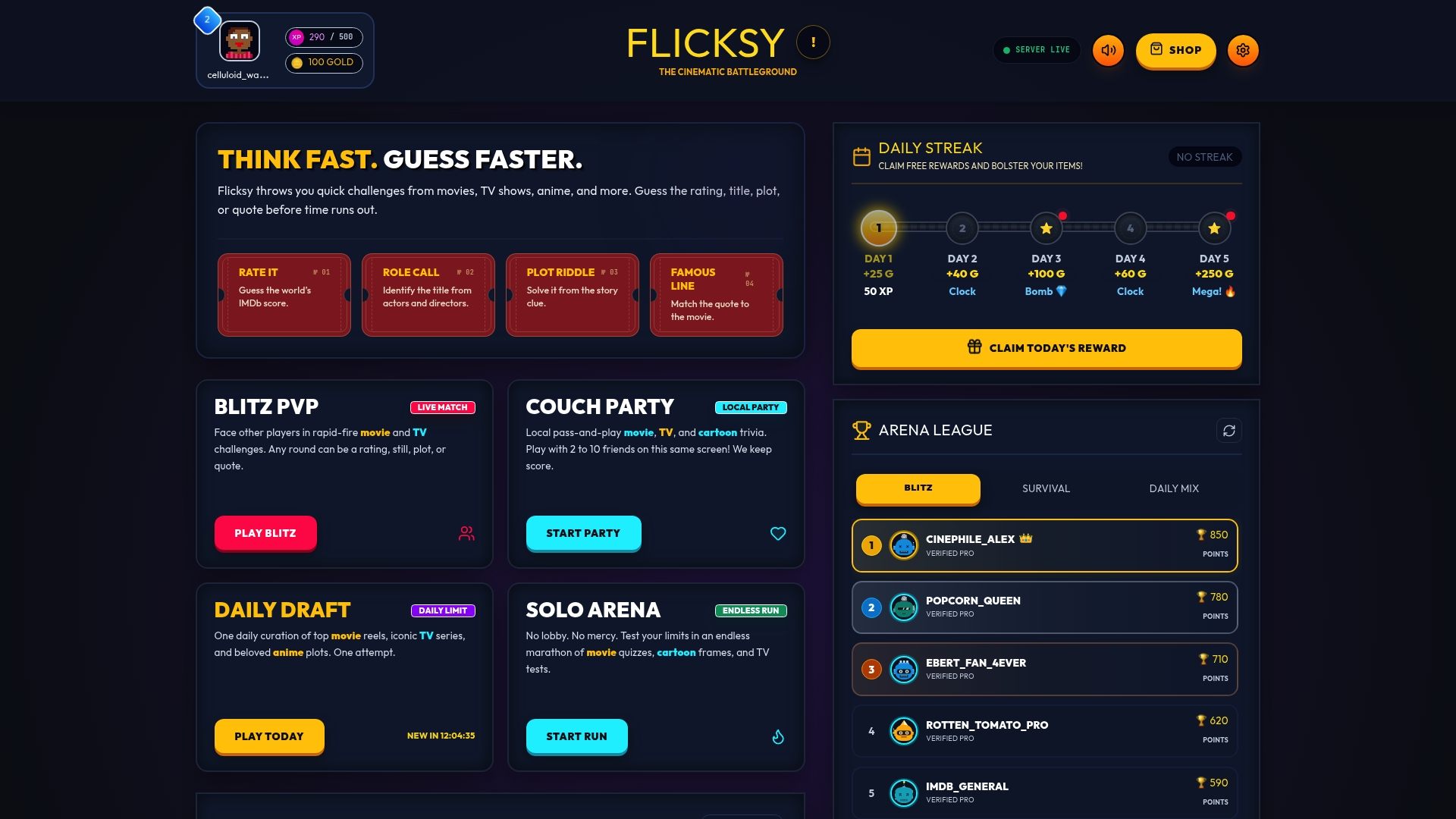
These two tools do different jobs. A spaced deck handles durability, drilling weak facts until they're locked in. The trivia game focuses on fluency, requiring you to produce answers quickly in competitive, solo, or group modes. Pairing a short daily card review with a timed trivia session can train both speed and accuracy in trivia skills. Head to Flicksy to jump into a match and see how your retrieval speed holds up against a real opponent.
Sources
This guide draws on four primary references: a PubMed summary on distributed practice and retention, a PMC paper on adaptive spacing algorithms, a PubMed comparison of expanding versus equal spacing schedules, and Birmingham City University's guidance on the 2357 method. Each one backs a specific claim made above rather than serving as general background.
- Distributed practice and memory retention (PubMed entry)
- Adaptive spaced repetition research (PMC article)
- Expanding vs equally spaced retrieval practice (PubMed 19966244)
- Birmingham City University — Spaced repetition and the 2357 method
FAQ
What is the 2357 rule for revision?
The 2357 rule schedules review sessions on days 2, 3, 5, and 7 after you first learn something, using active recall rather than rereading at each check-in. Birmingham City University recommends it as an easy fixed schedule for anyone who doesn't want to calculate custom intervals.
Can you give an example of spaced repetition for trivia?
Say you learn that Everything Everywhere All at Once won Best Picture. You'd quiz yourself on that fact two days later, then three days after that, then five, then seven, answering from memory each time before checking. Miss it once, and it gets tagged for an earlier retest instead of waiting for its next scheduled slot.
What is the 3-2-1 memory technique?
Definitions of the "3-2-1" technique vary across sources, and it isn't a formally standardized method the way 2357 is. One common practical version asks you to recall a fact correctly three separate times at spaced intervals before considering it learned, which lines up with the initial recall criterion research recommends before switching a card to maintenance mode.
How does the 2357 study method actually work?
You study new material once, then revisit it on day 2, day 3, day 5, and day 7, testing yourself rather than passively rereading at each step. The growing gaps between reviews line up with when you're statistically about to forget the material, which is the point at which review strengthens memory the most.
Does Flicksy work as a spaced repetition tool?
Flicksy isn't a flashcard scheduler. It's a rapid-fire trivia game across movies, TV, and anime built for Blitz PvP matches, Solo Arena runs, and Couch Party sessions. It complements a spaced-review deck by giving you fast, timed retrieval practice once your flashcards have already built the underlying recall.