

Competitive trivia games are real-time contests where you answer questions against a live opponent (or a full lobby) under a clock, with scores, rankings, or a bracket deciding who actually wins. If your focus is movies, TV, and anime, Flicksy is built for exactly that: Blitz PvP puts you in fast 1v1 matches, and its ranking system rewards speed and accuracy instead of just knowledge alone. The rest of this guide breaks down formats, must-have features, and how to pick and improve at the right one.
TL;DR:
- Faster match start times and active ranked ladders with clear season progress are essential for maintaining competitive engagement.
- Genre-specific question pools, such as movies, TV, and anime, ensure fairer matchups and more relevant content for dedicated fans.
- Cross-platform compatibility and low latency are critical to avoid excluding players or unfairly influencing game outcomes.
- Shallow question pools or lack of ranking transparency lead to less fair, less motivating competitive experiences.
- Community size and privacy settings impact match quality and continuity, favoring platforms with active, genre-focused communities.
Table of Contents
- What makes a trivia game competitive: core modes and formats
- Must-have features for competitive play
- How to choose the right competitive trivia game for your group or goals
- How to get better fast: competitive play strategies and practice routines
- Publisher proof: why Flicksy fits competitive movie/TV/anime trivia players
- Topic and category variety across trivia games
- Device accessibility: browser, mobile app, and cross-play
- Prizing and rewards: points, badges, and real prizes
- Where competitive trivia communities actually live
- Why speed and fairness both matter in trivia
- Try Flicksy for movie, TV, and anime trivia that actually moves fast
- Sources and further reading
- FAQ
What makes a trivia game competitive: core modes and formats
Competition comes from structure, not just difficulty. A trivia app becomes genuinely competitive when it introduces a clock, a live opponent, and consequences for missing a question. The most common formats each reward a different skill.
- 1v1 blitz matches: two players race the same question set, often decided by milliseconds on tied correct answers. This format rewards speed above almost everything else.
- Timed arenas: larger lobbies (sometimes dozens of players) answer simultaneously, with scoring weighted toward both correctness and response time.
- Team and tournament brackets: groups face off in elimination rounds, shifting the skill from individual recall to coordination and division of category expertise.
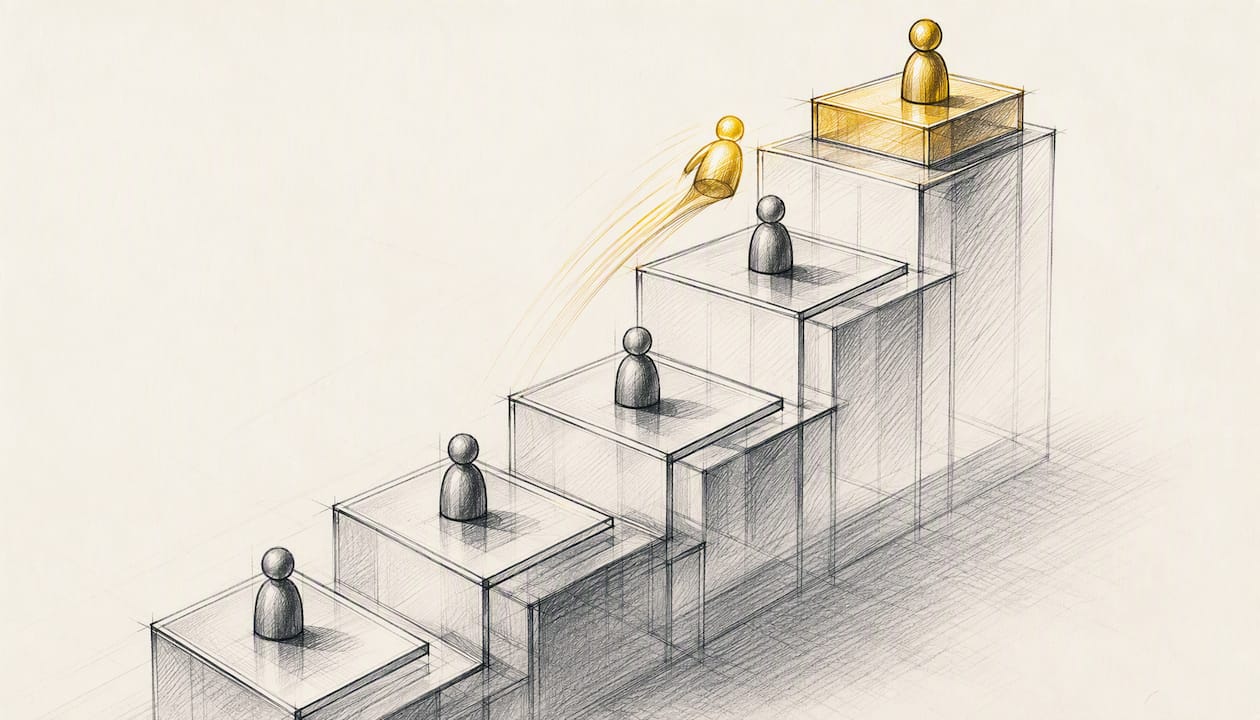
- Ranked ladders: ongoing seasons track a rating (often ELO-style) so players climb or drop based on match outcomes rather than a single game.
The skill emphasis changes with the format. A 1v1 blitz mode punishes hesitation. Broader arenas can let a slower but more accurate player still place well if enough others miss the same question. Question cadence matters too: a five-second timer forces snap judgment, while a fifteen-second window lets strategy and partial knowledge factor in.
Category depth changes the matchmaking experience as well. A platform with narrow, curated pools (say, exclusively movie trivia) tends to match players of genuinely similar knowledge, since everyone is drawing from the same well. Broad general-knowledge pools can feel less fair, because one player's strength in sports might face off against another's strength in history with no real overlap.
Must-have features for competitive play
Not every trivia app that calls itself competitive actually delivers a fair fight. Before committing to one, check for these features.
- Real-time matchmaking with low latency. A half-second delay in a speed-based game can decide the outcome before you've even read the question.
- Cross-platform play. If your group mixes iPhones, Android phones, and browsers, the game needs to bridge all three or half your friends get left out.
- Transparent ranking and scoring. Look for visible leaderboards, defined seasons, and clear tie-break rules, not a mysterious point total that never explains itself.
- Large, regularly updated question pools with category filters. A shallow pool gets memorized fast, and repeat questions kill the competitive edge within a few weeks.
- Anti-cheat and social tools. Private match creation, friends lists, and some form of answer review after each round all signal a platform built for serious repeat play.
Pro Tip: Run a quick test match before judging a platform. If you notice lag between tapping an answer and seeing the result, that latency will only get more frustrating as your skill improves and margins get tighter.
Platforms that publish clear matchmaking and ranking mechanics tend to hold onto competitive players longer, since a visible ladder gives people a reason to keep coming back.
How to choose the right competitive trivia game for your group or goals
Start with what you're actually trying to get out of it. A casual family game night has a different checklist than a group chasing leaderboard rank.
- Confirm the match format fits your group size: 1v1 blitz for head-to-head rivalries, team brackets for a full watch party, ranked ladders for solo climbers.
- Check topic coverage against your group's interests. A general-knowledge app is a poor fit for a group of hardcore anime fans who want deep-cut questions.
- Verify device compatibility across everyone's phones and browsers before you commit an evening to it.
- Look for a real ranking system, not just a raw point counter with no season structure.
- Gauge community size. A tiny player base means longer matchmaking waits and staler opponents.
- Review privacy and match settings, including whether you can lock a match to friends only.
Test a platform with a few pointed questions: How fast do matches actually start? Are results ranked, or just scored? Can you set up a private tournament for a group of six?
Red flags to walk away from: question pools so small you start recognizing repeats within a session, no visible ranking of any kind, matchmaking that takes minutes instead of seconds, or no way to review what you missed after the round ends.
How to get better fast: competitive play strategies and practice routines
Improvement in trivia is mostly about training your recall speed, not memorizing more facts. A few habits make a measurable difference within a couple of weeks.
- Run timed drills. Pick one category (say, 90s movies) and answer as many practice questions as possible in five minutes. Speed under pressure is a trainable skill, not a fixed trait.
- Read the stem, not the full question. In fast formats, the first few words of a question often give away the category and sometimes the answer before you finish reading.
- Trade speed for accuracy strategically. In arena formats where correctness carries more weight than raw speed, slow down on categories you know less well instead of guessing fast and losing points.
- Use power-ups with intent, not panic. If a platform offers boosts (extra time, double points, skip), save them for rounds in your weak categories rather than burning them early.
- Review every missed question. The fastest way to close knowledge gaps is analyzing exactly what tripped you up, not just replaying the same categories blind.
Pro Tip: Join daily events or ranked ladders instead of only casual matches. Ranked play forces you to perform under real stakes, which builds the reflexes that casual games never quite demand.
Publisher proof: why Flicksy fits competitive movie/TV/anime trivia players
This guide comes from an entertainment-focused editorial lens, built on close familiarity with how movie, TV, and anime fandoms actually argue trivia (and how competitive that gets). This platform's design lines up with the checklist above in a few concrete ways:
- Couch Party covers local multiplayer for group settings, where a single device passes between friends.
- Solo Arena gives players an endless practice mode for building recall without needing a live opponent.
- Leaderboards give players a visible reason to return daily instead of playing once and forgetting the app exists.
Topic and category variety across trivia games
Broad appeal in trivia usually comes from category range: movies, TV, science, sports, and pop culture each pull a different crowd, and the best competitive platforms let you filter rather than forcing a random mix. General-knowledge apps spread thin across all of these, which can leave genre fans stuck fielding sports questions they never wanted.
Category depth matters more than category count. A platform boasting twenty categories but only fifty questions each will run dry fast for a regular player. One with fewer categories but thousands of questions in each holds up over months of ranked play.
For entertainment-focused players specifically, narrow and deep beats broad and shallow almost every time. A movie fan wants decades of trivia, franchise-specific deep cuts, and enough anime and TV crossover content to keep matches fresh. Flicksy's entire structure leans into that specialization instead of trying to be a general-knowledge app with entertainment bolted on. If your trivia interests center on film, television, and anime rather than a mixed bag of sports and science, a platform built around that focus will simply have more relevant questions waiting for you than a generalist app ever will.
Device accessibility: browser, mobile app, and cross-play
Accessibility decides whether your friend group can actually play together. A trivia game locked to one operating system splits your group before the first question even loads.
Three access points matter most today: a browser version for quick, no-download play, a native mobile app for regular players who want push notifications and offline practice modes, and genuine cross-play so an iPhone user and an Android user can face off in the same match without either one getting excluded.
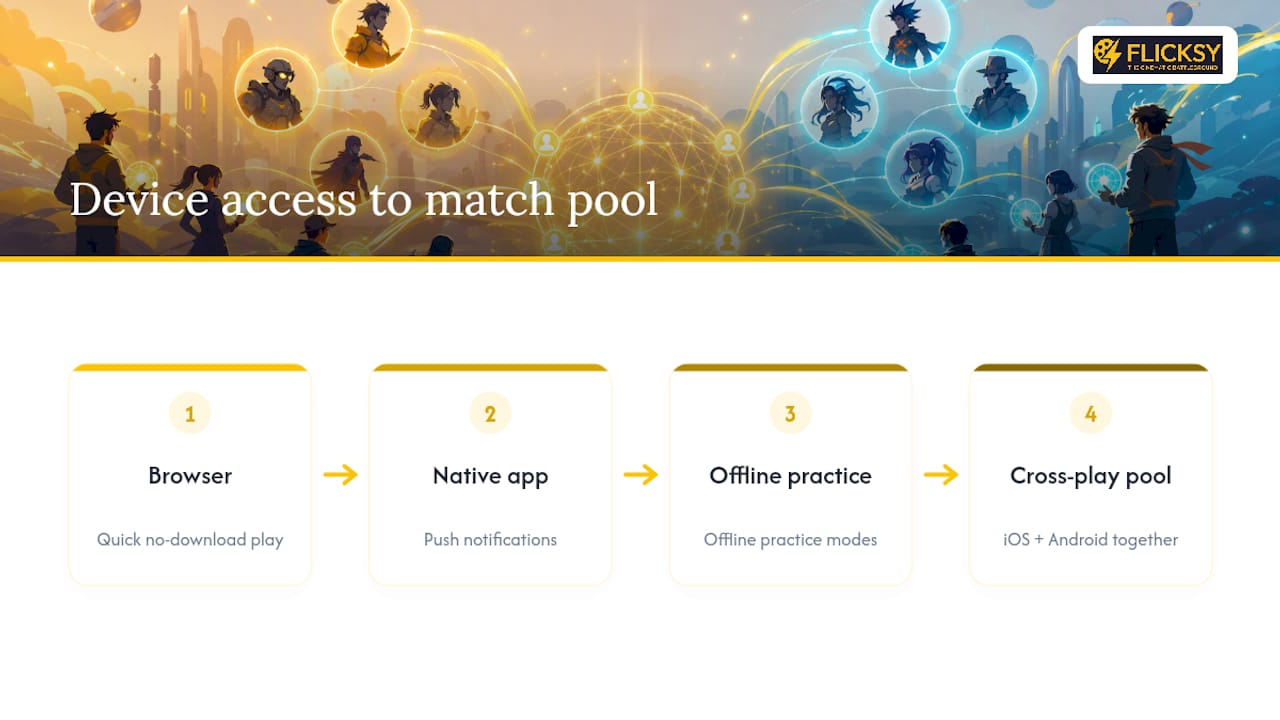
Cross-play is the piece that gets overlooked most often. Plenty of trivia apps technically exist on both iOS and Android but run separate matchmaking pools, meaning your friend on the other platform never actually shows up as an opponent. Before committing to a competitive trivia app for a group, confirm that matches pool players across devices rather than just existing on multiple app stores in name only.
Mobile-first design also affects match pacing. Apps built primarily for phones tend to favor shorter question sets and quicker rounds, since players are more likely to squeeze in a match during a commute or a break than sit down for a 45-minute session. If your group plays mostly on phones, prioritize a platform that treats mobile as the primary experience rather than a stripped-down afterthought of a desktop product.
Prizing and rewards: points, badges, and real prizes
Most competitive trivia games run on a layered reward system, and understanding the layers helps you judge whether a platform will keep you motivated past the first week.
The base layer is points: raw scoring tied to correct answers and speed, usually visible immediately after each question. Above that sits a badge or achievement layer, which recognizes streaks, category mastery, or milestones (like a hundred matches played) rather than single-game performance. The top layer, where it exists, is real-world prizing: cash, gift cards, or merchandise tied to seasonal leaderboard placement or tournament wins.
Daily rewards deserve separate mention, since they're one of the more effective retention tools in the category. A game that hands out a small bonus (extra lives, a cosmetic item, bonus points) simply for logging in and playing a match each day builds a habit loop that pure ranked play alone doesn't create. This platform leans on this model with daily curated quizzes and rewards designed to give players a reason to open the app even on days they're not chasing a season rank.
Real-money prizing sounds appealing but comes with a tradeoff worth knowing: platforms offering cash prizes often have stricter entry requirements, smaller player pools per bracket, and sometimes fees to enter tournaments. If your priority is fast, frequent, low-stakes competitive fun with friends, a points-and-badges system without a cash layer usually delivers a smoother experience than a prize-chasing structure built around a much smaller number of paid tournaments.
Where competitive trivia communities actually live
Competitive trivia has grown well beyond bar-night quiz formats into dedicated apps, social platforms, and live-streamed tournament communities. Discord servers built around specific trivia apps have become a common gathering point, where players organize private tournaments, share strategy for specific categories, and coordinate ranked play sessions with regular opponents.
Established gaming companies also offer a useful reference point for what a mature competitive platform looks like structurally. Companies like Electronic Arts publish clear terms, matchmaking policies, and security pages, which gives players a model for the kind of transparency worth expecting from any platform asking for an account and real-money purchases. Checking a trivia app's published terms and security practices before committing time (or money) to it is a habit worth carrying over from bigger gaming platforms.
Community size directly affects match quality in trivia specifically, more than in many other game genres. A small player base means longer waits for matchmaking and a higher chance you'll face the same three opponents repeatedly. Genre-focused platforms tend to build tighter, more engaged communities than sprawling general-knowledge apps, simply because everyone showing up already shares the same specific interest. For movie, TV, and anime fans, that means a smaller but more relevant community often beats a massive but generic one.
Why speed and fairness both matter in trivia
Competitive trivia gets interesting the moment speed and accuracy start pulling against each other. Anyone who's played a fast pop-culture quiz knows the specific tension: you recognize the answer, but do you trust your gut in two seconds or take an extra beat to be sure? That tension is the entire appeal, and it's why a well-designed ranking system matters more than people give it credit for. Rank isn't just a number. It's the thing that makes a five-second question feel like it's actually worth something.
What gets overlooked in most trivia app reviews is how much category depth affects fairness. A shallow general-knowledge pool rewards whoever happens to get questions from their strong subject that day, which has nothing to do with skill. Curated, genre-specific pools remove that lottery effect for fans who've actually built real expertise in movies, TV, or anime. If you want to test that difference yourself, try a short ranked match and pay attention to how the pacing and question quality feel compared to a general trivia app you've used before.
— Aakash
Try Flicksy for movie, TV, and anime trivia that actually moves fast
If the format checklist above is what you're shopping for, this platform covers it directly: Blitz PvP for ranked 1v1 speed matches, Couch Party for local group nights, and Solo Arena when you want to practice without a live opponent. First matches typically start in seconds, and the question pools stay focused on film, television, and anime instead of diluting into generic trivia that doesn't reward genre knowledge.
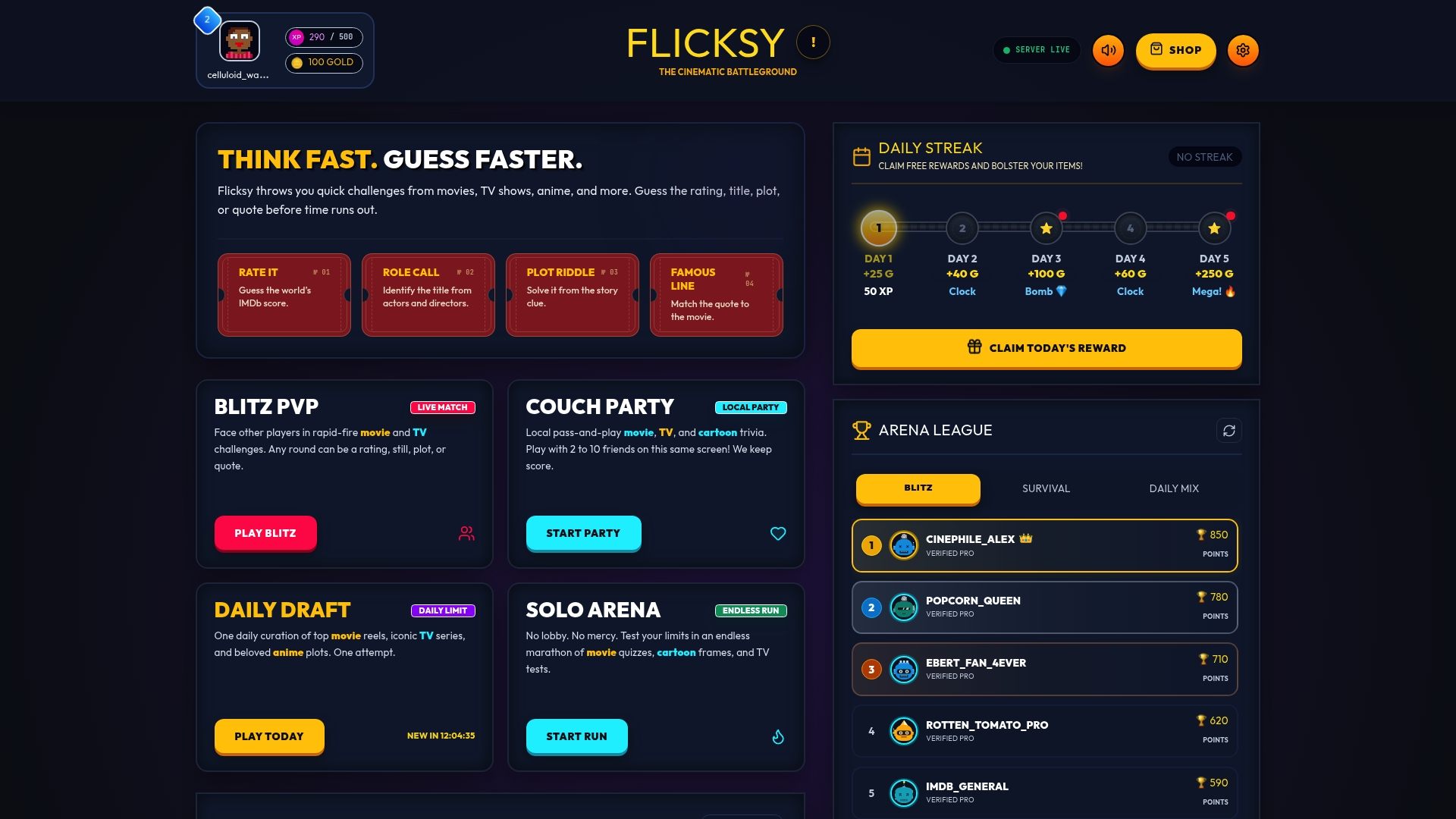
New players usually notice the pacing first: rounds move fast, scoring reflects both speed and accuracy, and daily curated quizzes give you a reason to check back even between ranked sessions. Leaderboards track where you stand against the wider community, so progress is visible from the first few matches rather than buried in a stats page nobody checks.
Head to the Flicksy landing page and jump into a Blitz PvP 1v1 match to see how the ranking and pacing feel against a live opponent.
Sources and further reading
Product details referenced in this guide come from the Flicksy landing page and its Blitz PvP breakdown. Platform trust-signal examples reference EA's published user agreement.
FAQ
What are some competitive quiz games?
Competitive quiz games include real-time 1v1 formats, timed arenas with multiple players, and ranked ladder systems that track ongoing performance. Flicksy's Blitz PvP mode is one example, built specifically for fast head-to-head movie, TV, and anime matches.
What are the top trivia games worth trying?
The strongest options combine real-time matchmaking, transparent ranking, and deep category pools rather than shallow general-knowledge question sets. For entertainment fans specifically, genre-focused platforms like Flicksy tend to outperform generalist trivia apps on question relevance and fairness.
What makes a trivia game genuinely fun and competitive at the same time?
The best mix comes from fast-paced formats with clear stakes, like ranked 1v1 matches or timed arenas, paired with categories players actually care about. Humor and fun often come from the social layer, private matches with friends, trash talk, and shared categories, rather than the questions alone.
Is there such a thing as competitive trivia?
Yes. Competitive trivia exists across ranked ladders, live tournaments, and real-time PvP formats where scoring, speed, and rank determine outcomes rather than casual play. Platforms with visible leaderboards and season structures, including Flicksy's ranked Blitz PvP, are built specifically around that competitive structure.
How do I know if a trivia app has fair matchmaking?
Check whether the platform publishes ranking criteria and pairs players of similar skill level rather than random assignment. Long wait times or repeated matches against the same few opponents usually signal a small player base rather than a matchmaking problem itself.