

The quickest route into a 1v1 trivia match is real-time matchmaking. Tap it and you're facing an opponent in seconds. If you'd rather play someone specific, an invite link gets you there almost as fast, and same-device pass-and-play needs zero setup at all. For short, competitive rounds, look for a rapid-fire timed mode. Flicksy's Blitz PvP is built exactly for that.
TL;DR:
- Real-time matchmaking offers instant play against strangers, while private invites and pass-and-play cater to specific players or local groups, with slight differences in setup time.
- Speed of gameplay depends on chosen mode, with instant match being fastest and asynchronous duels ideal for busy schedules and time zone differences.
- Fair play relies on accurate question pools, transparent sourcing, and quick response times, making app choice critical for competitive integrity.
- Strategy focuses on answering questions efficiently by eliminating obviously wrong options and practicing game categories to improve rapid recognition.
- Connection stability and question variety are common issues, so choosing platforms with strong infrastructure and large, refreshed question databases is essential.
Table of Contents
- Where to play 1v1 trivia online: modes and quick setup
- How to run a local 1v1 match (same-device and party setups)
- How scoring, timing, and fairness usually work in 1v1 trivia
- Practical strategies to win 1v1 trivia matches
- How to pick the right 1v1 trivia app or mode
- Tips for customizing categories and difficulty in 1v1 games
- Common pitfalls and troubleshooting in 1v1 trivia matches
- Publisher perspective: how Flicksy approaches fast 1v1 trivia
- Try Flicksy: rapid-fire 1v1 trivia, no pay-to-win
- Sources
Where to play 1v1 trivia online: modes and quick setup
Speed depends entirely on which mode you pick, and the three main routes solve different problems.
Real-time matchmaking is fastest when you just want a game, now, against a stranger of similar skill. You hit "play," get paired, and you're answering questions within moments. There's no waiting on a friend to be free and no coordination required. This is the default choice for anyone who wants a trivia competition on demand rather than a scheduled event.
Private invites work better when you want to settle a score with someone specific. Most platforms generate a friend code or shareable link. Send it, they tap it, you're both in the same lobby. It's slightly slower than instant matchmaking because you're waiting on the other person, but it guarantees you're playing someone you actually know.
Turn-based or asynchronous duels solve a different problem: time zones and busy schedules. Each player answers on their own clock, and results reveal once both sides finish. Services like FunTrivia's Duel format use this model, matching players by topic and difficulty, though some cap how many free duels you get per day.
Browser instant-play skips the download entirely, which is handy for a quick match on a shared computer. Native apps generally load faster on repeat visits and handle notifications better for ongoing rivalries.
Before you start, you need:
- A charged device with a stable connection (Wi-Fi or solid cellular)
- Headphones or speaker access if the mode uses audio cues
- A few minutes of uninterrupted attention, since rapid-fire rounds move fast
How to run a local 1v1 match (same-device and party setups)
Local play is the simplest setup in trivia gaming, and it works even with no internet at all in most cases.
- Set pass-and-play rules first. Agree on a timer per question (5 to 10 seconds is typical for rapid-fire) and decide whether the screen gets covered between turns to prevent peeking.
- Pair two devices if you want simultaneous play. Many apps offer a quick local pairing code so both players answer at once instead of trading the phone back and forth.
- Set party rules before round one. Best-of-seven or best-of-nine keeps a session tight. Rotate categories between rounds so no one dominates purely because they picked the topic.
- Decide your tiebreaker in advance. A sudden-death final question avoids arguments later.
- Check accessibility needs. Larger text settings and adjustable timer lengths matter if players have different reaction speeds or vision needs.
How scoring, timing, and fairness usually work in 1v1 trivia
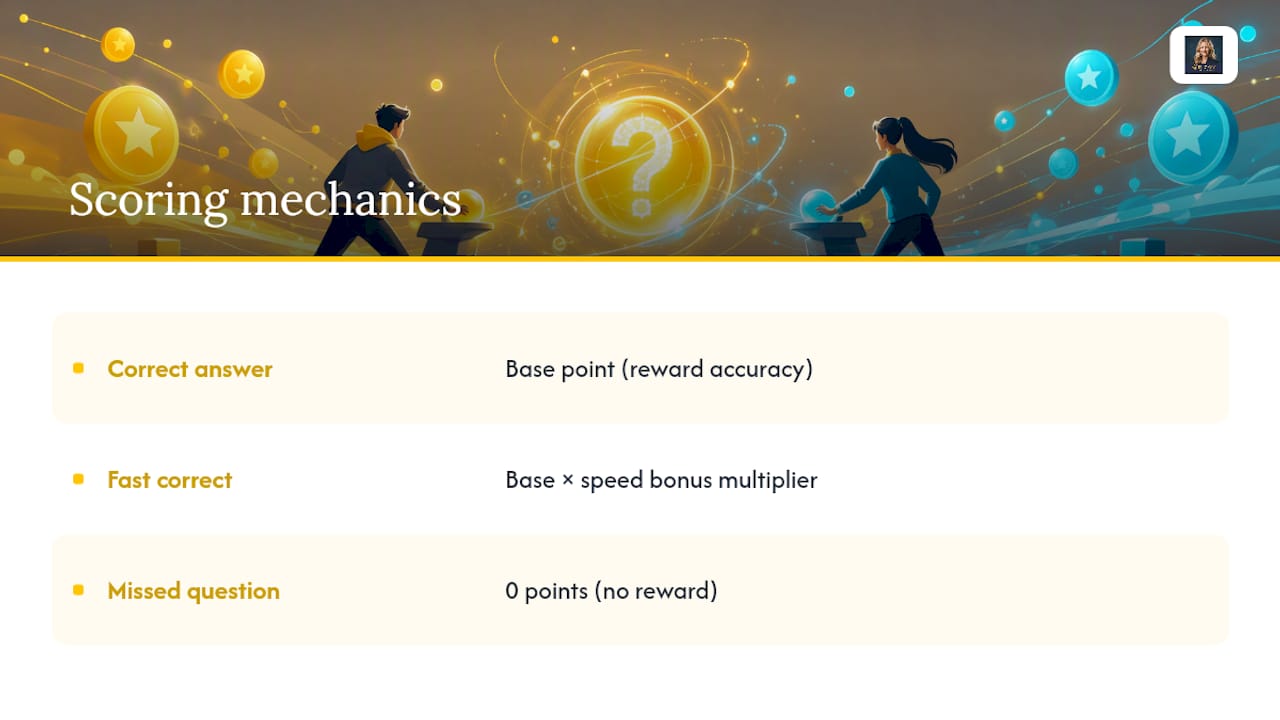
Most head-to-head trivia scoring blends accuracy with speed. A correct answer might earn a base point, sometimes with a bonus multiplier for answering fast. Miss it, and you get nothing. This rewards both knowledge and reflexes, which is the entire point of a rapid-fire format.
Round timing usually runs anywhere from a handful of rapid questions to longer best-of formats, allowing for quick or extended play sessions. Before trusting a platform with real competitive stakes, check for fair-play signals. Developers who build trustworthy 1v1 modes tend to state plainly that power-ups aren't purchasable in ways that affect answers, keeping outcomes tied to knowledge rather than spending. Also check that the question pool draws from a consistent source rather than shifting difficulty unfairly between players.
Before installing anything, glance at the app's privacy and terms to see what account data it collects.
Practical strategies to win 1v1 trivia matches
Winning a rapid-fire duel is less about trivia knowledge alone and more about how you process a question under a clock.
Structure your answer moment. Skim the full question first, don't jump on the first plausible option. Eliminate anything obviously wrong, then commit. That three-step habit (skim, eliminate, commit) shaves off the wasted seconds most players lose to second-guessing.
Prioritize categories where speed compounds. If you know movie release years cold, that's a category where recognition beats reasoning, so drill it until answers feel automatic. Weak categories cost you more time deliberating than they cost you in wrong answers, so triage them early rather than trying to master everything.
Play the match, not just the question. In a tight best-of-nine, a safe correct answer late in the match often beats a risky guess. But if you're down two points with one round left, an educated guess on partial recognition is worth the risk. Tiebreakers reward composure. Don't rush the final question just because the clock is loud.
Practice in short, timed drills. Ten minutes of rapid rounds daily builds pattern recognition faster than one long session weekly. Track your accuracy by category, not just your overall score, so you know exactly where to focus next.
Pro Tip: Keep a running note of the three categories that cost you the most matches. Most players discover it's not obscure trivia tripping them up. It's common categories they never bothered drilling.
How to pick the right 1v1 trivia app or mode
Not every trivia app is built for speed, and the wrong pick makes rapid-fire matches feel sluggish or unfair. Run through this checklist before committing to one platform:
- Latency: does the app feel instant, or is there a noticeable delay between your tap and the result?
- Question sourcing: is the pool curated and refreshed, or does it recycle the same 200 questions?
- Match length: can you choose a quick round, or are you locked into a long format every time?
- Friend invites: is challenging a specific person a two-tap process or a buried menu?
- Moderation and reporting: does the app expose a way to flag bad behavior or broken questions, in line with standard app and game rating guidance?
Red flags worth avoiding: any mode where spending money visibly changes match outcomes, and any app that won't tell you where its questions come from. If speed is your only priority, go instant match. If you're settling a rivalry, use a private invite. If it's game night with a group, party mode wins every time.
Tips for customizing categories and difficulty in 1v1 games
Locking a match to categories both players actually know levels the field and makes for a genuinely competitive round instead of a coin flip. Most trivia platforms let you filter by topic before matchmaking starts. If you're a movie buff going against a TV specialist, agree on a mixed category set rather than letting one person pick their strongest ground.
Difficulty settings matter just as much as category choice. A beginner-tier question pool moves faster because recognition beats deep recall, which suits true rapid-fire play. Harder tiers slow the pace naturally since players need an extra beat to think, so match the difficulty to how fast you actually want the round to move.
For repeat rivals, rotate categories match to match. Playing the same anime category five times in a row stops testing knowledge and starts testing memorization of that session's question set. If a platform offers themed packs, cycling through them keeps matches fresh and stops either player from gaming a narrow topic.
One underused trick: agree on a "wildcard" category neither of you has practiced. It strips away the home-field advantage entirely and turns the match into a pure speed and reasoning test, which is often the most fun version of a duel anyway.
Common pitfalls and troubleshooting in 1v1 trivia matches
Connection drops are the most common complaint in real-time duels, and they usually show up mid-question rather than at a convenient pause. If a match stalls, check your network first. Android's developer documentation notes that background network handling varies by app, which explains why some trivia apps reconnect gracefully and others just freeze.
Question repeats are the second big frustration, especially in apps with small pools. If you're seeing the same twenty questions across three matches, that's a sourcing problem, not bad luck. It's worth switching to a platform with a deeper, regularly refreshed catalog.
Synchronization issues, where one player's screen shows a different question or timer than the other's, usually trace back to a laggy connection rather than a broken app. If it happens repeatedly on the same platform, that's a signal worth reporting rather than tolerating. Most established apps include a reporting tool for exactly this.
Publisher perspective: how Flicksy approaches fast 1v1 trivia
Flicksy builds around this exact problem: Blitz PvP for real-time head-to-head speed, Couch Party for local group play, and Solo Arena for practice between matches. Every mode ties scoring to speed and accuracy, not spending, and leaderboards plus daily rewards give players a reason to come back beyond just one duel. On the editorial side, Flicksy's blog runs film coverage from Aakash, including a review of Christopher Nolan's The Odyssey and a take on Spider-Man: Brand New Day, the same subject-matter grounding that shapes the trivia content players actually get quizzed on.
— Aakash
Try Flicksy: rapid-fire 1v1 trivia, no pay-to-win
If you've read this far because you want speed over spectacle, Flicksy's Blitz PvP mode is built for exactly that: fast matchmaking, movie, TV, and anime questions curated for real fans, and a scoring system where knowing your stuff beats spending money. No purchasable shortcuts change who wins a round.
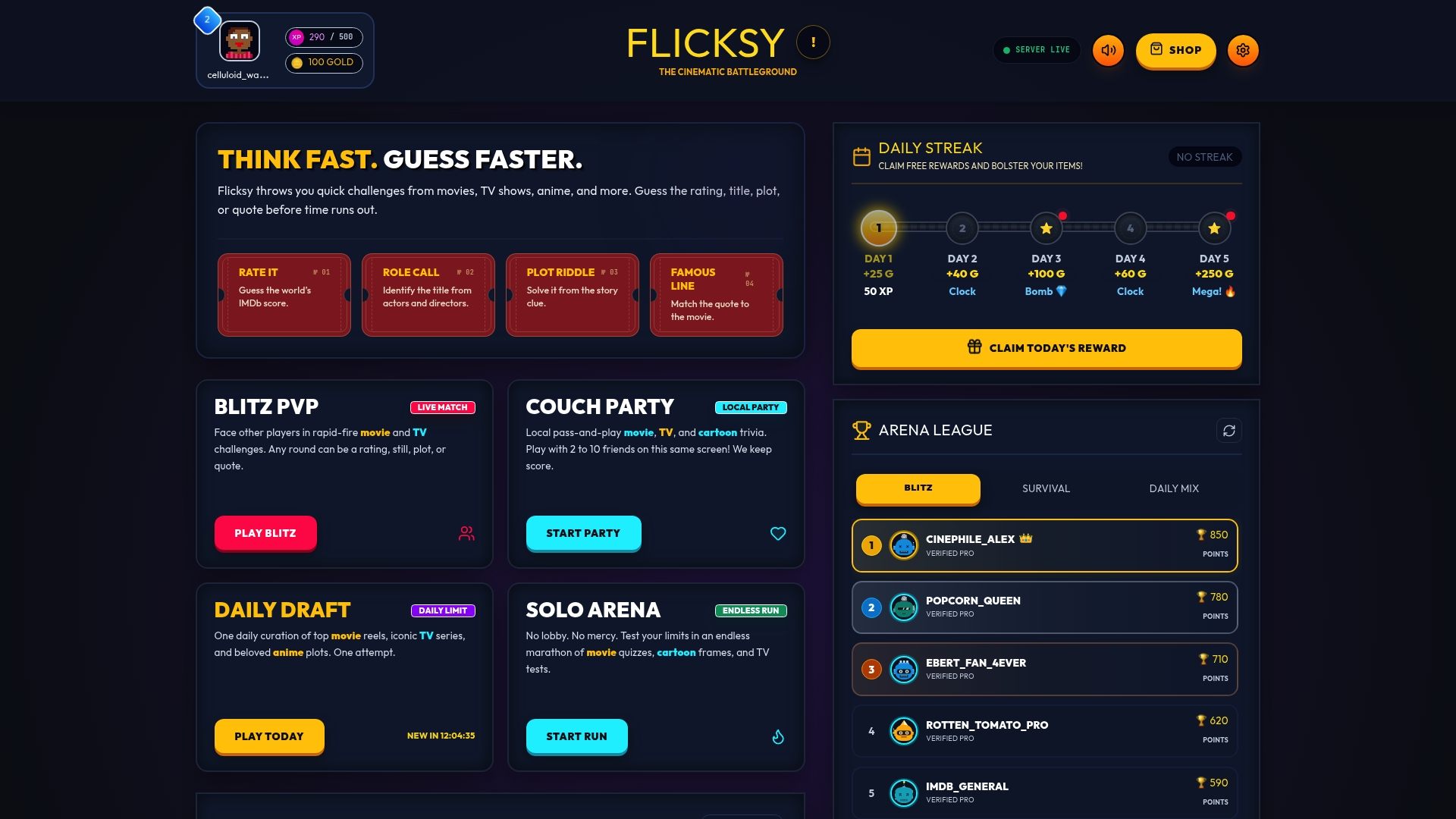
Getting started takes about as long as reading this sentence. Head to the Flicksy landing page, grab the app, and jump into your first Blitz PvP match today. Prefer a slower night in with friends? Switch straight into Couch Party from the same app, no separate download needed.
Sources
A few neutral references back the platform claims made throughout this guide. Google's privacy and terms policy explains how apps generally handle account data, worth a look before you grant any trivia app permissions. The Google Play support pages on app and game ratings cover how content gets rated and how to report a problematic app or player. For anyone curious about why certain trivia apps request network or notification access, Android's developer documentation lays out the standard permission behaviors behind those prompts.