

The strongest competitive setups use 1v1 Blitz, Jeopardy-style, and team relay formats, and every one of them needs three nonnegotiable rules: a synchronized timer, a published scoring formula, and a predetermined tie-breaker. This guide covers the formats, a copyable scoring model, a tech checklist for real-time fairness, round templates, and a sample question bank you can start using today.
TL;DR:
- Use single elimination for short 1v1 Blitz brackets, Swiss pairings for Jeopardy style events needing more games, and round robin for small team relay groups.
- Publish easy, medium, and hard point values before play; add capped speed bonuses for Blitz, but favor accuracy scoring in strategic Jeopardy style matches.
- Use a shared question source, server controlled timers, authoritative answer timestamps, reconnect grace periods, and rate limits; review generated questions before ranked play.
- Publish a tie breaker in advance: sudden death can resolve ties automatically by timestamp, while a best of three quiz suits high stakes finals.
- Write questions with one defensible answer, specify the adaptation or season, flag spoilers, and account for regional title differences when relevant.
Table of Contents
- 1. Which PvP formats work best for anime trivia?
- 2. Scoring tiers, difficulty multipliers, and timing rules that keep matches fair
- 3. Technical checklist for fair real-time PvP matches
- 4. Match templates: 1v1 Blitz, Jeopardy-style, and team relay
- 5. Host rules, referee guidelines, and scoring variations
- 6. Building a balanced anime trivia question bank
- 7. Tie-breakers and resolving scoring disputes fast
- 8. How daily rewards and leaderboards keep players coming back
- 9. Community features that support competitive anime trivia players
- 10. Why synchronized delivery makes PvP trivia feel genuinely fair
- Ready to run or join PvP anime trivia tonight
- FAQ
- Sources
1. Which PvP formats work best for anime trivia?
Picking the right format depends on how many players you have and how much time you want each match to take. These three cover almost every competitive scenario anime fans run into.
- 1v1 Blitz: short, rapid-fire head-to-head rounds with a small set of questions, built for ladders and quick elimination brackets.
- Jeopardy-style: categories with escalating clue values, better suited to slower, strategic play where players choose their risk level.
- Team relay: teammates alternate answering in sequence, with points pooled, which works well for larger groups that want cooperation alongside competition.
1v1 Blitz rewards speed and recall, so it fits best in ladder play or knockout brackets where match length needs to stay predictable. A full round can be kept short, which helps brackets move without long waits between matches. Jeopardy-style trades speed for strategy. Letting players choose clue value based on confidence adds a layer of decision-making that pure speed formats skip, and it tends to produce more memorable upsets since a player can bet big on a category they know cold.
Team relay sits between party fun and real competition. It fits groups that want the social energy of a party game with actual stakes attached, since points still accumulate toward a team score and a winner gets declared. For hosts running a mix of casual and competitive players, team relay format often bridges the gap better than a pure 1v1 ladder, since weaker players can still contribute without carrying full responsibility for the result.
Tournament structure should match the format: single-elimination pairs naturally with 1v1 Blitz because matches are short and brackets resolve fast. Swiss-style pairing fits Jeopardy-style events where you want more total games per player without a full round-robin. Round-robin works for team relay when the group is small enough to let everyone play everyone else in one session.
2. Scoring tiers, difficulty multipliers, and timing rules that keep matches fair
A fair PvP match needs scoring rules that reward both speed and accuracy, published before the first question drops so nobody can argue the math afterward.
A simple tiered system works for most formats:
- Easy questions: worth a lower point value, answered correctly within the time window.
- Normal questions: worth a middle point value, with the same timing rule.
- Hard questions: worth a higher point value, with the same timing rule.
Speed bonuses layer on top of the base score. A common approach awards a speed bonus based on the time remaining when the answer is submitted, capped so speed never fully outweighs correctness. Time-decay works the opposite way: full points for the first third of the time window, then a gradual point reduction as the clock runs out. Favor flat accuracy scoring over heavy speed bonuses in formats like Jeopardy-style where strategic thought matters more than reflexes, and lean into speed bonuses for 1v1 Blitz where reaction time is part of the skill being tested.
Published scoring formulas reduce disputes because every player can verify their own result against the same math everyone else used. The QuizRush real-time tournament research notes that transparent, consistent scoring directly supports perceived fairness in competitive quiz formats, since players need confidence that identical answers under identical conditions produce identical scores.
Here's a worked example: say a player answers easy, normal, and hard questions correctly, with a flat speed bonus for each fast answer. Add the base points and bonuses to get the round total.
3. Technical checklist for fair real-time PvP matches
Running trivia as a real head-to-head competition means the underlying tech has to be trustworthy, not just the question content. A handful of technical pieces separate a fair match from a disputed one.
- Shared question source: every player sees the identical prompt at the identical moment, with no version drift between clients.
- Synchronized countdown: a server-controlled timer, not a local device clock, so no player gets a timing advantage from lag or a fast phone.
- Authoritative answer timestamps: the server records when an answer arrived, not when the client claims it was submitted.
- Reconnect handling: a short grace window that lets a disconnected player rejoin without losing the round entirely.
- Anti-cheat controls: rate limits and submission validation that catch scripted or automated answer bursts.
- Human review path: a way to flag and correct a wrong answer key before it skews a tournament's standings.
The QuizRush research on real-time tournament quizzes lays out this same combination as the baseline for running a trustworthy competitive quiz, and it specifically flags that AI-generated questions need a review pass before ranked use, since a wrong answer key can invalidate a match even when it affects every competitor equally.
Server-authoritative scoring matters because it removes the client device as a source of truth. If each phone or browser calculated its own score locally, a modified client could simply report a better result. The OtakuVersus project demonstrates this architecture directly: centralized game state, synchronized timers, and WebSocket-based delivery that pushes questions and collects answers with minimal lag, keeping match rankings separate from casual solo scoreboards so competitive results stay clean.

Practical reconnect strategy usually looks like this: a short pre-match countdown that gives every device time to load the question, timestamped submissions that lock in the moment an answer arrives regardless of network speed, and a grace window of a few seconds that lets a dropped connection rejoin before forfeiting the question.
Pro Tip: Run a test match with a deliberately slow connection before your first tournament to confirm your reconnect window actually works under real lag, not just on a fast home network.
4. Match templates: 1v1 Blitz, Jeopardy-style, and team relay
These templates are ready to copy into your next event, whether you're running a single friendly match or a sixteen-player bracket.
- 1v1 Blitz template: players enter a lobby, a synchronized countdown starts the match, rapid-fire questions run back to back with a fixed time window each, scores tally immediately at the end, and a short post-match breakdown shows which questions decided the result.
- Jeopardy-style template: set up categories with escalating clue values, let the leading player pick the next category and value, give each clue a fixed response window, and allow either multiple-choice or typed-answer formats depending on your audience's preference.
- Team relay template: teammates alternate answering one question at a time in a fixed order, each correct answer adds to the shared team total, and a missed question passes the turn to the next teammate without penalty beyond the lost points.
- Sample bracket schedule: for a 1v1 Blitz bracket, plan short matches with a rest window between rounds. A Jeopardy-style Swiss event needs time for matches and scorekeeping between rounds.
For hosts building out a 1v1 ladder specifically, a dedicated walkthrough on Blitz-style competitive play covers tactics that pair well with this template, and a quick-start guide for starting a 1v1 match walks through the setup step by step.
5. Host rules, referee guidelines, and scoring variations
A short, clearly communicated rulebook prevents most disputes before they start. Share it with participants before the first match, not after a disagreement.
- Eligibility: define who can compete, whether accounts need to be a minimum age or verified in some way, and lock the roster before the bracket is drawn.
- Protests: give players a clear, time-limited window after a round ends to flag a disputed question or score.
- Enforcement: name one person or a small panel with final say on disputes, decided against the published rules rather than in the moment.
- Streak bonuses: extra points for consecutive correct answers reward consistency and work well in longer Jeopardy-style events.
- Difficulty multipliers: already covered in scoring, but worth restating in the rulebook so players know hard questions carry more weight.
- Penalties for wrong answers: a small point deduction for incorrect guesses discourages random guessing in formats where that's a problem, though it's usually unnecessary in fast Blitz formats where speed is already the limiting factor.
Scheduling tips matter as much as the rules themselves. Build in buffer time between rounds rather than assuming every match finishes exactly on time, and post the full schedule, scoring formula, and protest process somewhere every participant can see before the event starts. For party-style groups easing into something more competitive, a no-prep list of anime party games offers a gentler starting point before moving to full tournament rules.
6. Building a balanced anime trivia question bank
A good competitive question set mixes formats and difficulty levels deliberately, rather than pulling random trivia from memory.
Common question types include screenshot identification (naming a character or location from a cropped image), direct quotes (identifying who said a specific line), character facts (birthdays, voice actors, relationships), and scene details (what happened immediately before or after a specific moment).
- Easy: main character names, widely known catchphrases, obvious plot points.
- Medium: supporting character details, specific episode events, less iconic quotes.
- Hard: minor character trivia, animation studio details, obscure filler-episode content.
Wording matters more than it seems. Avoid questions with more than one defensible correct answer, and be specific about which adaptation (manga, anime, a particular season) a question refers to when a story has diverged across versions. Flag spoiler-heavy questions clearly so players can opt into or avoid a category, and account for regional title differences when a show is known by different names in different markets. For anyone building out a quote-heavy category specifically, a guide to tactics for anime quotes quizzes covers common pitfalls in that question type.
Any auto-generated question set needs a human pass before it goes into ranked play, since an unreviewed wrong answer key can throw off scoring for an entire match even when every competitor is affected equally.
7. Tie-breakers and resolving scoring disputes fast
Ties happen often enough in close matches that a predetermined method matters more than any specific method you pick.
- Sudden-death question: one question, first correct answer wins, fastest and most dramatic option for live audiences.
- Fastest-response sudden-death: both players answer the same question, correct answer with the lower timestamp wins.
- Best-of-3 micro-quiz: three quick questions decide the tie, useful when a single question feels too random for a high-stakes final.
Automatic resolution works for most in-match ties using server timestamps. Reserve human review for disputes involving a flagged question or a technical glitch like a dropped connection. When a dispute comes up, log the issue immediately, freeze the leaderboard so standings don't shift mid-review, check the authoritative timestamps, and apply whatever rule was published beforehand rather than improvising a new one. A list of ready-to-use tie-breaker questions gives hosts a quick bank to pull from live.
8. How daily rewards and leaderboards keep players coming back
Competitive trivia holds attention best when there's a reason to come back the next day, not just a reason to finish tonight's match. Daily rewards give players a small, low-effort incentive to log in regularly, which matters because consistent play is what builds the skill and familiarity that makes PvP matches actually competitive rather than lopsided.
Leaderboards serve a different purpose: they turn individual performance into a visible, comparable record. A player who sees their rank climb after a strong week of matches gets a concrete signal that practice is paying off, and that signal tends to matter more than the points themselves. Separating competitive rankings from casual or solo scoreboards keeps that signal meaningful, since a mix of casual and ranked results would make the leaderboard a weaker measure of actual PvP skill.
For hosts running their own tournaments, the same logic applies at a smaller scale. A simple running leaderboard posted during a bracket, updated after each round, gives players a reason to care about every match, not just the final. Pairing that with even a small daily login incentive for returning players between tournament sessions helps keep a casual group engaged long enough to build a real competitive habit rather than a one-off event that nobody follows up on.
9. Community features that support competitive anime trivia players
Competitive trivia works better with a community around it than as a series of isolated matches. Players who recognize opponents from past rounds, track their own rank over time, and compare results with friends tend to stay engaged longer than players who only ever see a single match in isolation.
A persistent leaderboard that spans multiple sessions gives players something to work toward beyond any single tournament. Curated anime content that gets refreshed regularly keeps question pools from feeling stale after a few rounds, which matters for players who compete often enough to notice repeats. Daily rewards tied to login or match participation give casual players a reason to check in even on days they're not planning a full competitive session, which keeps the overall player pool larger and matches easier to find.
None of this replaces good tournament rules, but it does make the difference between a one-off event and a format players return to on their own.
10. Why synchronized delivery makes PvP trivia feel genuinely fair
Writing about competitive trivia modes keeps coming back to the same realization: the format matters less than the fairness underneath it. A brilliantly designed Jeopardy-style round falls apart when one player's timer runs behind another's, and no amount of clever question writing fixes that.
Synchronized delivery and a published scoring formula do more for player trust than any feature on top of them. Players forgive a hard question. They rarely forgive a result they can't verify. The research on real-time tournament quizzes backs this up directly: fairness isn't a nice-to-have layered onto good trivia, it's the foundation the competitive experience sits on.
If you're hosting your own events, track more than just who won. Leaderboard data and basic round-by-round analytics tell you where matches are getting decided, whether by knowledge, speed, or lucky timing, and that's worth paying attention to.
— Aakash
Ready to run or join PvP anime trivia tonight
Everything covered here, from synchronized rounds to published scoring and fair tie-breakers, maps directly onto Flicksy. Blitz PvP handles real-time matches like the ones this guide walks through. Couch Party brings local multiplayer fun, and Solo Arena gives you a place to sharpen recall between competitive sessions.
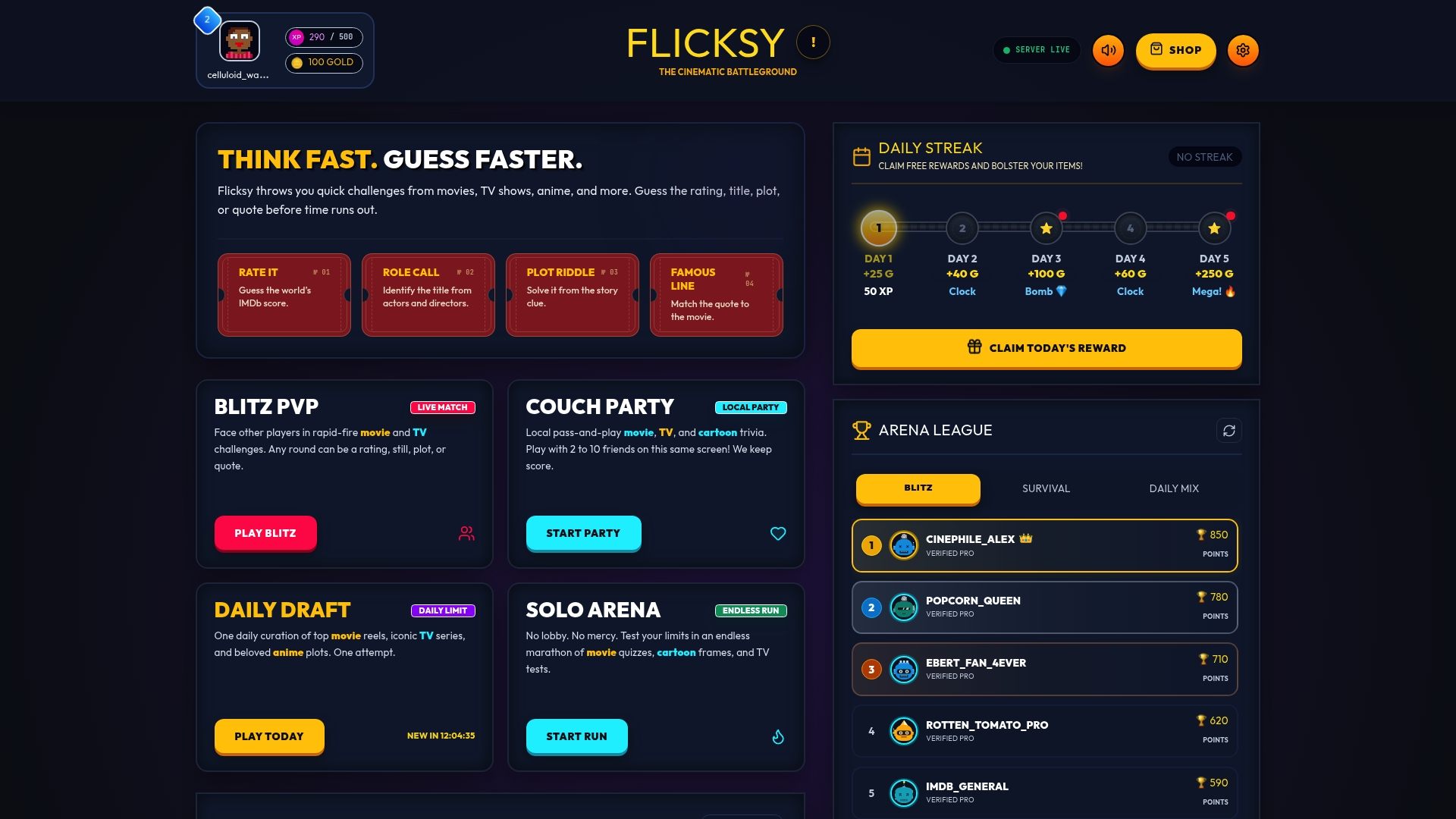
We offer curated anime content, leaderboards, and daily rewards that give you a reason to come back before your next tournament. If you're ready to put any of these formats into practice, start a match on Flicksy and see how it holds up against a real opponent.
FAQ
What is the best PvP format for a large anime trivia tournament?
Single-elimination 1v1 Blitz brackets can work well for large groups because short matches keep brackets moving without excessive downtime. Swiss-style pairing works well for Jeopardy-style events when you want more total games per player without a full round-robin.
How do you prevent cheating in real-time anime trivia matches?
Server-authoritative scoring, where the server records answer timestamps rather than trusting the client device, is the core defense, paired with rate limits that catch scripted answer submissions. The OtakuVersus implementation demonstrates this architecture using centralized game state and synchronized timers.
What's a fair tie-breaker for a close trivia match?
A sudden-death question, where the first correct answer wins, is the fastest and most common option for live events. A best-of-3 micro-quiz works better for high-stakes finals where a single question feels too random to decide the outcome.
How should I score easy versus hard trivia questions?
A common tiered approach assigns lower points to easy questions, middle points to medium, and higher points to hard ones, with an optional speed bonus layered on top for fast correct answers. Publishing this formula before the match starts is what keeps the scoring trustworthy to players.
Can I play anime PvP trivia without hosting my own tournament?
Yes, platforms built around real-time competitive trivia, including Flicksy's Blitz PvP mode, let you jump into a match without setting up brackets or scoring rules yourself. That's a faster route to a single competitive match than organizing a full event from scratch.