
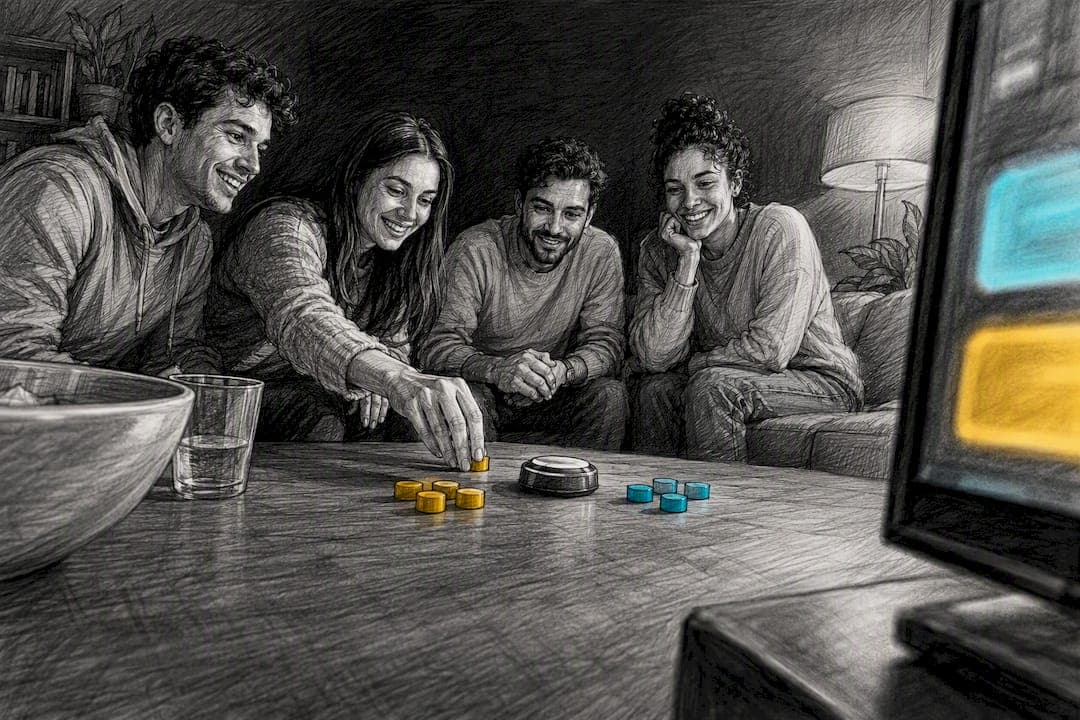
Watch party games for movie, TV, and anime fans are quick trivia formats, specifically Couch Party, Blitz PvP, and Solo Arena, that let you start playing in under two minutes. Pick Couch Party for a room full of friends, Blitz PvP for a head-to-head duel, or Solo Arena to warm up alone before the group arrives. There's no setup required beyond choosing a mode and a title everyone's watched.
TL;DR:
- Couch Party is ideal for groups of 3 to 8 players in a casual, shared-screen setting, focusing on fun rather than competition.
- Blitz PvP suits two players or rivals with a quick, accuracy-based duel, perfect for friends who enjoy fast-paced trash talk.
- Team Relay supports large groups of 7 or more by dividing them into teams and pooling points, suitable for bigger watch parties or office events.
- Difficulty levels should progress from easy to hard, with early rounds designed to engage casual players and maintain energy.
- Incorporating multimedia such as clips and images enhances engagement, but should be timed and limited to avoid disrupting the flow.
Table of Contents
- Which watch party games mode fits your group?
- Ready-to-run trivia rounds for movies, TV, and anime
- How do you set up watch party games without technical headaches?
- Team composition, scoring, and keeping everyone engaged
- What to do when the game glitches or the group gets disrupted
- Beyond movies, TV, and anime: customizing games for other themes
- Making multimedia part of the game, not just the backdrop
- What most watch-party guides get backward
- Run these formats tonight with Flicksy
- Sources
Which watch party games mode fits your group?
The right mode depends on two things: how many people showed up, and how competitive everyone's feeling. A trivia format built for two people falls flat with a room of ten, and a slow-paced group quiz kills the energy of a one-on-one rivalry.
Here's how the main formats break down by group size and mood:
- Couch Party (3 to 8 players): Local multiplayer where everyone answers from the same room, usually off one screen. Best for movie nights, family gatherings, and anyone who wants a shared, low-stakes vibe without splitting into teams.
- Blitz PvP (2 players, or paired rivals within a bigger group): A rapid-fire, real-time duel where speed and accuracy decide the winner. Best for friends who like keeping score and talking trash afterward.
- Solo Arena (1 player): An endless challenge mode for building knowledge or killing time before the group assembles. Best for warming up, practicing a niche category like anime opening themes, or just seeing how far your streak goes.
- Team Relay (7+ players): Split a big group into two or three teams that take turns answering, pooling points toward a group score. Best for larger watch parties, office hangouts, or anyone hosting a crowd too big for one shared screen.
A useful rule of thumb: if you can count the players on one hand, keep it individual (Blitz PvP or Couch Party). Once you're past six or seven, teams stop things from turning into a shouting match over who buzzed in first. Small groups skew casual and fast. Big groups need structure, which is exactly what Team Relay and a clear scoring system provide.
Ready-to-run trivia rounds for movies, TV, and anime
You don't need to build a quiz from scratch. Below are round templates you can run tonight, organized by format, with example prompts and suggested point values.
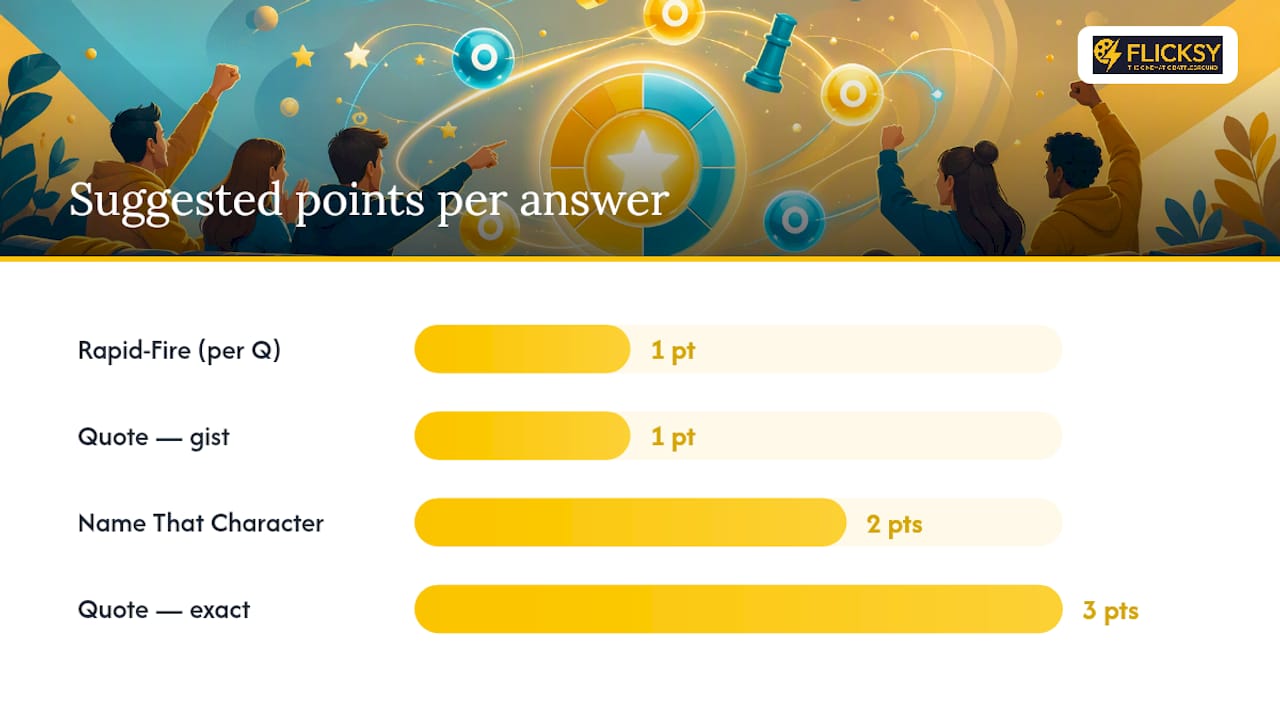
- Name That Character. Show a silhouette, a costume detail, or a single line of dialogue and have players shout out the character. Example: "This character says 'I am the one who knocks.'" (2 points, correct show gets a bonus point.)
- 10-Second Quote Completion. Read the first half of a famous line and give players ten seconds to finish it. Example: "Why so serious? [pause]" (3 points for the exact phrasing, 1 for the gist.)
- Rapid-Fire Trivia. Ten questions in 90 seconds, one point each, no discussion allowed. Great as an opening round because it's fast and forgiving.
- Freeze-Frame Stills. Pause a scene and ask players to name the episode, movie, or exact moment. Works well for shows with distinctive sets or recurring visual gags.
- Poster Pieces. Reveal a movie or anime poster in fragments, awarding more points for correct guesses made with less of the image shown.
- "Who Wore It" Rounds. Show a costume or prop and ask which character or actor it belongs to. Fun for franchises with multiple actors playing the same role over time.
- Soundtrack ID. Play 5 to 10 seconds of a score or theme song and award points for naming the show, movie, or specific scene.
- Theme-Tune Buzzer Rounds. For anime nights specifically, play opening or ending themes and have players buzz in with the series name. Bonus points for naming the studio or composer.
- Trope Spotting. Call out an anime trope (tsundere reveal, training arc, filler beach episode) and have players name a show that fits. Rewards deep-cut knowledge over surface recall.
- Creator and Studio Trivia. Ask which studio animated a series or which director helmed a film. This round tends to separate casual fans from the die-hards, so weight it heavier: 4 to 5 points per correct answer.
Audio and freeze-frame rounds work best in-room, where everyone hears and sees the same feed at once. Rapid-fire and quote-completion rounds travel better to remote sessions since they don't rely on synced audio.
Pro Tip: Save your hardest rounds, like studio trivia and trope spotting, for the back half of the session. Early wins keep casual players in the game, and that's exactly the difficulty curve trivia designers recommend for sustained engagement.
How do you set up watch party games without technical headaches?
The setup differs depending on whether everyone's in the same room or scattered across time zones, but the goal is identical: minimize friction so nobody's staring at a frozen screen instead of laughing at the game.
In-room essentials:
- A TV or laptop for the shared feed, plus a phone or tablet per player (or team) for a trivia app.
- Pen and paper as a backup scoring method if your app of choice hiccups.
- A shared streaming account so nobody's waiting on a buffering wheel mid-round.
Remote essentials:
- A video platform like Zoom or Discord for voice and video, since virtual trivia runs smoothest with one dedicated host managing questions and scores while everyone else focuses on answering.
- A rapid-fire trivia app that doesn't depend on screen sharing for every question, which cuts down on lag and spoiler risk.
- A shared timer, either built into the app or called out by the host, since a 60 to 90 second answer window keeps rounds moving without anyone stalling.
Keep total session length between 45 and 90 minutes, split into rounds of 5 to 12 minutes each. Build in a five-minute break around the halfway point. That's usually right when attention starts to drift, especially in remote sessions where screen fatigue sets in faster than it does in person.
Team composition, scoring, and keeping everyone engaged
Three-person teams tend to outperform pairs and solo players because they cover more trivia categories at once. Cleveland Clinic's reporting on trivia's cognitive and social benefits points to teams of at least three, mixed across ages and interests, as the sweet spot for both engagement and answer accuracy. One person who's obsessive about anime openings, one who remembers every quote from a 1990s sitcom, and one who just wants to have fun rounds out a team that can survive any category.
A simple scoring template that works across formats:
- 1 point per easy question, 2 for medium, 3 to 5 for hard or niche categories like studio trivia.
- A "steal" bonus: if one team misses, the next team to answer correctly earns double.
- Tiebreaker: a single sudden-death question, no team discussion allowed.
Difficulty laddering matters more than most hosts expect. Open with roughly 40 to 50% easy questions, move into 30 to 40% medium, and save the hardest 10 to 20% for last, a structure trivia design research links directly to sustained engagement. Casual players get early wins that keep them invested, and the format still rewards the fans who know the deep cuts.
Quick stat: correctly answering a trivia question triggers a small dopamine release, which is part of why players describe trivia nights as a genuine mood boost rather than just a way to kill time.
What to do when the game glitches or the group gets disrupted
Every watch party eventually hits a technical snag: someone's video freezes, a app crashes mid-round, or a latecomer shows up wanting to join a game already in progress. Handle these calmly and the session barely loses momentum.
For connectivity issues in remote play, designate a backup communication channel before you start, a group text thread works fine, so players can flag problems without derailing the round for everyone else. If a host's screen share drops, pause the timer rather than restarting the whole round; most groups lose more energy from a restarted question than from a 30-second pause.
For latecomers, don't stop the game to fold them in mid-round. Let them join at the next round break, and if scoring allows it, give them a small catch-up bonus rather than starting them at zero against a team that's five questions ahead.
Audio sync problems, especially in soundtrack ID or theme-tune rounds, usually come from one player's stream running a few seconds behind everyone else's. The fix is simple: designate one shared audio source, whether that's a single speaker in the room or one player's screen share in a remote session, and have everyone else mute their own playback. Never run an audio round off multiple unsynced streams.
If a rowdy player keeps shouting answers before their turn, a house rule fixes it faster than a lecture: a "false start" costs a point. Most groups adopt it after one enforcement and never need to mention it again.
Beyond movies, TV, and anime: customizing games for other themes
The same rapid-fire trivia structure that works for a movie night adapts easily to other interests, and the core mechanics (name-that-X, quote completion, rapid-fire rounds) transfer with minimal changes, as detailed in this list of party-games and low-pressure entertainment ideas.
For music-focused groups, swap soundtrack ID for artist and lyric rounds; the theme-tune buzzer format from anime night works almost identically for one-hit wonders or album cover reveals. Sports fans can run freeze-frame rounds on famous plays instead of movie scenes, with "who wore it" becoming "whose jersey number is this." Video game nights can lean on the same trope-spotting format anime fans use, just swapped for genre conventions like escort missions or boss-battle patterns.
The trick to adapting any format is keeping the difficulty ladder intact regardless of subject matter. Open with recognizable, mainstream questions (a chart-topping song, a famous game character) before working toward niche categories that reward true enthusiasts. That structure is what keeps a mixed-knowledge group engaged, not the specific topic on the card.
Themed nights also work well as a variation on a recurring watch party. If your group runs anime trivia most weeks, dedicate one session a month to a rotating theme, retro cartoons, video game soundtracks, or reality TV, so the format stays fresh without requiring anyone to build a new game from nothing.
Making multimedia part of the game, not just the backdrop
Clips, images, and sound bites turn a standard Q&A into something that actually feels like part of the watch party rather than an interruption of it. A well-placed 10-second clip does more work than a written question ever could, since it tests recall in the same format fans experience the content in the first place.
For image-based rounds, screenshots work better than posters when you want to test close attention rather than general familiarity; a blurry background detail from a well-known scene separates the casual viewer from the person who's rewatched the show four times. For sound, isolate a single line of dialogue or a few bars of score rather than an entire scene; shorter clips force faster recall and keep rounds from dragging.
Timing matters more than production value. Cue up your clips before the session starts rather than searching mid-round, since a 20-second search for the right timestamp kills momentum faster than almost anything else. If you're running a remote session, test your screen share and audio routing once before players join, not after the first round stalls out.
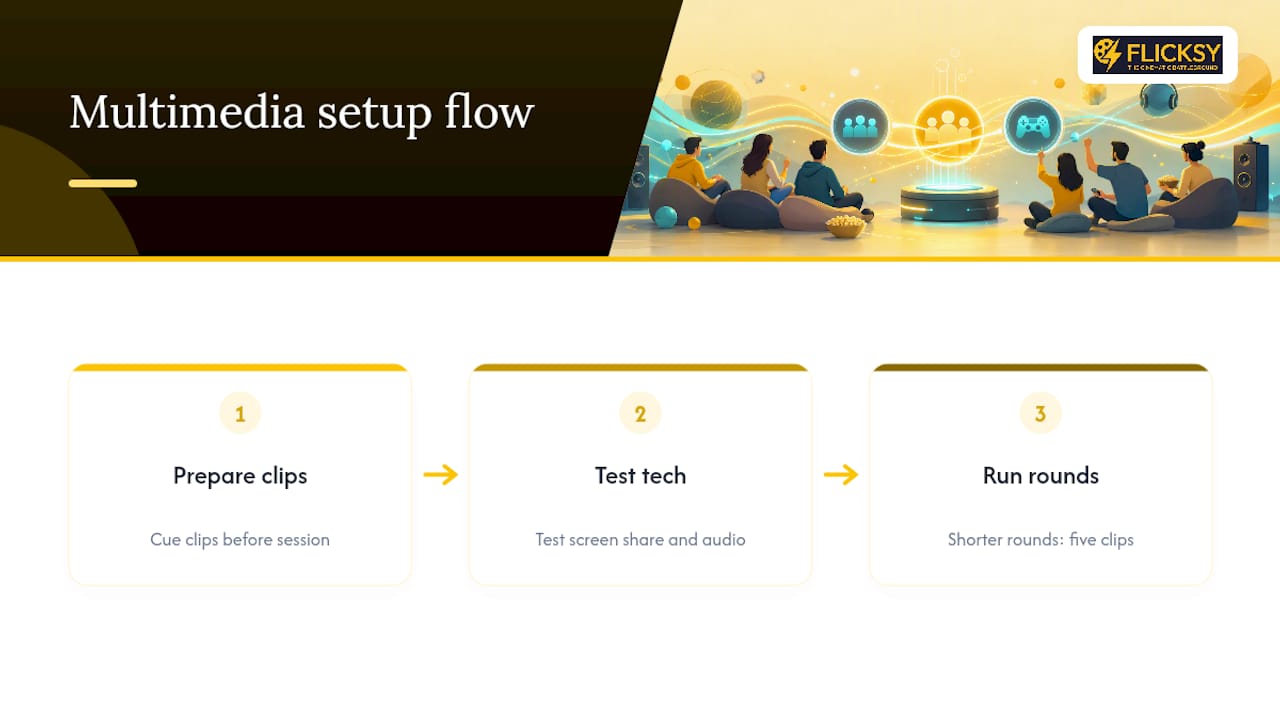
Keep multimedia rounds shorter than trivia-only rounds, five clips instead of ten questions, since visual and audio recall demands more attention per item than a straightforward question does.
What most watch-party guides get backward
Most advice on this topic treats trivia content and hosting logistics as separate problems. They're not. A perfectly written question about a studio's animation history falls apart if the host is fumbling with screen share settings while everyone waits, and the sharpest scoring system in the world won't save a session where the questions never escalate past trivia-night-easy.
The research backs a specific order of priorities: get the difficulty curve right first, because that's what determines whether casual players stick around for round three. Get team composition right second, since a group of three mixed-knowledge players beats five people who all know the same three shows. Only after those two things are solid does the format (Couch Party versus Blitz PvP versus a themed Team Relay) actually matter.
Where most hosts go wrong is treating format choice as the main decision. It's the smallest one. A poorly paced Blitz PvP duel and a poorly paced Couch Party round fail for the exact same reason: nobody thought about who's answering first, second, or fifth. Fix the sequencing before you worry about which mode looks more exciting on paper.
— Aakash
Run these formats tonight with Flicksy
Flicksy is built around exactly the formats covered above, so there's no gap between reading this guide and actually playing. Blitz PvP handles the rapid competitive rounds, real-time, head-to-head, decided by speed and accuracy. Couch Party covers local multiplayer for a room full of friends. Solo Arena gives you an endless challenge mode for practicing niche categories, anime opening themes, obscure directors, whatever your group's weak spot is, before the real session starts.
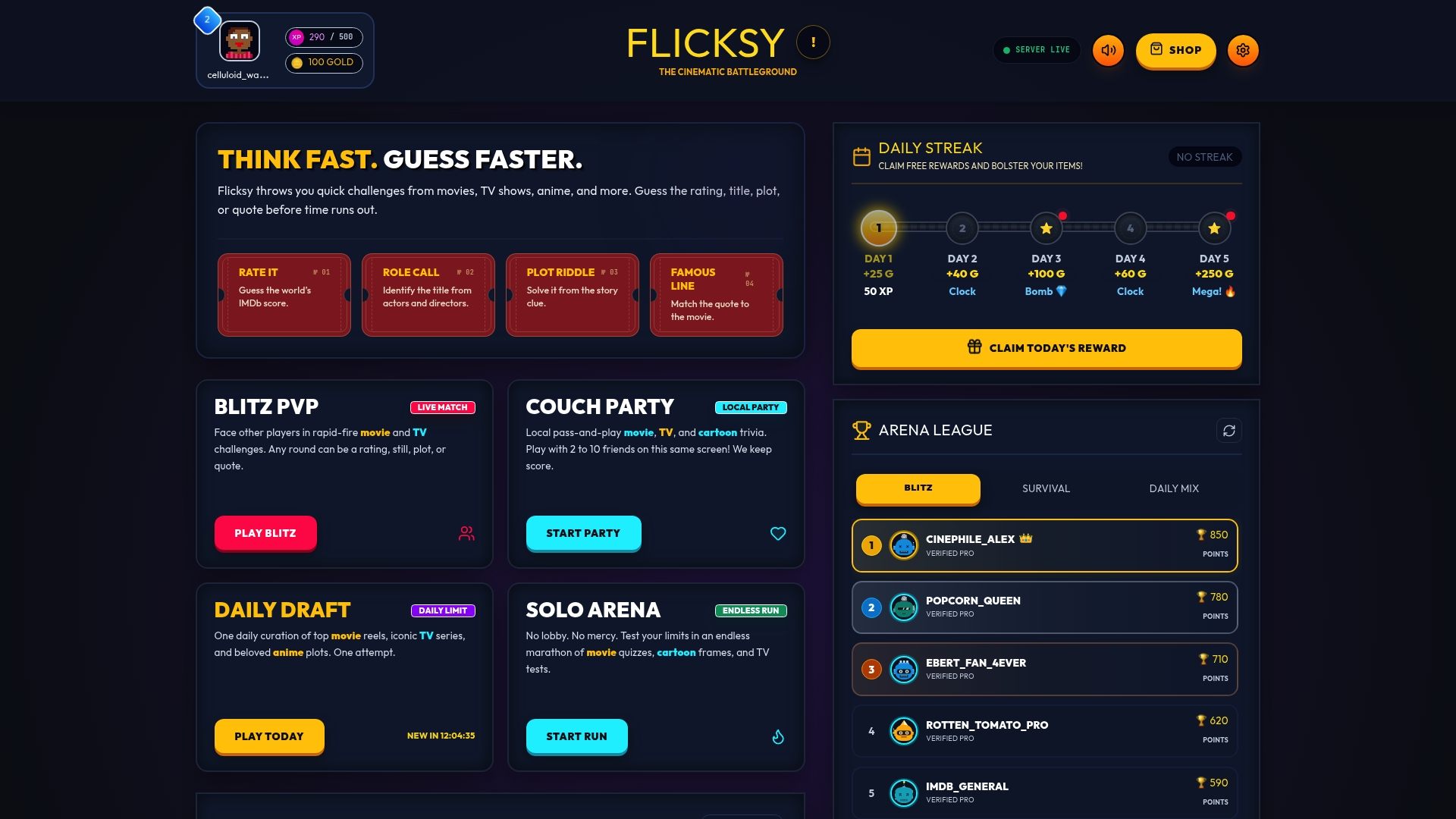
Starting a session takes three steps: launch the app, pick your mode based on who's in the room, and invite friends if you're running Couch Party or Blitz PvP. Daily curated quizzes and leaderboards mean there's always a fresh round waiting even outside a scheduled watch party. If you want to try the head-to-head format first, Blitz PvP gets you into a match in seconds. Otherwise, head to Flicksy and pick a mode to start playing tonight.
Sources
- Game On: How Trivia Can Improve Your Mood — Cleveland Clinic newsroom
- How to Host a Virtual Trivia Night: Complete Online Guide — CheapTrivia
- Healthwatch: How trivia can improve your mood — WSLS