
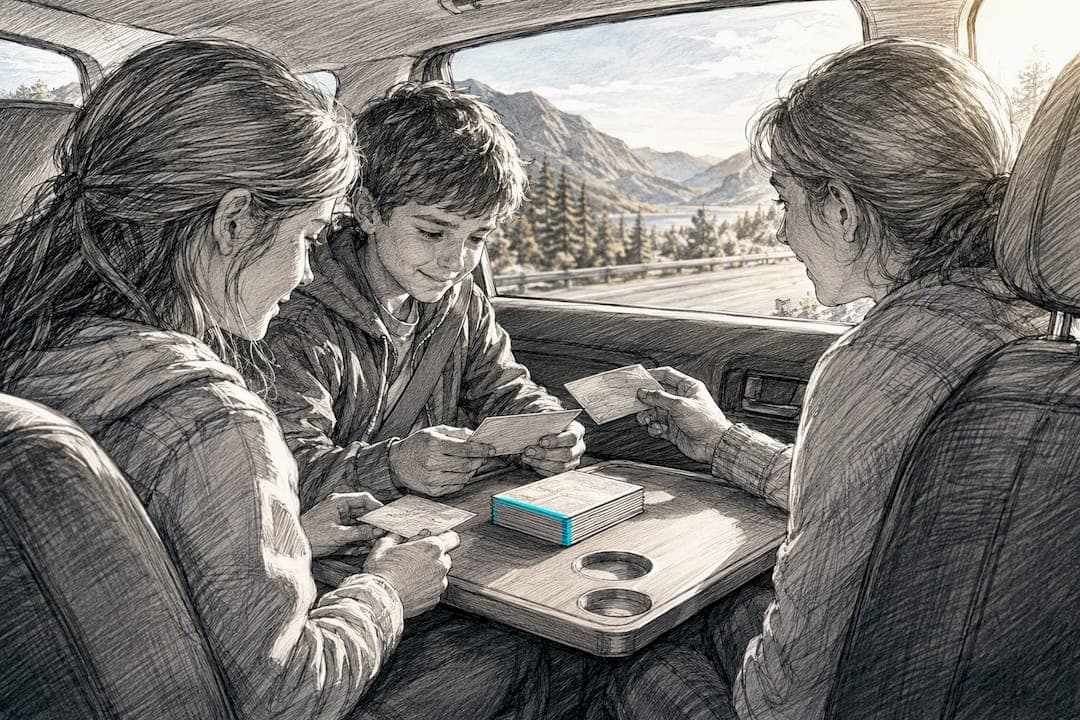
This page gives you six ready-to-play mini question packs, honest advice on which trivia format fits your trip, safety rules for playing while someone's driving, and a checklist to prep before you lose cell service. Grab the Roadtrip Trivia deck on Google Play if you want a phone-based option, or just scroll to the question sets below and start reading them out loud from the back seat.
TL;DR:
- Download offline trivia decks and test voice commands before the trip to ensure seamless gameplay and avoid signal disruptions during rural or mountainous drives.
- Use quick, themed rounds like rapid-fire, guessing, or visual clues to keep energy high and prevent boredom, especially with kids and long stretches.
- Pack printed cards, pens, and a backup note sheet to continue playing without electronic devices or signal issues, and consider splitting decks for faster turns.
- Keep driver safety a priority by relying on hands-free, voice-controlled apps that read questions aloud and support CarPlay or steering-wheel controls.
- Incorporate route-specific trivia about upcoming landmarks or regions to keep questions relevant and engaging, avoiding repetition on frequent routes.
Table of Contents
- Choosing the Right Road Trip Trivia Game Format
- Ready-to-Play Trivia Questions for Your Next Road Trip
- Building Your Own Printable Trivia Cards
- Rules and Scoring for Any Group Size
- Playing Trivia Safely While Someone's Driving
- Your Pre-Trip Trivia Packing Checklist
- Physical Challenges to Break Up Long Trivia Stretches
- Turning Your Route Into the Trivia Game Itself
- Why Quick, Themed Rounds Win on Long Drives
- Try Flicksy Before Your Next Long Drive
- Sources
Choosing the Right Road Trip Trivia Game Format
The format matters more than the questions. A carload of tired kids on a six-hour interstate haul needs something different than two adults on a scenic backroad with spotty signal.
Apps with offline decks solve the biggest problem with phone-based trivia: dead zones. Download your question packs before you leave home, because downloading curated decks in advance keeps games running when Wi-Fi and mobile service disappear, which happens constantly on rural highways and mountain passes.
Voice-first and hands-free apps are built for exactly one situation: the driver wants to play too. Some apps now support CarPlay and Siri launch so questions get read aloud without anyone touching a screen. Test the voice commands in your driveway first. A driver fumbling with an app mid-merge defeats the entire purpose.
Printable cards and physical decks never crash, never lose signal, and never need charging. Pack a stack as backup even if you're all in on an app.
Quick-play formats worth trying:
- Rapid-fire rounds (10 seconds per answer) work great for teens and adults who want competition.
- Team play splits the car into two sides, useful for four or more passengers.
- Guess-the-year rounds (movies, songs, historical events) suit adults and older kids better than young children.
- Untimed rounds with visual or written clue cards work best for kids under eight.
Ready-to-Play Trivia Questions for Your Next Road Trip
Long-form question lists are what most travelers actually search for, and research on how road trip trivia pages perform confirms that categorized mini-sets of six to eight questions per theme are the sweet spot for a quick round between rest stops. Read these straight off the page. Answers aren't included here on purpose. Save them to a separate note or print an answer sheet so the reader doesn't spoil the round.
- General knowledge: What's the tallest mountain in the world? What year did the Berlin Wall fall? What's the smallest country on Earth? How many bones are in the adult human body? What's the largest organ in the human body? What planet is known as the Red Planet?
- Pop culture and movies: What movie features the line "I'll be back"? Who played the title role in Barbie? What's the highest-grossing animated film of all time? Which streaming show is set in the fictional town of Hawkins, Indiana? Who directed Jaws? What sitcom is set in a coffee shop called Central Perk?
- Geography and landmarks: What's the longest river in the world? Which country has the most time zones? What U.S. state has the most coastline? Where is the Great Barrier Reef located? What's the capital of Australia (it's not Sydney)? Which desert is the largest in the world?
- Music: Which band recorded "Bohemian Rhapsody"? What decade did hip hop emerge as a genre? Who's known as the "King of Pop"? What instrument has 88 keys? Which artist has the best-selling album of all time? What's the best-selling single of all time?
- Kid-friendly: What sound does a cow make? How many legs does a spider have? What color do you get mixing blue and yellow? What's the fastest land animal? How many days are in a week? What do bees make?
- Road and state facts: Which U.S. state is nicknamed the "Sunshine State"? What's the speed limit on most rural interstates? Which state has no sales tax on most goods? What's the oldest active drive-in movie theater state? Which state has the most national parks?
Variation ideas: run a lightning round where wrong answers cost a point, double the value of questions in the final set, or rotate "question readers" every mini-set so no one dominates.
Building Your Own Printable Trivia Cards
A basic printable card needs three things: a category label, six to eight questions, and enough white space that someone can read it at a glance without squinting on a bumpy road. Export your deck as a PDF before you leave, since PDFs print reliably from almost any device and don't reformat oddly like some phone note exports do.
DIY deck ideas specific to your trip:
- Family trivia: "What was Grandpa's first car?" or "What year did Mom and Dad meet?"
- Route trivia: pull three facts about each town, park, or landmark you'll pass and turn them into questions.
- Local food trivia: what's the signature dish of the state you're driving through?
Packing checklist for a printable backup:
- Printed cards (laminated or in a sleeve if you expect drink spills)
- A pen for anyone keeping score
- A small container or envelope to keep cards from scattering across the back seat
- A phone note copy of the same questions as a backup to the backup
Pro Tip: Print two identical decks and split them between the front and back seats. It cuts down on the "pass it up here" shuffle and lets two people read questions at once for a faster pace.
Rules and Scoring for Any Group Size
Trivia doesn't need complicated rules to work, but a little structure keeps things fair when siblings start arguing over who answered first.
- Casual mode: One person reads a question, anyone can shout an answer, and the group moves on. No scorekeeping. This works best for mixed ages and short trips under two hours.
- Competitive mode: Award one point per correct answer, add a bonus point for three-in-a-row streaks, and rotate which passenger reads questions every round. Break ties with a sudden-death final question.
- Team mode: Split the car into two teams (front seat versus back seat is the obvious split), alternate who answers first each round, and total scores at a rest stop.
- Age adjustments: Give younger kids simpler categories or multiple-choice hints, add a handicap point for adults playing against kids, and keep rounds to five questions max for toddlers or anyone prone to motion sickness. Long rounds and constant screen glancing both make queasiness worse.
Playing Trivia Safely While Someone's Driving
The rule that matters most: the driver's job is driving, full stop. Trivia is a passenger activity unless the app is genuinely hands-free.
If a passenger is running the game, they should hold the phone, read questions aloud, and never ask the driver to look at a screen. If you want the driver playing too, the app needs real voice controls. Steering-wheel and voice-first Car Mode features let drivers hear questions and respond without looking away from the road, and that's the bar to test for before you rely on it.
Features worth checking before a long drive:
- Audio playback that reads questions aloud, not just text on screen
- CarPlay or steering-wheel control support
- Offline decks so a dead zone doesn't kill the round mid-question
- A distraction-free or "zen" visual mode, since reducing screen brightness and motion on the display can ease motion-sickness risk for passengers reading in a moving car
- Large-type and audio-only options for passengers who get carsick looking at small screens
One in-app-store listing puts it plainly: hands-free operation should be tested before the trip, not during it. Launch the app with Siri or your voice assistant while the car is still parked in your driveway. If it doesn't work smoothly there, it won't work better at 70 miles an hour.
Your Pre-Trip Trivia Packing Checklist
Do this the night before, not somewhere past the last cell tower.
- Download your app's question decks for offline play
- Save PDF copies of any printable card sets
- Charge a power bank, since trivia apps and GPS both drain batteries fast
- Pack pens and paper for scorekeeping
- Test voice commands (Siri, Google Assistant, CarPlay) if anyone plans to use hands-free mode
- Keep one printed answer sheet plus a phone note version as a backup to the backup
If every device dies and you have zero signal, fall back on verbal-only games: license-plate spotting, twenty questions, or reciting your printed deck from memory. Some travelers skip apps entirely and rely on printed lists as their primary format, specifically because paper never needs a signal.
Physical Challenges to Break Up Long Trivia Stretches
Trivia gets stale after 45 minutes straight, especially with younger kids. Mixing in movement or hands-on challenges resets attention without derailing the game entirely.
Try a "trivia plus task" round: answer a question correctly, then complete a quick physical challenge before the next one, like touching your nose with your eyes closed, doing a seated stretch, or holding a silly pose for ten seconds. For younger passengers, alternate trivia rounds with a scavenger hunt using a printed list of roadside items (a red barn, a water tower, an out-of-state license plate). Spotting something checks a box and gives kids a break from sitting still and thinking.
Another option: turn wrong answers into a small forfeit, like a goofy voice for the next round or a turn as designated snack-passer. Keep forfeits light and fun, never embarrassing, especially with mixed-age groups.
For teens and adults, a "trivia relay" works well at rest stops: everyone gets out, stretches, and answers one bonus question standing up before piling back in. It breaks the monotony of sitting for hours and gives the whole car a natural reset point.

The goal isn't constant stimulation. It's variety. A car full of people who've been doing the exact same activity for two hours gets cranky regardless of how good the questions are.
Turning Your Route Into the Trivia Game Itself
The best road trip trivia often isn't generic. It's built around the actual drive. Experienced road-trippers put together small themed decks tied to what's coming up on the map, whether that's national parks along the route, regional food, or state capitals, which makes the game feel connected to the trip instead of a random distraction.
Before you leave, glance at your route and pull three or four quick facts about each state or major town you'll pass through. Turn each fact into a question: "What's this state's official bird?" or "What year did this city get founded?" You don't need deep research, just enough to spark a guess and a follow-up conversation.
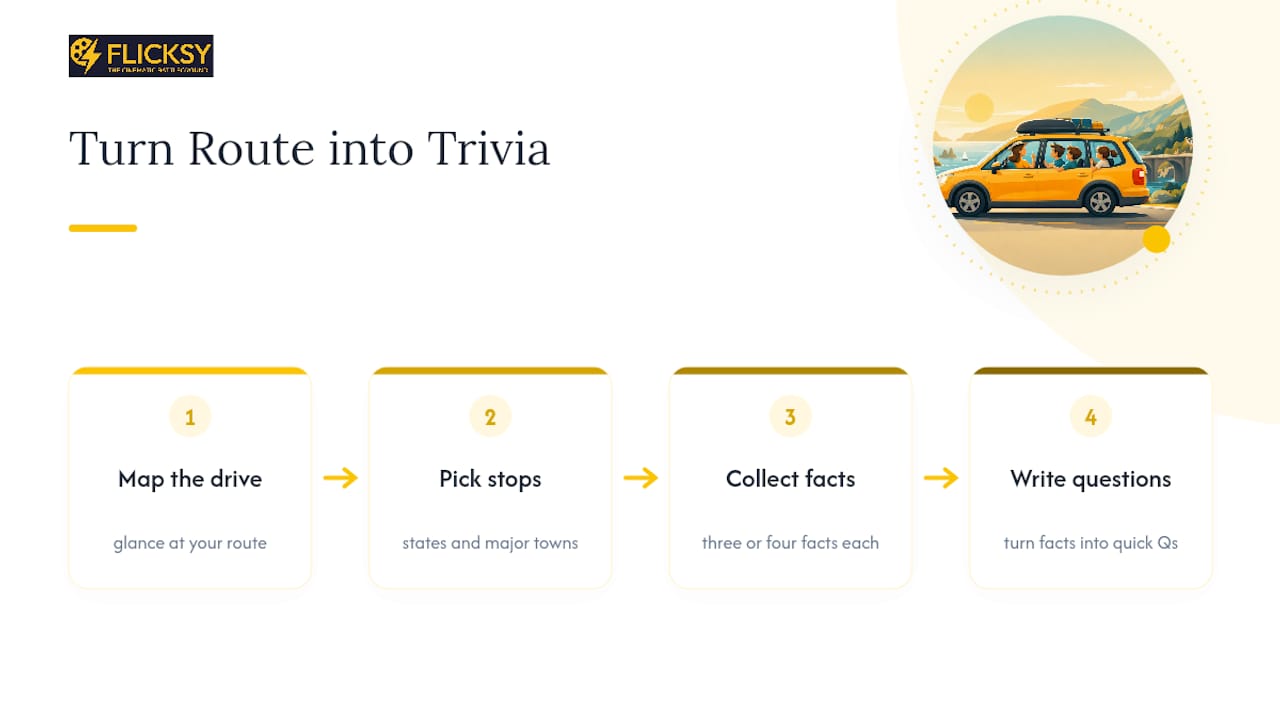
Passing through a national park corridor? Build a mini-set around park history, wildlife, or elevation records. Driving along a coastline? Ask about lighthouses, shipwrecks, or local seafood specialties. Kids especially respond to trivia tied to something they can see out the window right now, since the question stops being abstract the moment they spot the actual landmark.
This approach also solves the "we've done this before" problem. Generic trivia decks get reused trip after trip until everyone knows the answers. Route-specific trivia changes every single time you drive somewhere new, so the game never goes stale even on a route the family drives every summer.
Why Quick, Themed Rounds Win on Long Drives
Short, punchy rounds beat long trivia marathons almost every time. A five-minute movie or TV-themed burst tends to spark better conversation than an hour of scattered general-knowledge questions, mostly because everyone has an opinion about a plot twist or a favorite character. Flicksy's Blitz PvP mode is built around that same instinct: fast, focused rounds instead of a slow grind.
The trick that works best in practice is alternating pace. Run a lightning round, then let the conversation drift for a few minutes before starting the next one. Constant rapid-fire questions burn people out faster than you'd expect.
— Aakash
Try Flicksy Before Your Next Long Drive
If your crew is more into movies, TV, and anime than state capitals, This app fits the car ride better than a generic trivia deck. It runs on rapid-fire questions built for short attention spans and offers a local multiplayer mode for when everyone's crammed into the same back seat, a solo mode for whoever wants to play alone, and quick-match options that suit a five-minute stretch between rest stops just as well as an hour-long haul.

Test it before the trip actually starts. Run one short round in the driveway to check pacing, audio, and whether the questions land with your specific group, since a movie-obsessed teenager and a casual weekend viewer will have very different reactions to the same anime category. If it clicks, download Flicksy and add it to your road trip lineup alongside your printed backups.
Sources
- Road Trip Trivia Quiz App (App Store)
- 170 Road Trip Trivia Questions To Ask Your Friends & Family (OwalaLife)