
This page is a working catalog of movie trivia categories, organized into genre and era groups, specialty theme rounds, and format types, plus ready-to-run round templates, with sample prompts. Use it to build a full trivia night, populate a printable pack, or load rounds into a rapid-fire app for solo or head-to-head play.
TL;DR:
- Core categories should include genre, era, awards, franchise, and quote rounds to ensure broad appeal and flexible difficulty escalation.
- Specialty rounds such as director deep dives, micro-themes, and international films boost engagement and cater to dedicated fans.
- Mix question formats by including visual, audio, quote, and matching rounds, with a focus on one-answer prompts to avoid disputes.
- Balance questions in each round with easy, medium, and hard levels, starting with accessible questions and gradually increasing difficulty to retain all players.
- Sequence categories thoughtfully, starting with accessible topics, building tension, and ending on a challenging note to maintain pacing and player interest.
Table of Contents
- Movie Trivia Categories Every Host Should Have on Hand
- Specialty Theme Rounds That Reward Real Fans
- Formats and Media Types: Beyond the Multiple-Choice Question
- How to Balance Difficulty Without Losing Half the Room
- Ready-to-Run Round Ideas You Can Use Tonight
- Why This List Holds Up: Author Background and Ongoing Coverage
- Tips for Keeping Every Category Genuinely Engaging
- Mistakes That Quietly Wreck a Trivia Night
- Tailoring Categories to Casual Fans Versus Film Buffs
- What Actually Makes a Trivia Night Work
- Turn These Categories Into a Real Trivia Night in Minutes
- Where to Find More Movie Trivia Questions
- Sources
Movie Trivia Categories Every Host Should Have on Hand
Every solid trivia night rests on a handful of category groups that almost never miss. These are the ones worth building first, because they scale up or down depending on your crowd and give you a backbone to hang niche rounds on later.
Genre lists are the easiest entry point because everyone has an opinion on horror, comedy, or sci-fi. Splitting a genre round into action, comedy, horror, rom-com, and sci-fi/fantasy lets you match tone to the room; a horror round works great for an October event, while rom-com trivia is a low-stakes crowd-pleaser for mixed groups.
Era and decade groups do double duty as both nostalgia bait and difficulty control. Classic Hollywood trivia (pre-1970) skews harder for younger players but lights up older ones, while '80s, '90s, 2000s, and 2020s rounds each carry their own instantly recognizable soundbites and faces.
Here's a quick reference for building your core rotation:
- Genre rounds: action, comedy, horror, rom-com, sci-fi/fantasy — good defaults for mixed-age groups
- Era/decade rounds: Classic Hollywood, '80s, '90s, 2000s, 2020s — strong for generational trivia nights
- Awards rounds: Oscar winners, nominees, and year-by-year Best Picture rundowns — great mid-round difficulty spike
- Franchise rounds: superhero universes, space operas, spy franchises — built-in fan enthusiasm, easy to scale by difficulty
- Quote and character rounds: broad accessibility, works well as an icebreaker category
Large curated question banks covering these exact buckets already exist if you need to fill gaps fast. MentalFloss's collection of film trivia questions spans decades and genres, and similar organized buckets like Classic Hollywood, Blockbusters, and Animated films show up across other curated trivia sites too, which makes them reliable templates when you're assembling a round on short notice.
Specialty Theme Rounds That Reward Real Fans
Once your core rounds are set, specialty themes are what turn a decent trivia night into a memorable one. These rounds let you spotlight specific tastes in the room and give returning players a reason to come back.
Director-focused rounds work best when you scope them tightly. Instead of "name any Christopher Nolan fact," try "identify the film from this Nolan shot" or "what year did this Nolan movie release." A tighter scope also makes scoring cleaner, since one-answer prompts avoid arguments over what counts as correct.
A few themed rounds worth rotating in:
- Actor deep dives: career-highlight rounds built around a single actor's filmography arc
- Subgenre micro-themes: A24-style indie darlings, holiday movies, or musicals
- International and festival categories: Cannes or Sundance winners add variety and shift the difficulty curve
- Seasonal rounds: holiday-themed categories timed to the calendar (they land better in December than in July)
Auteur and decade-specific rounds also tend to boost participant satisfaction because the theme cohesion makes the round feel like its own mini-event rather than a grab bag of random facts.
Formats and Media Types: Beyond the Multiple-Choice Question
The format matters as much as the topic. A picture round tests visual recall, an audio round tests memory for sound, and a quote round tests recall of specific phrasing, so mixing formats across a night keeps different kinds of movie knowledge in play.
- Picture rounds: source stills or posters, crop tightly to hide obvious identifiers (studio logos, actor names in credits), and keep clue difficulty consistent within a round
- Audio rounds: short clips (5 to 10 seconds) work better than full scenes; decide upfront whether players identify the film or name the composer/actor speaking
- Quote rounds: choose between "who said this line" and "finish this line," since they test different skills
- Matching/connection rounds: pair actors to roles or directors to films, and score partial matches to keep scoring fair
- Rapid-fire interactive rounds: built for buzzer-style live play or app-based timed formats where speed counts as much as accuracy
Design single-answer prompts wherever possible. MentalFloss's approach to trivia question design favors clear, one-answer formats specifically because they cut down on scoring disputes and keep live rounds moving.
How to Balance Difficulty Without Losing Half the Room
A round that's all easy questions gets boring fast. A round that's all hard questions clears the room. The fix is a deliberate mix, not a guess.
A balanced round should mix a variety of easy, medium, and hard questions to keep all players engaged. That ratio keeps casual players scoring points early while giving your sharper fans something to chase toward the end.
- Open easy, close hard. Start each round with an accessible question, then escalate. A rolling easy-to-hard pattern within a single round paces better than clumping all the easy questions together up front.
- Match difficulty to platform. A live pub-style night can absorb a few tough stumpers because players can confer at the table; a solo app format needs a gentler curve since there's no group brainstorming to fall back on.
- Reserve micro-detail questions. Save deep production trivia, like obscure crew credits or behind-the-scenes facts, for a small share of any round. Cinephile-focused trivia sources note that these "curveball" questions are great separators between casual viewers and film buffs, but overloading a round with them alienates everyone else.
- Build in a tiebreaker. A single bonus kicker question, ideally a hard, specific one, settles ties without dragging out the night.
Pro Tip: Write your hardest question first, then work backward. If you can't imagine anyone in the room answering it, it's your tiebreaker, not your round opener.
Ready-to-Run Round Ideas You Can Use Tonight
These formats show up again and again because they work. Here's how to run each one, with example prompts to get you started.
- One-word movie titles. Give a single word ("Up," "Signs," "Jaws") and have players name the plot, year, or director. Judge ambiguity carefully. Titles like "It" or "Her" invite multiple correct answers, so pick words with a clear single match or accept reasonable alternates.
- Who won the Oscar? Name a year, then ask which film took Best Picture, or flip it and give the film and ask the year. This format scales easily from casual (recent decades) to brutal (1930s ceremonies).
- Sci-fi villains and antagonists. Start with iconic, widely recognized villains for an easy tier, then move to lesser-known antagonists from cult sci-fi for the hard tier.
- Soundtrack and theme music. Play a 5 to 8 second clip and ask players to name the film or composer. Keep clips short enough that recognition, not exposure time, decides the winner.
- Supporting roles and micro-detail. Ask about a character actor's other credits or a specific line delivered by a background character. This tier is built for advanced players and works best as a bonus round rather than a core one.
Big curated lists are worth keeping bookmarked for backup material. Parade's roundup of movie trivia questions runs over 150 questions deep, which is more than enough to pull extra prompts for any of these five formats when you're short on time.
Why This List Holds Up: Author Background and Ongoing Coverage
This catalog draws on hands-on movie coverage and category testing rather than a generic list scraped together for search traffic. Aakash's film reviews, including a breakdown of Spider-Man: Brand New Day and Christopher Nolan's The Odyssey, inform how newer releases get folded into decade and director rounds here.
Flicksy tests round balance across three very different formats: Blitz PvP's real-time head-to-head pace, Couch Party's local group play, and Solo Arena's untimed practice mode. That range forces categories to work under time pressure and at a relaxed pace alike. The full blog tracks fresh releases as they land, and lists here get refreshed to reflect 2026 titles and trends rather than sitting static for years.
Tips for Keeping Every Category Genuinely Engaging
The categories themselves matter less than how you deploy them. A brilliant category list still falls flat if every round feels identical in pacing and tone.
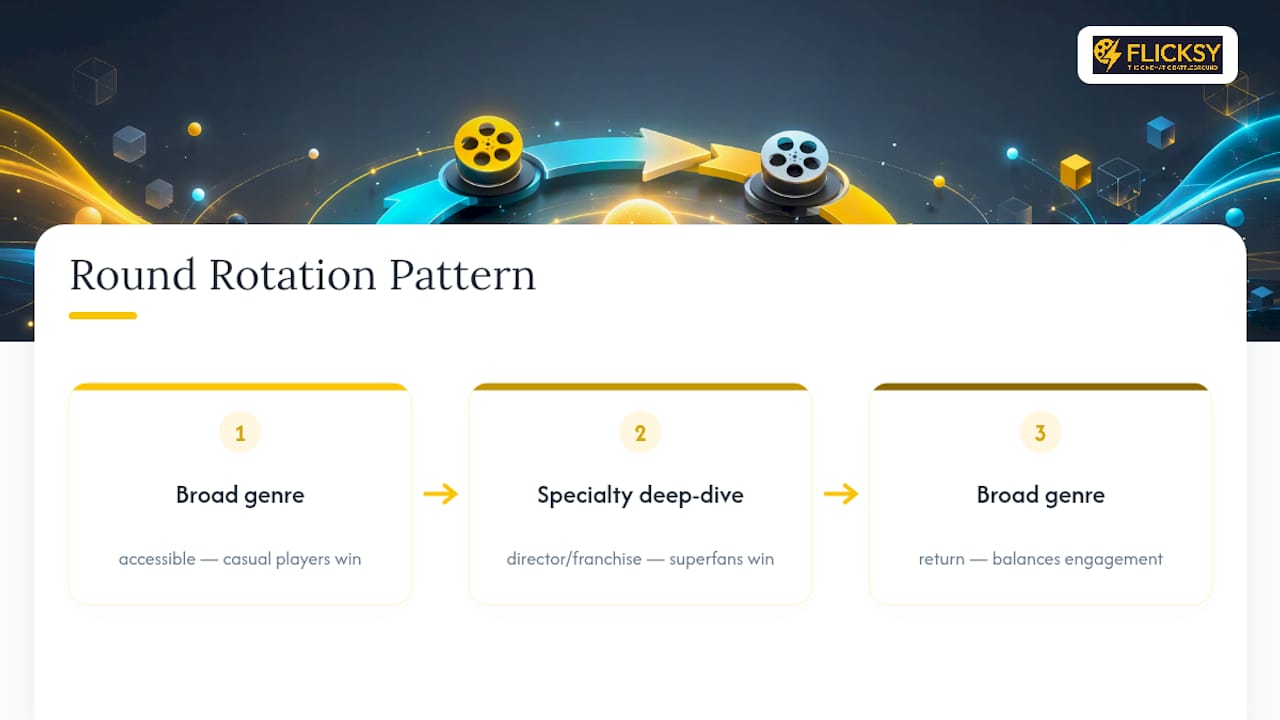
Rotate specialist and generalist categories back to back. Follow a broad, accessible genre round with a tighter specialty round, like a director deep dive, so casual players and superfans both get moments where they're winning. Balancing niche topics with wide-access categories keeps engagement steady across a full night rather than concentrated in one group's favorite round.
Keep each round thematically tight. A round that jumps from '90s comedies to obscure Japanese cinema to Marvel trivia in three consecutive questions feels scattered. Dedicating a whole round to one theme, whether that's a decade, a director, or a franchise, makes the experience feel intentional and gives players a clear sense of what knowledge is being tested.
Watch your question count per round. Six to eight questions per themed round is usually the sweet spot: enough to build momentum, short enough that energy doesn't sag. Longer rounds work for a dedicated trivia league; shorter rounds fit better for casual app-based or party play where attention spans run shorter.
Finally, vary your answer formats within a round even if the theme stays constant. Mixing a straight identification question with a quote-based one and a picture-based one, all under the same theme, keeps the format from feeling monotonous even when the topic doesn't change.
Mistakes That Quietly Wreck a Trivia Night
The most common failure isn't a bad question. It's a badly chosen category that seemed like a good idea in planning and falls apart in the room.
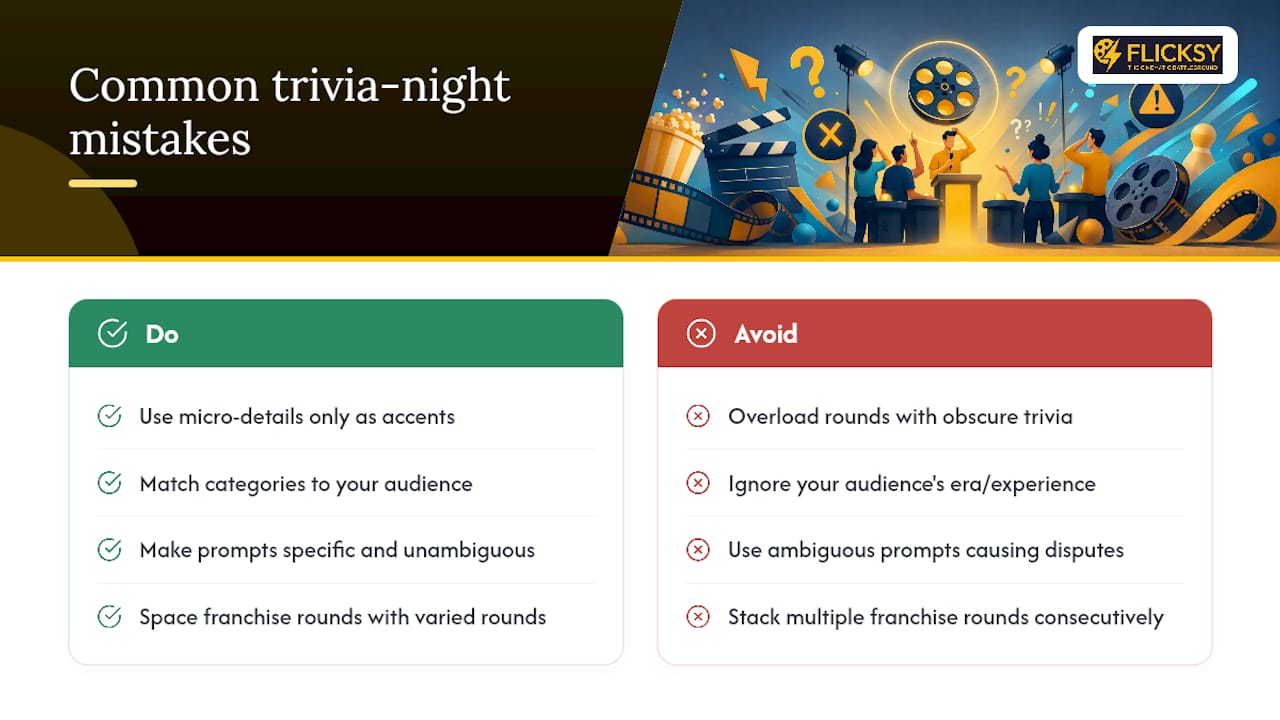
Overloading a round with obscure trivia is the biggest offender. A round built entirely around deep-cut cinematography credits or forgotten box office numbers might thrill two people and lose everyone else. Micro-detail questions work as accents, not as the entire meal.
Ignoring your audience's actual frame of reference is a close second. A category built around 1970s New Hollywood cinema might be perfect for a film club and a disaster for a birthday party where half the guests were born after 2000. Match the era and specificity of your categories to who's actually in the room, not to what you personally find interesting.
Ambiguous prompts cause more arguments than any other single issue. A one-word title round asking about "It" without specifying which adaptation, or a quote round using a line that appears in more than one film, creates disputes that stall momentum and frustrate players who feel cheated out of a fair answer.
Stacking too many franchise rounds back to back is another trap. Franchise categories are popular, but three superhero rounds in a row starts to feel repetitive even for fans. Space them out with genre, decade, or quote rounds in between.
Last, skipping a difficulty check before the event. Running every question past even one test player catches the prompts that seemed obvious while writing them but land as impossible, or embarrassingly easy, once they hit a live room.
Tailoring Categories to Casual Fans Versus Film Buffs
Casual viewers want recognition, not research. Broad genre rounds, quote identification, and franchise trivia work well because the answers surface from memory almost instantly. For this crowd, skip deep-cut director filmographies and lean into blockbusters, recent releases, and widely quoted lines.
Cinephiles want to be tested, not just entertained. This is where micro-detail rounds earn their place: production trivia, character actor deep dives, and festival-circuit films. These players respond well to questions that require genuine film knowledge rather than pop-culture osmosis, but even a room full of film buffs benefits from a few accessible questions to open each round and keep pacing brisk.
Mixed audiences, which describes most real trivia nights, need a blended structure. Run broad-access rounds early in the night while energy and attention are highest, then introduce a specialty round or two once the group has warmed up. Close with something universally accessible so no one leaves on a round they bombed.
What Actually Makes a Trivia Night Work
Most trivia guides treat categories like a checklist: pick a genre, pick an era, done. That misses the actual variable that decides whether a night succeeds, which is sequencing, not selection. A great category list run in the wrong order still falls flat.
The conventional advice to "know your audience" is true but incomplete. Knowing your audience only matters if you translate that knowledge into a specific difficulty curve and a specific format mix, not just a topic choice. A room of casual fans doesn't need "easier categories." It needs single-answer prompts, shorter audio clips, and fewer micro-detail questions sprinkled in as occasional flavor rather than a full round.
If there's one thing worth prioritizing above all else, it's this: design for pacing before you design for cleverness. A round that opens easy, escalates steadily, and closes with one memorable hard question will outperform a round stacked with brilliant trivia delivered in the wrong order. Categories are the raw material. Sequencing is the craft.
— Aakash
Turn These Categories Into a Real Trivia Night in Minutes
Building categories on paper is one thing. Running them live without a stopwatch, a scorekeeper, and an argument over "who buzzed first" is another problem entirely. There are rapid-fire modes built specifically for movie, TV, and anime trivia across Blitz PvP head-to-head matches, Couch Party group play, and Solo Arena practice runs.
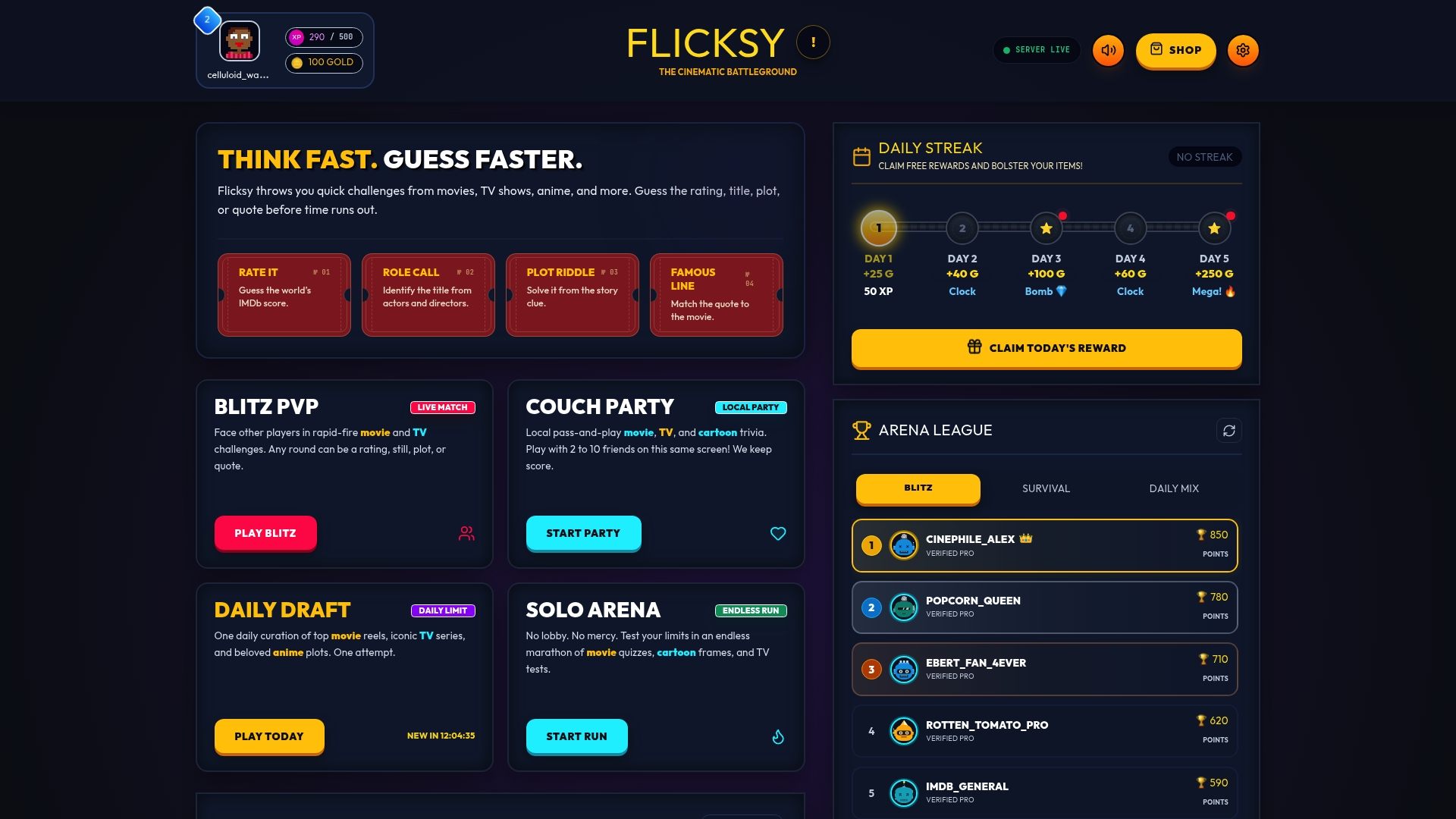
The categories above translate directly: picture rounds and audio rounds load right into the format, and curated daily quizzes mean you're not stuck writing every question from scratch before your next game night. If you've got a group ready to play or just want to test a round solo before hosting it live, start a match on Flicksy and see how your one-word title round or Oscar-winner round actually holds up under a timer.
Where to Find More Movie Trivia Questions
A few outlets are worth bookmarking when you need to expand beyond this list. MentalFloss organizes questions across eras and genres, useful for filling gaps in decade-specific rounds. /Film leans into production trivia and behind-the-scenes detail, ideal for advanced micro-detail rounds. Parade offers a deep, single-list question bank exceeding 150 entries, handy when you need bulk material fast across multiple genres in one sitting.
Sources
- /Film — Movie trivia questions (slashfilm)
- MentalFloss — The best film trivia quiz questions
- Parade — 151 fun movie trivia questions