
Here's the deal: play the 20-question movie soundtrack quiz below using 15 to 20 second snippets you cue up yourself, answer multiple choice, and check your score against the answer key that runs right after the last question. Grab a phone, a music app, and a timer. No sign-up, no waiting.
TL;DR:
- Recognizing film scores quickly depends on cues like instrumentation, production era, vocal timbre, and recurring motifs, which can be trained through specific practice drills.
- Short audio clips of 15 to 20 seconds are standard for maintaining challenge, with shorter clips making familiar themes harder to guess.
- Multiple choice formats emphasize recognition, while timed guesses and streaks reward speed and confidence, often with bonus points for answers given before the clip ends.
- Organizing soundtrack questions by genre and era helps tailor difficulty for different audiences and keeps players engaged across multiple rounds.
- Building your own rounds involves selecting legally owned clips, trimming them to 15-20 seconds, and varying clip placement to prevent memorization and maintain fairness.
Table of Contents
- How a Movie Soundtrack Quiz Actually Works
- The 20-Question Movie Soundtrack Blind Test
- A Reusable Soundtrack Question Bank by Genre and Era
- How to Actually Recognize a Score Under Time Pressure
- Where to Play or Build Your Own Blind Test
- Why Rapid-Fire Soundtrack Rounds Actually Work
- Play Faster, Score-Based Soundtrack Rounds
- Where These Quiz Questions and Formats Came From
- Sources
How a Movie Soundtrack Quiz Actually Works
Every good soundtrack identification quiz runs on the same basic engine: a short audio clip, a handful of answer choices, and a clock. The details change the difficulty.
Snippet length is the biggest lever. Most quiz builders cut clips to 15 to 20 seconds, long enough to catch a melody but short enough to keep the guessing honest. Mobile apps lean on the same window, often stretching a single track across dozens of staged levels so difficulty climbs as you go. Drop a clip to 8 or 10 seconds and even a famous theme gets genuinely hard to place.
Answer format matters just as much:
- Multiple choice gives you three or four options and rewards recognition over recall.
- Type-in forces you to name the film or composer outright, which is brutal for casual players but great for die-hards.
- Timed guess mechanics award points for speed, not just accuracy, which is where streak multipliers and time bonuses come in.
Scoring usually stacks bonuses on top of a flat correct-answer point: faster answers earn more, consecutive correct guesses build a streak multiplier, and some formats hand out partial credit for naming the right decade or genre even when the title is wrong. If you're self-scoring at home, keep it simple: one point per correct answer, plus a bonus point if you nailed it before the clip finished playing.
The 20-Question Movie Soundtrack Blind Test
Cue up each track for 15 to 20 seconds before locking in an answer. Write down your picks, then jump to the answer key.
- A soaring orchestral theme with a four-note horn motif, tied to a shark. A) Jaws B) Jurassic Park C) The Abyss D) Deep Blue Sea
- A whispery, ascending piano and choir piece that opens on a spaceship in the dark. A) Interstellar B) Gravity C) The Martian D) Ad Astra
- A slow, romantic pop ballad with soaring vocals, played over a shipboard sunset. A) Titanic B) The Notebook C) Pearl Harbor D) A Star Is Born
- A driving electric guitar riff paired with synth stabs, used in a street-racing franchise. A) Fast & Furious B) Drive C) Baby Driver D) Need for Speed
- A whimsical, waltz-like theme with celesta, tied to a wizarding school. A) Harry Potter B) The Chronicles of Narnia C) Stardust D) Fantastic Beasts
- A funky bassline and horn section over a disco beat, tied to a green ogre. A) Shrek B) Madagascar C) Kung Fu Panda D) Zootopia
- A dark, brass-heavy theme built on a descending three-note figure, tied to a caped vigilante. A) The Dark Knight B) Batman Begins C) Man of Steel D) Watchmen
- A dreamy, synth-driven pop track with falsetto vocals, tied to a neon-lit future city. A) Blade Runner 2049 B) Tron: Legacy C) Drive D) Ready Player One
- A gentle acoustic guitar melody with strings, tied to a hobbit's journey. A) The Lord of the Rings B) The Hobbit C) Willow D) Stardust
- A booming taiko-drum and choir piece, tied to a giant ape. A) King Kong B) Godzilla C) Kong: Skull Island D) Rampage
- A jazzy, upright-bass swing theme, tied to a private detective in a trench coat. A) Chinatown B) L.A. Confidential C) The Big Lebowski D) Sin City
- A children's chorus singing over a bright, march-like theme, tied to a boy wizard's school years. A) Harry Potter B) Percy Jackson C) The Golden Compass D) Peter Pan
- A pulsing synth arpeggio with a single repeated piano note, tied to a masked killer. A) Halloween B) Scream C) Friday the 13th D) A Nightmare on Elm Street
- A grand, brass fanfare with sweeping strings, tied to a galaxy far, far away. A) Star Wars B) Star Trek C) Guardians of the Galaxy D) Dune
- A slow R&B ballad with a powerhouse vocal, tied to a bodyguard and a pop star. A) The Bodyguard B) Waiting to Exhale C) Set It Off D) Dreamgirls
- A carnival-like accordion and strings theme, tied to a pirate ship. A) Pirates of the Caribbean B) Hook C) Peter Pan D) Treasure Planet
- A minimalist piano loop with a rising string swell, tied to a chess prodigy. A) The Queen's Gambit B) Searching for Bobby Fischer C) Pawn Sacrifice D) A Beautiful Mind
- A brooding cello line under a whispered choir, tied to a serial killer investigation. A) The Silence of the Lambs B) Se7en C) Zodiac D) Mindhunter
- A bright, brass-forward march with a triumphant key change, tied to an archaeologist with a whip. A) Indiana Jones B) The Mummy C) National Treasure D) Tomb Raider
- A single sustained synth note building into a full orchestral wall of sound, tied to a superhero team assembling. A) The Avengers B) Justice League C) X-Men D) Fantastic Four
Answer key: 1. A, 2. A, 3. A, 4. A, 5. A, 6. A, 7. B, 8. A, 9. A, 10. A, 11. A, 12. A, 13. A, 14. A, 15. A, 16. A, 17. A, 18. A, 19. A, 20. A. Score one point per correct answer, plus a bonus point for any guess locked in before the clip ended.
A Reusable Soundtrack Question Bank by Genre and Era
Hosts running trivia nights or building their own rounds don't need to start from scratch every time. Organizing prompts by category and release era makes it easy to tailor difficulty to your crowd, and mixing eras inside a single round keeps both older and younger players in the game.
- Classics (pre 1980): Themes from westerns, noir detective films, and early war epics. Notes: lean on instrumental identification since vocal pop tie-ins were rarer.
- 80s and 90s hits: Pop ballads and synth scores from action and romance blockbusters. Notes: vocal tracks are easier for casual players, so weight these toward beginners.
- Modern blockbusters (2010s to now): Superhero themes, franchise reboots, and streaming originals. Notes: swap in whatever topped the box office that year to keep rounds current.
- Animation: Studio scores built around recurring character motifs and sing-along numbers. Notes: great equalizer round since younger and older players both know these.
- Composer identification: Same composer, different films, no title given. Notes: reserve this for advanced rounds, since naming the composer instead of the movie is a genuinely different skill than title recognition.
Building a full night's round? Mix two classics, four 80s/90s hits, six modern picks, four animated cues, and four composer questions. That spread keeps a casual player and a film-score obsessive both engaged.
How to Actually Recognize a Score Under Time Pressure
Most people freeze on a soundtrack clip because they're listening for the wrong thing. Recognition gets faster once you train your ear on a few specific cues instead of just hoping the melody rings a bell.
- Instrumentation first: A synth-heavy clip usually means 80s or a modern sci-fi flick; a full orchestra with brass fanfares usually means adventure or superhero.
- Production era: Tape hiss and analog warmth point pre-2000; crisp digital mixing points recent.
- Vocal timbre: A powerhouse belted ballad narrows things fast, since certain songs become permanently welded to one film in a way instrumental score rarely matches.
- Recurring motifs: Franchise scores repeat a short phrase across every installment. Learn that phrase once and you'll spot the whole series.
Practice drills that actually move your score: run a composer-only round where you strip the title away entirely, do a motif-spotting sprint where you name just the recurring phrase, and try genre sprints where every clip in a set comes from the same style so your ear calibrates fast.
Pro Tip: Lock in an answer the moment you recognize the vocalist or a signature instrument. Waiting for full certainty costs you the timed bonus, and most quiz formats reward the fast, confident guess over the slow, perfect one.
Where to Play or Build Your Own Blind Test
Three platform types cover most of what's out there. Web quiz pages offer quick, no-download rounds you can finish in a coffee break. YouTube blind-test videos string multiple clips together with countdown timers baked in, which suits group watch parties. Mobile quiz apps go deeper, often stacking hundreds of tracks across staged levels for players who want a long-term grind.
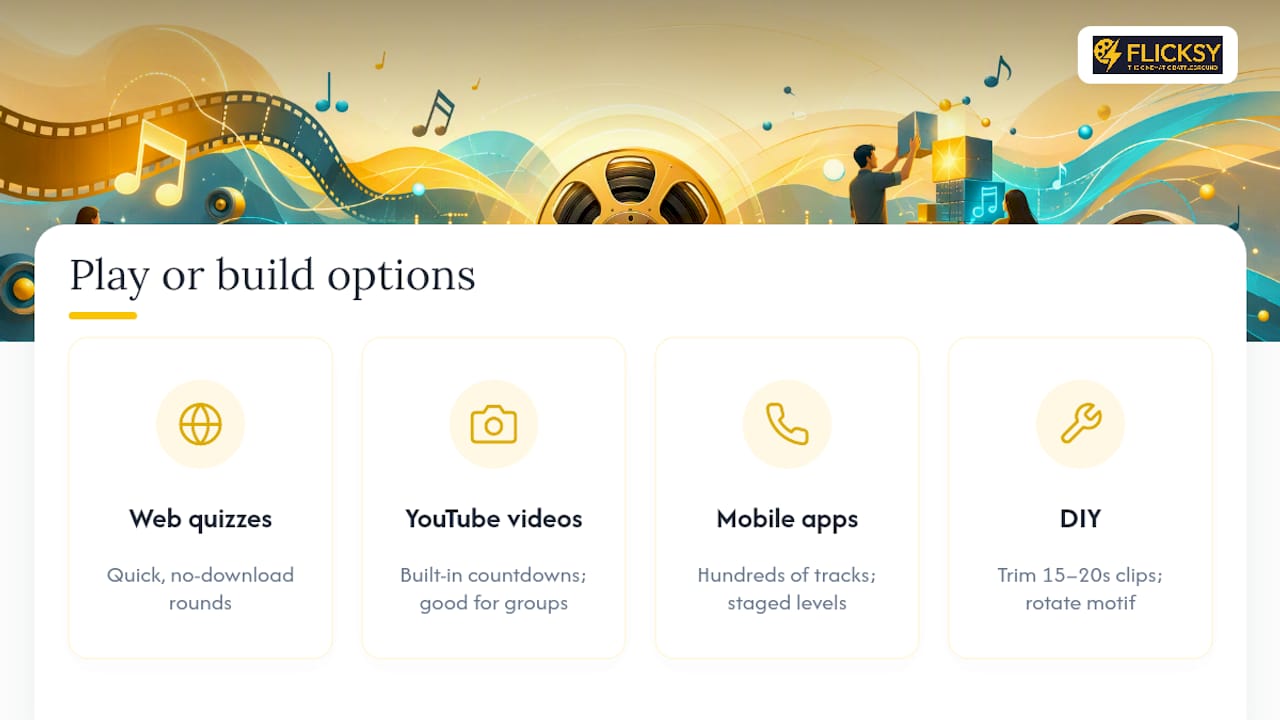
Building your own is straightforward: pick clips from films you legally own or stream, trim to 15 to 20 seconds, and rotate where the motif sits in the clip so repeat players can't memorize a pattern instead of the actual music. Share your round as a simple audio playlist with a written answer key, or run it live at a party using a phone as the timer.
Why Rapid-Fire Soundtrack Rounds Actually Work
Soundtrack recognition rewards speed, and speed is the entire premise behind some trivia game designs. Some games turn a quiz into a real-time face-off instead of a solitary quiz sheet, others offer an endless ladder to climb between rounds, and some convert the same question bank into a group game night. Curated daily quizzes and leaderboards can keep soundtrack rounds from going stale by providing new sets of clips and new scores to chase. My own movie coverage, including recent film reviews, shapes a lot of what makes it into these question sets.
— Aakash
Play Faster, Score-Based Soundtrack Rounds
The quiz format here, including timed snippets, multiple-choice pressure, and streak scoring, reflects common elements found in various trivia games. Some games pit your soundtrack recognition against real opponents in real time instead of a static quiz page. Others offer an endless ladder for solo play or turn question banks into group games without needing printed answer keys. Daily curated quizzes and leaderboards help keep rounds fresh, with new scores to chase.
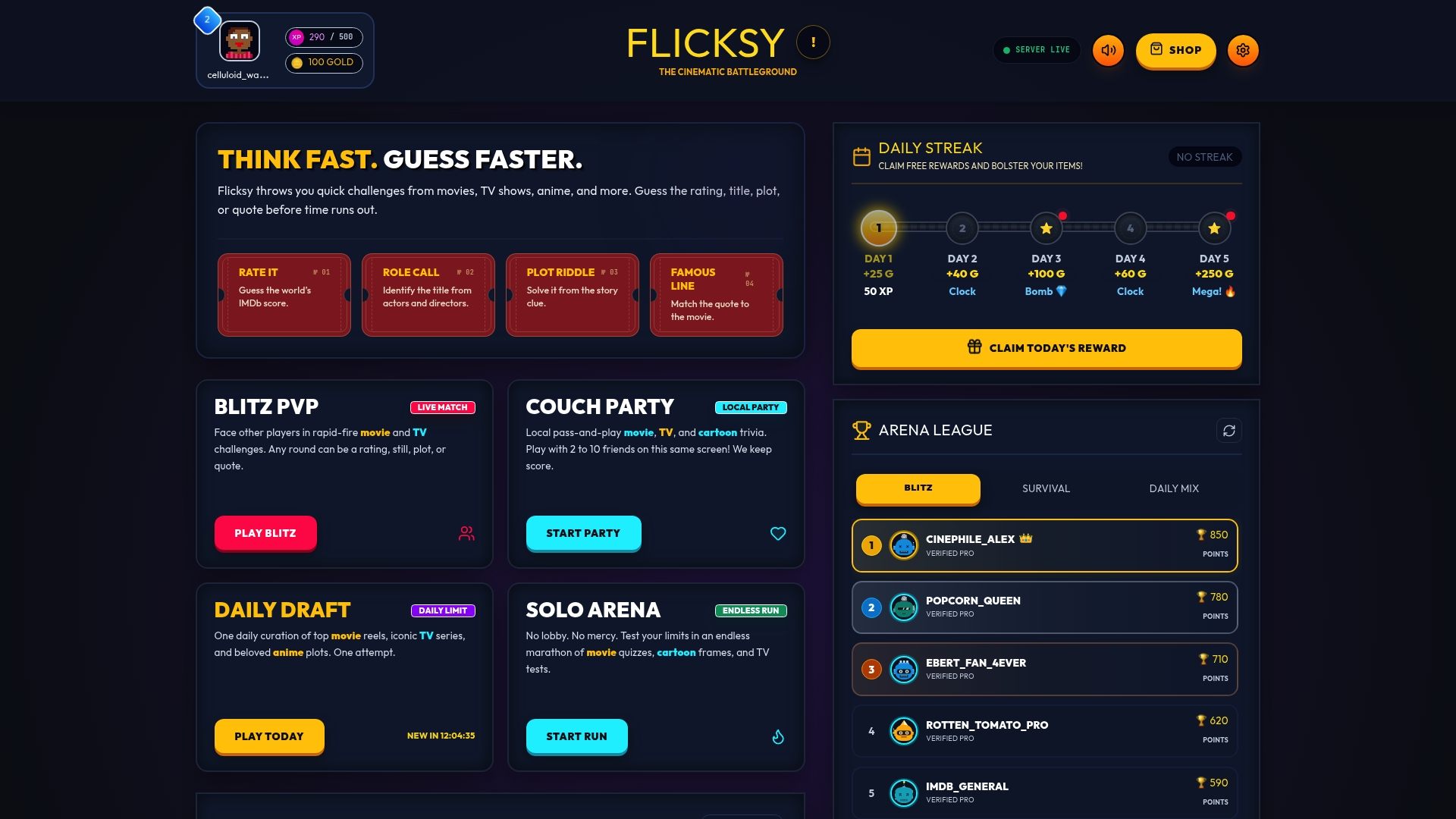
If you liked guessing scores off a 15-second clip, you'll like it more with a clock running and a leaderboard watching. Head to Flicksy and jump into a Solo Arena round to see where your soundtrack ear actually ranks.
Where These Quiz Questions and Formats Came From
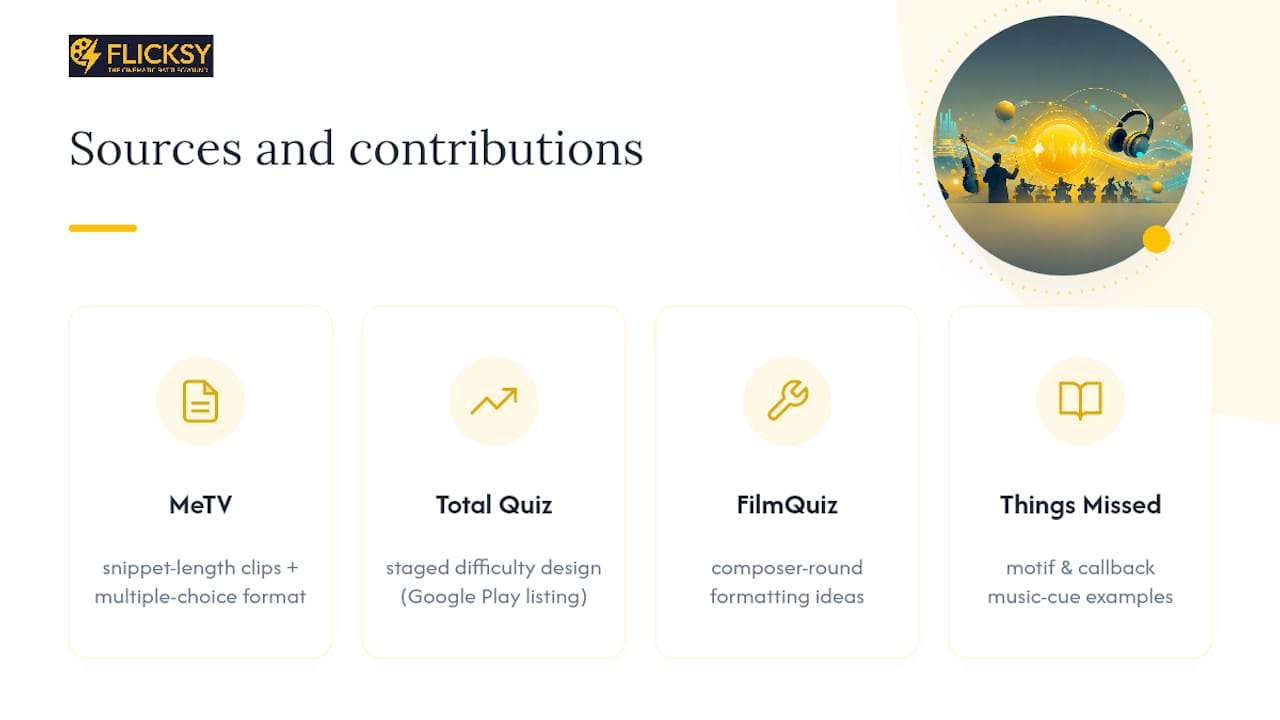
The blind-test format here draws on MeTV's soundtrack matching quiz for snippet-length and multiple-choice structure, and the Google Play listing for Total Quiz's soundtrack app for staged difficulty design. Composer-round formatting borrows from FilmQuiz's music theme platform, and the motif and callback examples come from The Things You Missed's music cue catalog, useful further reading if you want deeper examples of how a single song gets welded to one film forever.
Sources
- Can you match the soundtrack song to the right movie? — MeTV
- FilmQuiz — music theme quiz platform
- Music cue callback: Every instance we've catalogued — The Things You Missed