

"Curated" means carefully chosen and thoughtfully organized, and a curated quiz is simply a set of questions someone has deliberately selected and arranged for a reason, whether that's a theme, an audience, or a specific learning goal. It's the opposite of a random pile of trivia.
TL;DR:
- A curated label signals deliberate selection and arrangement, not expert authorship or accuracy; check answers against sources rather than trusting the label.
- Applying three checks, such as theme fit, factual accuracy, and sequencing, can expose poorly built quizzes within a few questions, Buffer’s guide says.
- A well sequenced quiz matches difficulty to its audience, opens with a warm up, and saves harder questions for the closing stretch.
- Aggregation compiles tagged questions without editorial review, while personalization follows past behavior; curation applies human judgment to select and order a purposeful set.
Table of Contents
- What does "curated" actually mean?
- What does a curated quiz actually involve?
- How do you tell if a quiz is well curated?
- How is curation different from aggregation or personalization?
- What does a curated quiz look like in real life?
- What are good alternatives to the word "curated"?
- Why curation matters more than people assume
- Try a curated quiz built for speed and variety
- FAQ
- Sources
What does "curated" actually mean?
"Curated" is the past participle and adjective form of the verb "curate." Merriam-Webster defines it as "carefully chosen and thoughtfully organized or presented," and notes that this broader sense of the word entered common usage around 1990. Grammatically, it works both ways: someone curated these questions (the action) and the result is a curated quiz (the description).
The word traces back to museum curators, the people responsible for selecting and arranging collections so visitors could understand them. Over time, the same idea spread into playlists, reading lists, and digital content feeds. A few quick points on how it functions in a sentence:
- As a past-tense verb: "She curated the questions herself."
- As an adjective before a noun: "a curated quiz," "curated content," "a curated list."
- Rarely as a standalone noun: curation refers to the process itself.
What does a curated quiz actually involve?
A curated quiz is more than a random grab-bag of questions. It's a set arranged around a theme, built for a specific audience, or designed to lead toward a particular outcome, whether that's entertainment, a quick knowledge check, or a learning milestone. You'll run into the term in a few recurring places:
- Trivia apps that release a themed set of questions each day.
- Teachers building a short formative quiz to check understanding of one topic.
- Pub quiz nights where rounds are grouped by era, genre, or category.
- Online courses using a curated question bank tied to a specific module.
One thing worth clearing up: "curated" doesn't automatically mean difficult, expert-written, or officially certified. It describes selection and organization, not a guarantee of rigor. A curated quiz can be easy or hard, written by a hobbyist or a specialist. The label tells you someone made deliberate choices, not that those choices meet any particular standard.
Pro Tip: If a quiz calls itself "curated," check whether the questions actually share a theme or difficulty arc. If they feel scattered, the label is doing more marketing than describing.
How do you tell if a quiz is well curated?
Good curation follows a handful of practical criteria, and you can spot them without any special expertise. Here's what separates a thoughtfully built quiz from a thrown-together list:
- Theme relevance: every question fits a clear topic or thread.
- Audience fit: difficulty and references match who's playing.
- Factual accuracy: answers are correct and checkable against a source.
- Variety: topics or difficulty levels shift enough to stay interesting.
- Sequencing: questions build in a logical order rather than jumping randomly.
That last point matters more than people expect. A well-sequenced quiz often moves from a warm-up question, to a few challenging mid-round questions, to a payoff question that rewards attention or sharp recall. This arc keeps players engaged instead of front-loading all the difficulty or burning out the format early.
Buffer's curation guide outlines a similar checklist for evaluating any curated set: theme fit, audience fit, sourcing, variety, sequencing, and ongoing maintenance. Applying even three of these criteria (theme, accuracy, sequencing) catches most poorly built quizzes within a few questions, according to Buffer's guide to content curation.
How is curation different from aggregation or personalization?
These three terms get mixed up constantly, and the differences matter. Aggregation is automated compiling, like a feed that pulls every trivia question tagged "movies" with no judgment about quality or fit. Personalization is algorithmic tailoring, where a system adjusts what you see based on your past behavior or preferences.
Curation is neither. It's a person applying judgment, adding context, and framing a selection around a purpose. Mailchimp's explainer on curated content describes this as evaluating relevance and quality, then organizing items to create value, rather than just gathering them.
For quizzes, the contrast looks like this:
- Aggregated feed: every "90s movies" question in a database, unsorted, unfiltered.
- Curated set: a hand-picked round of 10 questions building from easy to hard, checked for accuracy.
- Personalized stream: questions an algorithm selects based on what you've answered before.
Curation adds the human layer that pure automation skips.
What does a curated quiz look like in real life?
Curated quizzes show up more often than people notice once they know what to look for. A few familiar examples:
- A trivia app releasing a themed daily quiz, say five questions all built around 90s sitcoms.
- A teacher writing a five-question check tied to one chapter instead of pulling from a random bank.
- A pub quiz round organized by decade, so the "80s music" round stays internally consistent.
- A "best-of" collection pulling the sharpest questions from months of past content.
- A fast-paced trivia round built around a single theme, timed and sequenced so easier questions open the round and tougher ones close it.
What ties these together is deliberate structure: someone chose the theme, checked the facts, and decided the order questions appear in. That's the signature of curation, whether it shows up in a classroom or a game app.
What are good alternatives to the word "curated"?
A few synonyms carry slightly different shades of meaning, depending on what you want to emphasize:
- Hand-picked: stresses personal selection, often one at a time.
- Selected: neutral, focuses on the choosing without implying arrangement.
- Edited: implies refinement or trimming down a larger set.
- Organized: emphasizes structure over selection.
- Compiled: suggests gathering from multiple sources into one place.
- Tailored: implies the set was built for a specific person or group.
"Curated" sits in the middle of all of these: it implies both the choosing and the arranging.
Why curation matters more than people assume

Deliberate selection changes how content feels to use. A random pile of questions tires people out fast. A sequenced, themed set holds attention because each question has a reason for being there and for appearing in that order.
That's the proof point behind daily curated quizzes across movies, TV, and anime, paired with rapid-fire multiplayer and solo game modes. The sense of community that leaderboards and daily rewards create only works because the underlying content was chosen with care, not pulled at random.
— Aakash
Try a curated quiz built for speed and variety
If you want to see curation in action rather than just read about it, Flicksy offers daily curated quizzes across movies, TV shows, and anime, built for players who want speed and variety instead of a random trivia dump.
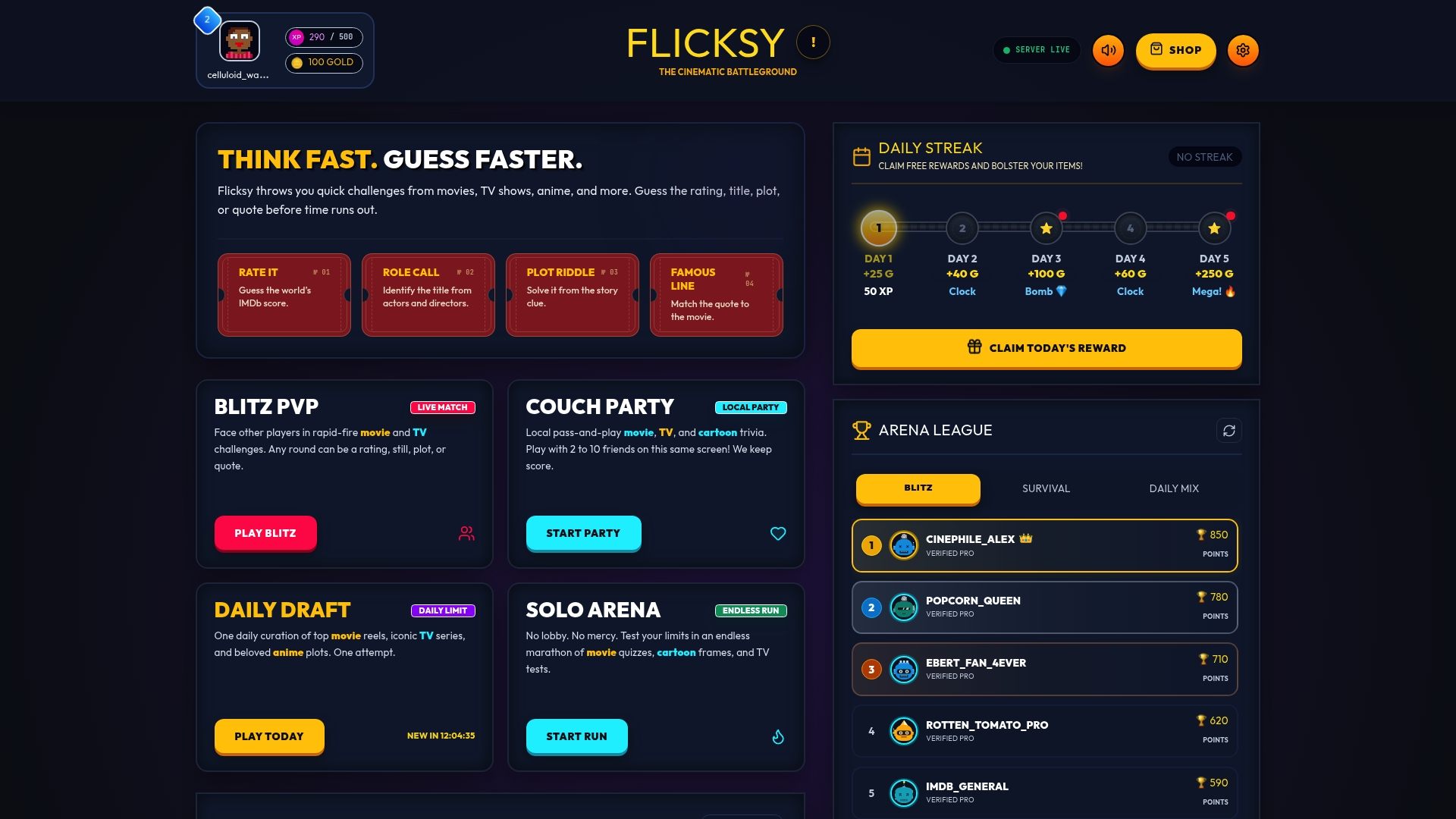
A few things that come from building quizzes with real selection criteria:
- Themed daily sets instead of random question pulls.
- Rapid-fire modes for competitive play (Blitz PvP) or casual group play (Couch Party).
- Solo Arena for endless practice at your own pace.
- Leaderboards and daily rewards that reward consistent play.
For a sense of how curated collections work in other entertainment formats, the curated retro game library at RetroPorts shows the same selection principle applied to classic games, and the puzzle-design approach described in Oswald Journal's piece on evidence-driven gameplay shows it applied to historical escape rooms. Head to Flicksy to try a themed quiz today.
FAQ
What does curated mean in simple terms?
"Curated" means something was carefully chosen and thoughtfully organized, rather than assembled randomly. Merriam-Webster defines it as "carefully chosen and thoughtfully organized or presented."
What does "curated questions" mean?
Curated questions are a set that someone deliberately selected and arranged, usually around a theme, audience, or purpose, rather than pulled at random from a larger pool. The arrangement often follows a logical order, such as building from easier to harder.
What is an example of curated content?
A themed daily trivia set, a teacher's topic-specific quiz, or a "best-of" collection of past questions are all examples. Each shows deliberate selection plus organization, which Mailchimp's guide to curated content describes as evaluating relevance and adding context rather than simply gathering items.
What is another word for "curated"?
Common alternatives include hand-picked, selected, edited, organized, compiled, and tailored, each with a slightly different emphasis. "Hand-picked" stresses personal choice, while "organized" leans more toward structure than selection.
Does "curated" mean a quiz is expert-made or error-free?
No. "Curated" describes selection and organization, not a guarantee of expert authorship or accuracy. Quality still depends on the curator's own standards and whether sources were checked, as curation commentary on curation versus aggregation points out.