
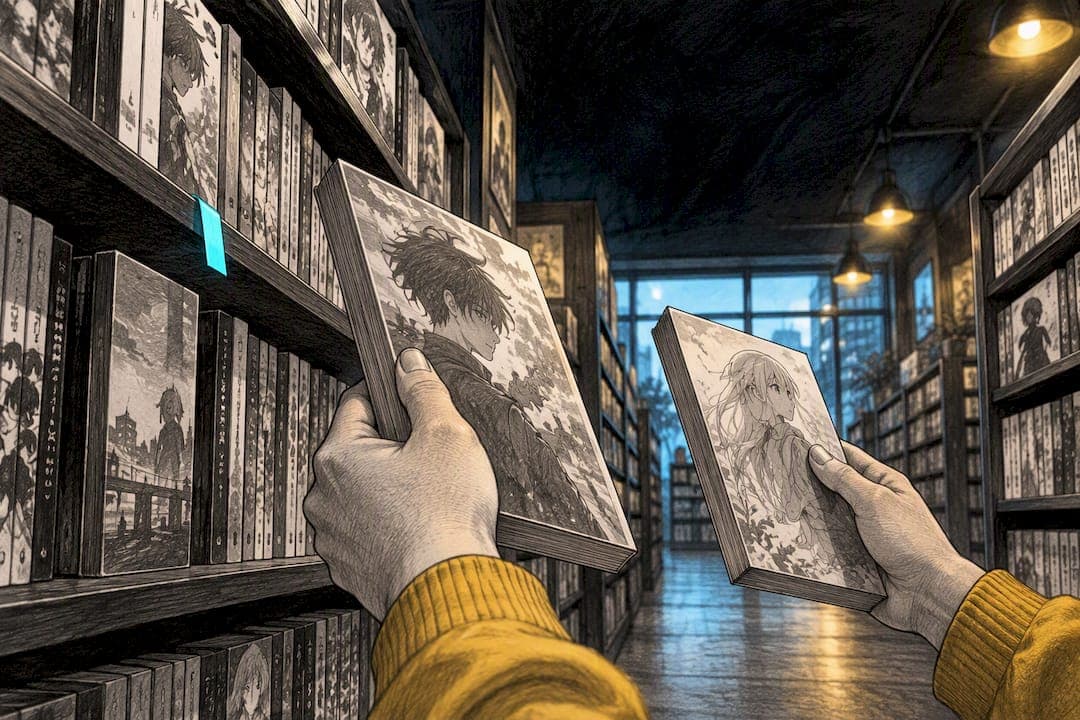
Anime uses two separate labeling systems, and mixing them up is the number one thing that confuses newcomers. Demographic labels (kodomomuke, shonen, shojo, seinen, josei) tell you who a series was originally marketed to. Story genres (action, romance, horror, isekai, and dozens more) tell you what actually happens in the plot. Almost every show carries at least one label from each category, which is why "shonen romance" or "seinen sports drama" are both completely normal descriptions, not contradictions.
TL;DR:
- Demographic labels in anime indicate the target publisher audience, not the story tone or content, allowing shows across genres to share the same label.
- Genre labels describe the type of experience and themes a series promises, regardless of the demographic or target readership.
- The overlap between demographic labels and story genres often causes confusion, as shows can appeal to different age groups yet contain mature or dark themes.
- Visual style and animation quality often signal a show's genre before any dialogue, with studios and design choices reinforcing genre expectations.
- When choosing anime, focus on mood and episode count rather than demographic labels, and sample a few episodes early to determine if the tone matches your preferences.
Table of Contents
- Anime Genres Explained: The Five Demographic Labels
- What Do Anime Story Genres Actually Promise You?
- Why Genre and Demographic Labels Overlap and Confuse Newcomers
- Beginner Watchlists by Mood and Time Commitment
- Who's Behind This Guide
- How Anime Genres Evolved Over Decades
- How Japanese Culture Shapes Which Genres Get Made
- How Anime Genre Rules Differ From Western TV and Film
- Hybrid and Genre-Bending Anime Worth Knowing
- Common Tropes That Define Major Anime Genres
- How Animation Style Signals Genre Before the Plot Does
- A Quick Word on Not Overthinking This
- Sources
- FAQ
Anime Genres Explained: The Five Demographic Labels
Demographic labels come from Japanese publishing, not from streaming platforms or fan forums. Each one originally described which magazine a manga ran in and which readers that magazine was chasing, not the tone or subject matter of the story itself. That distinction matters because a shonen title can be a romance or a sports story just as easily as a fighting series. The label only tells you who the publisher had in mind, not what you'll actually watch.
Here's what each demographic traditionally signals:
- Kodomomuke (children): Aimed at young kids, typically light on violence and heavy on clear moral lessons. Think Pokémon and Doraemon.
- Shonen (teen boys, roughly ages 12 to 18): Built around action, rivalry, and growth arcs. Naruto, My Hero Academia, and Demon Slayer are the genre's biggest ambassadors.
- Shojo (teen girls, similar age range): Focused on emotional relationships, personal growth, and romance. Sailor Moon, Fruits Basket, and Ouran High School Host Club fit this mold.
- Seinen (adult men, generally college age and up): More mature themes, darker violence, and morally gray storytelling. Berserk, Tokyo Ghoul, and Vinland Saga are classic examples.
- Josei (adult women): Realistic relationships and adult life, often without the heightened drama of shojo. Nana and Paradise Kiss are frequently cited starting points.
Understanding shojo vs. josei is one of the trickiest distinctions for newcomers, since both center relationships. The real difference is tone: shojo leans idealized and dramatic, while josei tends toward grounded, everyday adult concerns like careers and messy breakups. The same split applies to shonen vs. seinen: both can feature violence and action, but seinen assumes an audience old enough to sit with moral ambiguity and graphic consequences.
What Do Anime Story Genres Actually Promise You?
Story genres tell you what kind of experience to expect, independent of who the show was marketed to. Think of each genre as a promise the show makes to its audience.
- Action: Promises fights, stakes, and momentum. Example: Attack on Titan.
- Romance: Promises emotional tension between characters, often slow-building. Example: Toradora!
- Comedy: Promises jokes, absurd situations, and low stakes. Example: Konosuba.
- Slice of life: Promises calm, everyday moments overdramatic plot, often building attachment through small repeated character beats rather than a ticking clock. A lighter substyle called nichijō-kei strips out romance entirely and leans into casual conversation, drawn from the broader slice-of-life tradition that traces back to the French phrase "tranche de vie." Example: Nichijou.
- Isekai: Promises a character transported into another world, a premise that became a dominant label in anime during the 2010s. The premise itself doesn't tell you the tone. It can play out as comedy, power fantasy, or genuinely bleak survival drama. Example: Re:Zero.
- Mecha: Promises giant robots and often a meditation on war or technology. Example: Neon Genesis Evangelion.
- Horror: Promises dread, tension, and often body horror or psychological unraveling. Example: Junji Ito Maniac.
- Fantasy: Promises magic systems, invented worlds, or mythic stakes. Example: Fullmetal Alchemist.
- Sports: Promises competition, training arcs, and team dynamics. Example: Haikyuu!!
- Psychological: Promises mind games, unreliable narrators, or moral complexity. Example: Death Note.
- BL/GL (boys' love, girls' love): Promises romance between same-sex characters, ranging from lighthearted to dramatic. Example: Given.
- Magical girl: Promises a young protagonist gaining powers tied to transformation and often coming-of-age themes. Example: Madoka Magica.
Why Genre and Demographic Labels Overlap and Confuse Newcomers
The confusion almost always comes from treating a demographic label as if it predicts tone. It doesn't. Demographic tells you the original target readership; genre tells you the plot and mood. A show can be shonen and still get genuinely dark, because shonen only describes the magazine's audience, not a content ceiling.
Attack on Titan ran in a seinen-adjacent magazine aimed at older teens and young men, yet gets marketed alongside pure action shonen despite its bleaker themes. Made in Abyss is technically aimed at a young readership but contains some of the most disturbing content in the medium. These aren't exceptions. They're proof that the demographic label and the emotional experience are two different axes entirely, a point modern anime guides consistently reinforce when they walk newcomers through crossover titles.
Here's a three-step approach that actually works when you're staring at a streaming catalog:
- Pick your mood first. Decide if you want action, comedy, romance, or something quieter, since genre filters matter more than demographic tags for matching your actual mood.
- Check episode length and count. A 12-episode season is a weekend; a 100-plus episode shonen is a real commitment.
- Sample one to three episodes before committing. Tone reveals itself fast, usually by episode two.
Pro Tip: Judge a show's tone from its actual first episode, not from its demographic label. A "shonen" tag tells you nothing about whether episode one will make you laugh or wreck you emotionally.
Beginner Watchlists by Mood and Time Commitment
Rather than sort by demographic, sort by what you're in the mood for and how much time you've got.
Long hype shonen (for when you want to binge for months):
- My Hero Academia, superhero school drama with real stakes, over 150 episodes.
- Demon Slayer, gorgeous fight animation and grief at its core, around 55 episodes so far.
Comfort and slice of life (for low pressure, easy watching):
- Nichijou, absurdist everyday comedy, 26 episodes.
- Barakamon, quiet countryside healing story, 12 episodes.
Romance and slow burn (for emotional investment over time):
- Toradora!, tsundere classic with real growth, 25 episodes.
- Horimiya, sweet high school romance, 13 episodes.
Mature and thought-provoking (for when you want something heavier):
- Vinland Saga, brutal historical revenge story that becomes about peace, over 50 episodes.
- Monster, psychological thriller about identity and guilt, 74 episodes.
For any of these, expect episodes one through three to set tone and introduce the cast. If nothing has hooked you by episode three, that's your cue to try a different pick, according to common sampling advice beginner guides tend to repeat for good reason.
Who's Behind This Guide
This guide draws on library and encyclopedic sources for genre definitions and history, alongside fandom research on why anime resonates the way it does. It's written from the perspective of a trivia platform built around rapid-fire movie, TV, and anime quizzes, which means genre accuracy isn't an academic exercise here. It's the backbone of every question we write.
How Anime Genres Evolved Over Decades
Anime genres didn't spring up fully formed. Early postwar anime leaned heavily on adaptations of folk tales and children's stories, with kodomomuke as the default mode simply because television anime started as a kids' medium. Shonen action exploded in the 1980s and 1990s alongside manga magazines like Weekly Shonen Jump, which needed serialized, high-stakes stories to keep young readers coming back week after week.

Seinen and josei matured as the original child audiences of the 1960s and 1970s grew up and publishers realized there was money in stories that grew up with them. That's part of why seinen so often deals with war, corporate life, and disillusionment: it was built for readers who'd outgrown simple morality tales.
Isekai is the newest major shift. The genre existed in scattered form for decades, but it didn't dominate release schedules until web novels and light novel platforms made "average person dropped into a fantasy world" a low-risk, high-volume format publishers could churn out fast. That boom really took off during the 2010s and hasn't slowed since, reshaping what a typical seasonal anime lineup even looks like.
How Japanese Culture Shapes Which Genres Get Made
Genre popularity in anime tracks Japanese cultural anxieties and interests more closely than Western audiences often realize. The postwar obsession with giant robots in mecha anime wasn't random. It reflected real tension around rebuilding a technological identity after World War II, with robots serving as stand ins for both hope and fear about mechanized power.
Slice of life's popularity connects to a cultural appreciation for quiet, ordinary moments and seasonal change that runs through a lot of Japanese art and literature, not just anime. Isekai's escapism boom lines up with economic stagnation and a generation of young adults facing fewer opportunities than their parents. Escaping to another world where hard work reliably pays off resonates differently when your own economy has been flat for years.
Sports anime consistently emphasizes team harmony and effort over individual glory, echoing broader cultural values around collective success. None of this means Western viewers can't enjoy these shows. It just means the emotional logic underneath them is doing more cultural work than it looks like on the surface.
How Anime Genre Rules Differ From Western TV and Film
Western media tends to sort by story genre almost exclusively. A show is a sitcom, a procedural, or a drama, and that's usually the end of the conversation. Anime's dual system of demographic plus genre doesn't really have a clean Western equivalent, though the closest comparison is how Western publishing sorts books by age category (middle grade, young adult, adult) separately from genre (mystery, romance, horror).
Western genre conventions also tend to be more rigid about tone matching category. A children's cartoon rarely kills off a major character permanently; a shonen anime aimed at teenagers does it routinely. Western horror and thriller are usually kept distinct, similar to how slasher vs. thriller works as a meaningful split in American film crit, while anime horror blends psychological dread, body horror, and supernatural elements more freely within a single series.
Episode structure differs too. Western procedural dramas usually deliver a complete case per episode, while serial dramas build one continuous arc. Anime frequently does both within one season, resolving a minor conflict episode by episode while building toward a season-long threat. That procedural vs. serial blend is common enough in anime that Western viewers used to strict format rules sometimes find it disorienting at first.
Hybrid and Genre-Bending Anime Worth Knowing
Some of anime's most acclaimed titles refuse to sit still in one category, and that's often exactly why they stand out. Genre mixing happens constantly: Cowboy Bebop blends space western, noir, and character drama into something that resists a single tag. This kind of blending functions similarly to neo-noir in Western film, borrowing a classic genre's mood and injecting it into an unexpected setting.

Meta genre entries go a step further by commenting on anime tropes from inside the story. Konosuba is technically isekai, but it spends most of its runtime mocking isekai conventions rather than playing them straight. Gintama does something similar with shonen structure, breaking the fourth wall constantly to joke about its own genre.
Anthology series occupy their own strange corner of this space. The anthology series meaning in anime usually points to something like Junji Ito Maniac, where each episode tells a self-contained story rather than continuing one plot. That format lets a single show hop between horror subtypes episode to episode in a way a continuous narrative never could.
These hybrids matter for a practical reason: if a show feels hard to categorize, that's often a sign it's doing something more interesting than a straightforward genre entry.
Common Tropes That Define Major Anime Genres
Every genre carries its own toolkit of recurring tropes, and recognizing them helps you predict what you're signing up for. Shonen leans on training arcs, tournament arcs, and the "power of friendship" resolving conflicts that raw strength couldn't. Isekai relies on the "cheat skill," where the protagonist arrives with knowledge or an ability the new world doesn't have yet.
Slice of life trades on small recurring rituals: a shared meal, a walk home, a season changing. Romance anime leans on the slow confession arc, misunderstandings that stretch for episodes, and the childhood-friend-versus-new-arrival triangle. Horror repeats the "ordinary world corrupted" trope, where a mundane setting slowly reveals something wrong underneath it.
Mecha alternates between two camps: real robot stories that treat machines as realistic military hardware, and super robot stories where the machine is closer to a hero in armor. Psychological thrillers lean on unreliable narration and the slow reveal that the protagonist may not be who they seemed. Sports anime almost always includes an underdog team, a rival who becomes a friend, and a final tournament that tests everything the training arcs built.
How Animation Style Signals Genre Before the Plot Does
Visual style often tells you what genre you're watching before a single line of dialogue plays. Shonen action shows favor sharp, high contrast character designs built for dynamic fight choreography, with studios investing heavily in fluid motion during key battle sequences. Slice of life leans toward softer color palettes, gentle lighting, and lingering background art that rewards a quieter pace.
Horror anime frequently drops the level of animation detail on purpose, using stillness and awkward pauses to build dread rather than relying on movement. Psychological thrillers often use tighter framing and unnatural color grading to put viewers slightly on edge without explaining why.
Studio identity plays into this too. A studio known for meticulous, painterly backgrounds tends to get hired for slice of life and drama projects, while studios known for high frame rate combat animation get the action and shonen contracts. None of this is a hard rule, but it's consistent enough that experienced viewers can often guess a show's genre from a single promotional image, before reading a single synopsis.
A Quick Word on Not Overthinking This
Labels are search filters, not rulebooks, and the sooner you stop treating them as strict predictions, the more fun you'll have picking things blindly. Some of the best anime ever made refuse to sit inside one tidy genre box, and that's usually a feature, not a confusing flaw. If you want to test how much of this actually sticks, some trivia platforms run quick anime trivia rounds that make spotting these genre patterns weirdly addictive.
— Aakash
Sources
FAQ
What Are the Five Main Categories of Anime?
The five demographic categories are kodomomuke (children), shonen (teen boys), shojo (teen girls), seinen (adult men), and josei (adult women). These labels describe the original target readership of the manga's publishing magazine, not the story's content or tone.
What Does Isekai Mean?
Isekai describes a story where a character gets transported to another world, whether through death, a portal, or summoning. The label became one of anime's dominant genres during the 2010s, but it says nothing about tone. Isekai shows range from comedic to genuinely grim.
Why Does a Shonen Show Sometimes Feel Mature?
Shonen only indicates the magazine's original target readership of teen boys, not a content ceiling. Series like Attack on Titan carry shonen or seinen adjacent labeling while dealing with war, loss, and morally gray choices that go well beyond typical kids' content.
Why Is Anime So Popular With Gen Z?
Anime resonates with Gen Z largely because of strong characters and high-quality animation. Research from Crunchyroll and NRG found that 54% of Gen Z surveyed said they like or love anime, citing those two factors among the top reasons they keep watching.